Your Guide to Diminished Value Claims

So, what exactly is a diminished value claim? Think of it as compensation for the simple fact that a car with an accident history is worth less than an identical one without it. Even if your car was perfectly repaired, its market value takes a hit. This claim is your way of recovering that financial difference from the at-fault driver’s insurance company.

Disclaimer: This article is for informational purposes and not to be construed as legal advice. No attorney-client relationship exists based on the review of this article, and none of the information in this article is legal advice.

What a Diminished Value Claim Actually Is
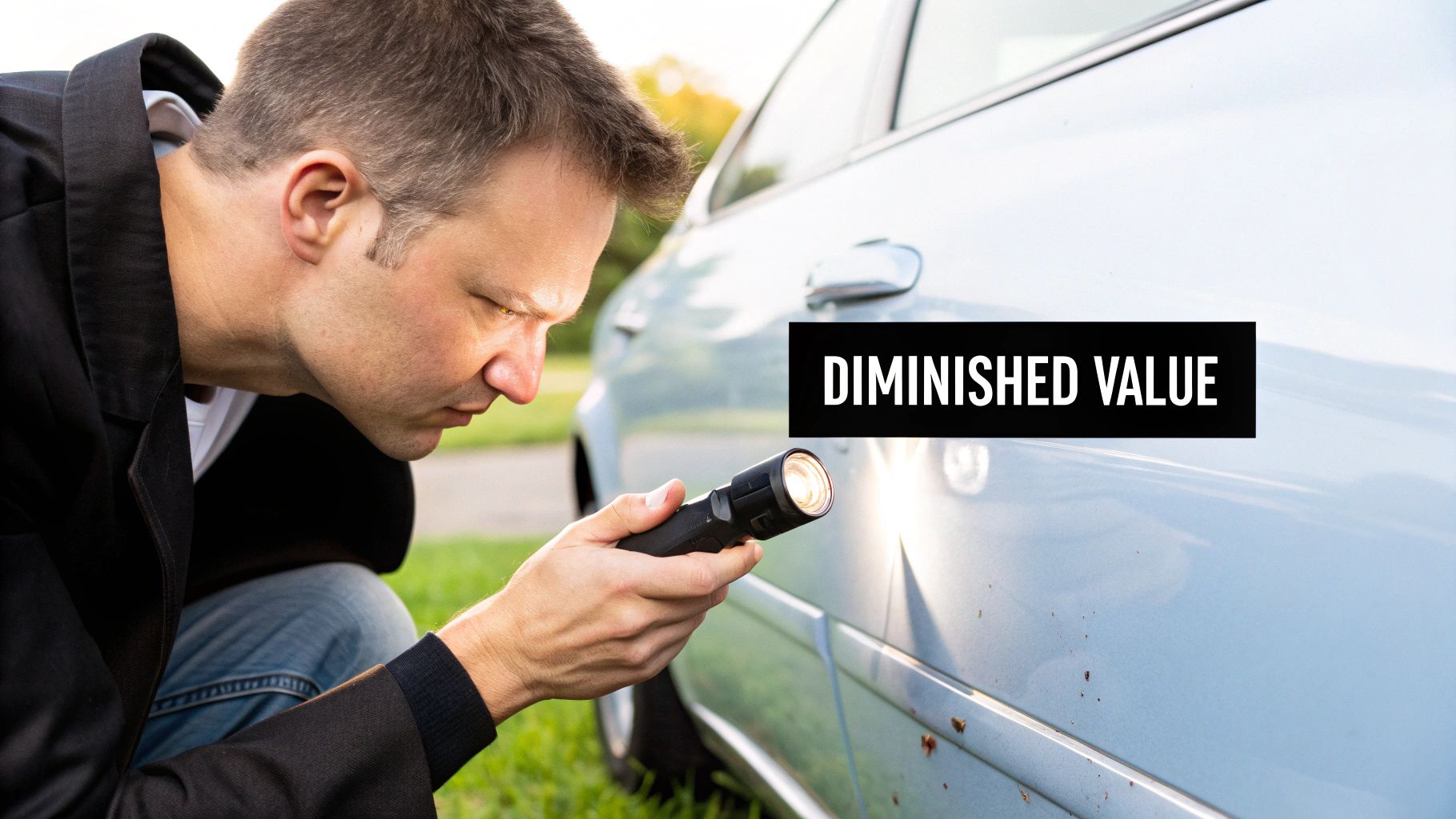
Let’s imagine you’re trying to sell your car. Now picture an identical one for sale right next to it—same make, model, year, and mileage. The only difference? Yours has a collision on its vehicle history report. A smart buyer will almost always offer you less money for your car, and that gap in price is its diminished value.

A diminished value claim specifically targets this loss in your car’s market value after it has undergone necessary auto repairs from an accident someone else caused. It’s a completely separate financial loss from the repair bill itself. While the insurance company pays the body shop to fix the dents and scratches, that payment does nothing to restore your car’s pre-accident market worth.

Diminished Value vs. Normal Depreciation

So, how is diminished value different from the everyday depreciation that happens to all cars? Think of it this way: depreciation is just your vehicle aging gracefully—losing value each year as miles add up, french fries disappear into the seats, and the new car smell fades into that mysterious “eau de commuter.” All cars experience it, collision or not.

Diminished value, on the other hand, is an extra hit to your car’s worth, just because its history now includes an accident—even after a picture-perfect repair. Buyers (and dealerships) tend to be wary, imagining gremlins lurking beneath that shiny paint job, and, as a result, they’ll likely offer you less than they would for a car that’s never seen a body shop.

In a nutshell:

  • Depreciation happens to every car simply because of age and use.
  • Diminished value is the specific loss of value caused by that accident history, over and above normal depreciation.

Bottom line: while depreciation is business as usual, diminished value is the unfair “scarlet letter” your car wears after a collision.

Diminished Value vs. Normal Depreciation

So, how is diminished value different from the everyday depreciation that happens to all cars? Think of it this way: depreciation is just your vehicle aging gracefully—losing value each year as miles add up, french fries disappear into the seats, and the new car smell fades into that mysterious “eau de commuter.” All cars experience it, collision or not.

Diminished value, on the other hand, is an extra hit to your car’s worth, just because its history now includes an accident—even after a picture-perfect repair. Buyers (and dealerships) tend to be wary, imagining gremlins lurking beneath that shiny paint job, and, as a result, they’ll likely offer you less than they would for a car that’s never seen a body shop.

In a nutshell:

  • Depreciation happens to every car simply because of age and use.
  • Diminished value is the specific loss of value caused by that accident history, over and above normal depreciation.

Bottom line: while depreciation is business as usual, diminished value is the unfair “scarlet letter” your car wears after a collision.

Do You Need to Sell Your Vehicle to Make a Diminished Value Claim?

Not at all. You can absolutely file a diminished value claim even if you plan to keep your car for years to come. The important thing to understand is that diminished value happens the moment an accident hits your vehicle’s history—regardless of whether or not you put a “For Sale” sign in the window. Your right to claim compensation starts as soon as your car’s value takes that post-collision dip, not when you actually sell it. So, whether you’re trading in next week or planning to drive your trusty Toyota for another decade, you’re still entitled to seek reimbursement for that lost value.

The Three Types of Diminished Value

To build a strong claim, you first need to understand where the loss is coming from. Diminished value isn’t just one broad idea; it actually breaks down into three distinct categories.

To make it clearer, here’s a quick breakdown of the three types of diminished value you might encounter.

Types of Diminished Value Explained

Type of Diminished Value When It Occurs Key Characteristic
Inherent Diminished Value After repairs are completed The automatic loss of value just because the car now has an accident history.
Immediate Diminished Value Right after the accident, before repairs The difference between the car’s pre-accident value and its value while damaged.
Repair-Related Diminished Value After repairs are completed An additional loss in value due to poor-quality repair work (e.g., mismatched paint).

Most claims focus on inherent diminished value. It’s the unavoidable drop in resale price that happens the moment an accident is recorded on the vehicle’s history, no matter how perfect the repairs are.

Ultimately, filing a diminished value claim is about your right to be made financially whole again. The driver who caused the accident is responsible for all the damages, and that includes this often-overlooked depreciation. While amounts vary depending on the car and the accident, the average claim is around $1,500.

What Is a Total Loss Appraisal—and When Should You Get One?

When accident damage is severe, there comes a point where fixing your vehicle simply doesn’t make financial sense. If repair costs add up to more than your car is worth, insurers will typically declare it a “total loss.” In these situations, you’ll receive a settlement offer based on the car’s fair market value, minus any deductible you carry.

But here’s where a total loss appraisal steps in. If you suspect the offer is too low, or you want to make sure you’re not leaving money on the table, a total loss appraisal provides an independent assessment of your vehicle’s true market value before the accident. This process helps ensure the insurance payout reflects what your vehicle was actually worth—not just what the insurer says it’s worth.

You might need a total loss appraisal if:

  • You disagree with the insurer’s initial valuation.
  • Your vehicle is a specialty model, classic car, or has unique features not captured in generic pricing tools like Kelley Blue Book or Edmunds.
  • You want to negotiate a fairer settlement for your totaled car.

A well-supported appraisal can make all the difference in reaching a satisfactory resolution, especially when negotiating with insurers who may initially offer a lowball figure.

What Is “Loss of Use,” and How Is Compensation Calculated?

After an accident, being without your car can throw a serious wrench into your daily routine. This is where “loss of use” comes into play. In California, you have the right to recover compensation for the time you’re unable to use your vehicle while it’s being repaired or replaced—even if you don’t actually rent a substitute car.

Here’s how the calculation usually works: insurers look at the reasonable rental rate of a similar vehicle to yours, multiplied by the number of days it takes to get your car back on the road. For example, if you drive a newer SUV and repairs take three weeks, your claim could be based on what it would cost to rent a comparable SUV from a company like Enterprise or Hertz for those 21 days.

The numbers can add up quickly, especially for high-end or luxury vehicles. It’s not uncommon for daily rental rates to climb above $300—or far more for exotic cars. So if your Tesla or Porsche is in the shop for a month, the loss of use damages alone could reach into the tens of thousands.

Ultimately, loss of use is about making sure you’re compensated for the time your vehicle was out of commission due to someone else’s mistake. Keep in mind: you’re entitled to this even if you don’t actually go out and rent another car. The key factor is what it would have reasonably cost to do so.

Knowing Your Right to File a Claim

Before you can even think about getting paid for your car’s lost value, you have to understand your legal right to ask for it. This is the foundation of your entire claim.

The core principle is actually quite simple: the person who caused the accident is responsible for all the damages that resulted. That doesn’t just mean fixing the dent in your door. It also covers the invisible damage—the loss of market value your car now carries because it has an accident history.

This leads us to a crucial distinction you absolutely must grasp: the difference between a first-party and a third-party claim. Who you file against makes all the difference.

Let’s clear up a common misconception: you’re not limited to just what it costs to fix your car. If someone else is at fault in a collision, you have the right to pursue compensation for both diminished value and loss of use—two separate but important categories of damages.

Diminished value covers that frustrating “invisible damage” to your car’s market price. Even after professional repairs, your car’s accident history lingers like a shadow—dropping the value compared to similar, never-crashed vehicles listed on sites like Kelley Blue Book or Edmunds. For most people, this reduction in value can be meaningful, especially when it comes time to sell or trade in your car.

Loss of use, on the other hand, is about the time you’re without your car. Imagine your vehicle is laid up in the shop for days or weeks. California law (and common sense) says you’re entitled to be compensated for the reasonable rental value of your car during that downtime. Whether you drive a basic sedan or a luxury sports car, those daily rental rates can stack up quickly—sometimes running into the thousands for specialty or high-end models.

So yes, you can—and should—recover for both diminished value and loss of use, if you’ve suffered both after an accident. Just remember: insurance companies may not rush to offer these damages. In many cases, securing a fair outcome might mean standing your ground (and perhaps getting an independent appraisal to counter a lowball offer).

This dual claim is an important tool for making sure you’re truly made whole after someone else’s mistake, not left absorbing losses they should cover.

First Party vs. Third Party Claims

When you file a claim against the at-fault driver’s insurance, that’s a third-party claim. In nearly every state, this is the correct—and accepted—way to go after diminished value compensation. The other driver’s liability policy is specifically designed to cover the damages their client caused to others, including you.

A first-party claim, on the other hand, is when you try to file against your own insurance policy. Don’t waste your time. Most standard auto insurance contracts have language that explicitly excludes covering your own car’s diminished value. Unless you live in a state with a specific law that allows it (like Georgia), this is a dead end.

Disclaimer: This article is for informational purposes and not to be construed as legal advice. No attorney-client relationship exists based on the review of this article, and none of the information in this article is legal advice.

Underinsured Motorist Coverage and Diminished Value in California

If you’re hoping to tap into your underinsured motorist (UIM) coverage for a diminished value claim in California, prepare for disappointment. UIM coverage is designed to step in when the at-fault driver doesn’t carry enough insurance to cover your actual damages—think medical bills or necessary repairs.

But—and this is key—California law does not require UIM or uninsured motorist (UM) policies to pay out for diminished value. Insurers like Geico, State Farm, and Progressive have policy language specifically excluding this type of loss. So, even if the other driver’s coverage runs out, your own UIM policy won’t make up the difference when it comes to your car’s lost market value.

Why State Laws Are So Important

Your ability to file a claim, and the specific hoops you have to jump through, are all dictated by your state’s laws. Each state has its own statute of limitations for property damage, which is basically a countdown timer for filing your claim. This window is typically between two and four years, but it can vary quite a bit.

Knowing the rules in your state isn’t just a good idea; it’s non-negotiable. These laws determine:

  • Who you can file against: This almost always confirms the third-party rule.
  • How long you have to file: Missing the statute of limitations deadline means you get nothing.
  • What proof you need: Different states may have different standards for the evidence required.

If you ignore these local rules, your claim can be shut down before it even gets off the ground. By figuring out the right person to file against and respecting your state’s timeline, you’re building your case on a solid legal foundation from day one.

California’s Minimum Property Damage Coverage

Let’s clear up the basics: in California, every driver is required to carry at least $15,000 in property damage liability coverage. This is the bare minimum that insurance companies like Geico, State Farm, and Progressive are required by law to offer—and that you must carry to legally hit the road.

This coverage is designed to pay for damage you cause to someone else’s property (usually their car) in an accident. But keep in mind, $15,000 can vanish fast if you’re unlucky enough to get tangled up with a newer vehicle or multiple cars. If the damage exceeds this minimum, you could be on the hook for the rest out of pocket.

Understanding these minimum limits is crucial, especially when you’re weighing whether to pursue a diminished value claim or thinking about how much insurance you actually need.

How California Courts Decide Damages for Your Car

If you ever wonder how a California judge or jury actually puts a dollar figure on your car’s loss in value, here’s what the law says in plain English.

California jury instructions lay out a clear roadmap for how damages are calculated when your car gets dinged (or worse). The first step is to look at two numbers: the cost to fix your car or the amount by which its value dropped after the damage. The court goes with whichever number is less—not both. So, if fixing your car costs less than what you lost in value, that’s your max.

But it doesn’t stop there. If your car is repairable but still ends up worth less than before the incident, you may be compensated for two specific things:

  1. The drop in value from what it was before to what it’s worth after all repairs, plus
  2. The reasonable cost of those repairs themselves.

However, there’s a big catch: the total payout you can receive can’t be more than your car’s value right before the accident. No windfalls—just enough to make you whole.

When it comes to figuring out “fair market value,” California uses the classic yardstick: what would a well-informed buyer pay a well-informed seller, with neither side desperate or rushing? So, think of fair market value like the price you’d actually get on Craigslist or at a dealership, with everyone knowing the full story of your car’s condition.

Understanding these ground rules helps you know exactly what to expect—and what to push for—if you end up in court.

Uninsured Motorist Coverage and Diminished Value in California

Now, what about uninsured drivers? In California, uninsured motorist property damage (UMPD) coverage exists, but don’t get your hopes up for a diminished value payout. UMPD is optional, and while it can pay for repairs—up to $3,500 per accident if you’re hit by an identified uninsured driver—it does not cover diminished value. And there’s no coverage if the at-fault party flees the scene, so hit-and-runs are excluded.

Bottom line: If you’re hoping to recover diminished value after a wreck with an uninsured motorist in California, you’ll have to look beyond your own policy.

What Do California Jury Instructions Say About Diminished Value?

If you’re in California and considering a diminished value or property damage claim, it helps to know how courts approach these issues. The state’s official jury instructions give a roadmap for how damages to personal property—like your car—are calculated.

Here’s the gist:

  • Repairs vs. Reduction in Value: California law says you’re generally entitled to the lesser of (a) the reduction in your car’s value after an accident or (b) the reasonable cost to repair it. If there’s proof of both, a jury will award whichever is less.
  • When Repairs Aren’t Enough: If fixing your car leaves it worth less than it was before the accident (think that lingering “accident history” buyers spot on CARFAX), you can claim the drop in value plus the reasonable repair costs.This is called a diminished value claim. Even after repairs, your car can carry a stigma—future buyers may hesitate or offer less simply because the vehicle’s accident history is now part of its permanent record. Companies like CarFax and others will log this, which means the reduced resale value isn’t just a hunch; it’s a real financial loss you can seek to recover.
  • Fair Market Value Defined: Any calculation hinges on “fair market value”—meaning the highest price a well-informed buyer would pay to a well-informed seller, with neither under pressure to make the deal. Think of it as what you’d expect to see on sites like Kelley Blue Book or Edmunds for a similar car, in similar shape, absent any accidents.

Understanding these instructions helps you set realistic expectations. After all, it’s not about getting a windfall—the law’s aim is to make you whole, not leave you better off than before things went sideways.

How Diminished Value Is Calculated

There isn’t some magic calculator that spits out a single, definitive number for diminished value. Honestly, this ambiguity is where things get messy, because the insurance company and an independent appraiser can come up with wildly different figures.

Insurance adjusters often rely on their own internal formulas, which are almost always designed to pay out as little as possible. One of the most infamous is the “Rule 17c,” a formula that came out of a Georgia lawsuit. It’s widely criticized for its arbitrary caps and multipliers that stack the deck in the insurer’s favor, usually leading to a lowball offer.

Disclaimer: This article is for informational purposes and not to be construed as legal advice. No attorney-client relationship exists based on the review of this article, and none of the information in this article is legal advice.

You are under no obligation to accept a number based on a flawed formula like 17c. A real, credible calculation of your car’s diminished value hinges on several specific, real-world factors that only a professional appraiser will properly analyze.

How Diminished Value Is Calculated When Repairs Aren’t an Option

So, what happens if your vehicle can’t be repaired at all, and you’re left staring at what looks like a very expensive lawn ornament? In these situations, calculating diminished value comes down to a simple (but often hotly debated) equation: you figure out what your car was worth on the open market right before the damage, and then subtract what it’s worth now, post-accident. The difference between those two numbers is the diminished value—even if the “after” amount feels insultingly low.

Of course, this is easier said than done. Tracking down accurate before-and-after market values can be a moving target, thanks to fluctuating car prices, unique vehicle features, and the ever-opportunistic used car market. Expect some back-and-forth with the insurance company, and if numbers seem suspiciously low, don’t be afraid to bring in an independent appraiser to back you up.

Key Factors Influencing Your Claim

The true loss in your car’s market value isn’t found in a simple spreadsheet. It’s determined by a combination of critical variables—the kind of details that actual car buyers care about.

A professional appraiser will dig into factors like these:

  • Vehicle Specifics: The make, model, age, mileage, and condition of your car before the accident set the baseline. High-end, luxury, or in-demand vehicles tend to take a much bigger financial hit after a collision.
  • Severity of Damage: A minor parking lot scuff won’t have the same impact as a crash that caused structural damage. If you’re worried about major damage, you should understand when frame damage equals a total loss in California.
  • Quality of Repairs: Were original manufacturer (OEM) parts used, or cheaper aftermarket ones? Does the paint match perfectly? Any hint of a shoddy repair job will scare off potential buyers and tank the resale price.

From a legal and actuarial standpoint, research has shown that a vehicle’s diminished value loss often lands somewhere between 10% to 20% of the direct repair costs. So, if your car needed $10,000 in repairs, a fair compensation range for its lost market value would likely be between $1,000 and $2,000. You can see some of the data behind this in these actuarial findings from the National Association of Insurance Commissioners.

Remember, the first number the insurance company gives you is just their opening offer. It’s not the final word. Your best weapon in this fight is a detailed, independent appraisal from a professional. That document gives you a credible, evidence-based valuation to stand on, allowing you to counter their lowball number with a figure that’s actually grounded in market reality.

But don’t stop there—negotiating a diminished value claim is part strategy, part persistence. Keep these practical tips in your corner:

  • Act Quickly: While California gives you up to five years to file a diminished value claim, you’ll get better results if you move fast. The sooner you file—while damage reports, repair estimates, and appraisals are still fresh—the less ammunition the insurance company has to question your numbers.
  • Gather Multiple Appraisals: One expert opinion is good; two or more can be even better. Having several professional appraisals shows that your valuation isn’t a fluke and gives your claim more weight during tough negotiations.
  • Consider Legal Help if Necessary: If the insurance company still won’t budge, or if negotiations start to feel like you’re talking to a brick wall, don’t hesitate to consult an attorney experienced in diminished value claims. Sometimes just having legal backup can move things along.

With solid evidence, quick action, and a willingness to push back, you put yourself in the best position to claw back the true value you’ve lost.

When Filing a Diminished Value Claim Makes Sense in California

Not every fender bender is worth pursuing a diminished value claim. But certain circumstances can tip the scales and make such a claim genuinely worthwhile—sometimes even essential if you want to recoup your real financial loss.

Consider filing a diminished value claim if:

  • You drive a newer vehicle: Late-model cars (especially those still under warranty or with advanced features) can see their resale value take a nosedive after an accident, even if they’ve been meticulously repaired.
  • Your vehicle had a high pre-accident market value: Luxury brands, collectible models, and specialty vehicles are particularly vulnerable—buyers in these markets scrutinize every accident report, and even expert repairs can’t fully erase the stigma.
  • The damage was substantial: If the collision resulted in major repairs, frame damage, or replacement of OEM parts with aftermarket substitutes, chances are your car’s market value has taken a bigger hit than you might think.

While California uses a “pure comparative negligence” system—meaning your potential compensation gets reduced if you share any blame—the right claim in the right situation can still secure you a meaningful payout. The bottom line: If your car is newer, worth more, or suffered serious damage, don’t leave money on the table by skipping a diminished value claim.

When Filing a Diminished Value Claim Makes Sense in California

Not every fender bender is worth pursuing a diminished value claim. But certain circumstances can tip the scales and make such a claim genuinely worthwhile—sometimes even essential if you want to recoup your real financial loss.

Consider filing a diminished value claim if:

  • You drive a newer vehicle: Late-model cars (especially those still under warranty or with advanced features) can see their resale value take a nosedive after an accident, even if they’ve been meticulously repaired.
  • Your vehicle had a high pre-accident market value: Luxury brands, collectible models, and specialty vehicles are particularly vulnerable—buyers in these markets scrutinize every accident report, and even expert repairs can’t fully erase the stigma.
  • The damage was substantial: If the collision resulted in major repairs, frame damage, or replacement of OEM parts with aftermarket substitutes, chances are your car’s market value has taken a bigger hit than you might think.

While California uses a “pure comparative negligence” system—meaning your potential compensation gets reduced if you share any blame—the right claim in the right situation can still secure you a meaningful payout. The bottom line: If your car is newer, worth more, or suffered serious damage, don’t leave money on the table by skipping a diminished value claim.

When Filing a Diminished Value Claim Makes Sense in California

Not every fender bender is worth pursuing a diminished value claim. But certain circumstances can tip the scales and make such a claim genuinely worthwhile—sometimes even essential if you want to recoup your real financial loss.

Consider filing a diminished value claim if:

  • You drive a newer vehicle: Late-model cars (especially those still under warranty or with advanced features) can see their resale value take a nosedive after an accident, even if they’ve been meticulously repaired.
  • Your vehicle had a high pre-accident market value: Luxury brands, collectible models, and specialty vehicles are particularly vulnerable—buyers in these markets scrutinize every accident report, and even expert repairs can’t fully erase the stigma.
  • The damage was substantial: If the collision resulted in major repairs, frame damage, or replacement of OEM parts with aftermarket substitutes, chances are your car’s market value has taken a bigger hit than you might think.

While California uses a “pure comparative negligence” system—meaning your potential compensation gets reduced if you share any blame—the right claim in the right situation can still secure you a meaningful payout. The bottom line: If your car is newer, worth more, or suffered serious damage, don’t leave money on the table by skipping a diminished value claim.

Limits on Diminished Value Recovery

Of course, there’s a ceiling on how much you can actually recover for diminished value—it’s not a blank check. Your total payout can never be more than what your car was worth right before the accident. Think of it like this: If your beloved Subaru was worth $12,000 before a fender bender, that’s the absolute upper limit the law allows, no matter how high those repair bills or lost value estimates climb.

So, even if adding up both your repair costs and your claim for lost market value seems to go beyond your pre-accident car value, the insurer won’t write a check for more. This cap keeps everything grounded in actual market value, no matter what creative math someone tries to run.

What Happens If Your Car Is Declared a Total Loss?

So, what if your car is so badly damaged that fixing it would cost more than the car is actually worth? In the insurance world, that’s what’s called a “total loss.” This can happen even if the vehicle isn’t a twisted heap—sometimes, all it takes is the math not adding up in your favor.

Here’s how the process usually unfolds:

  • The Assessment: After your claim is filed, the insurer sends out an adjuster to review the extent of the damage and tally up repair costs.
  • Crunching the Numbers: If those repair costs exceed the vehicle’s actual cash value (minus your deductible), the insurer will deem it a total loss. Each state—and even individual insurance policies—may have a different threshold, but the math is often unforgiving.
  • The Offer: The insurance company typically presents you with what they determine to be your car’s “actual cash value.” Beware: their calculation may not reflect what your car was truly worth pre-accident. This is where most folks get frustrated—the payout can feel low, and it’s easy to feel boxed in by insurance math.
  • Getting a Second Opinion: You’re not stuck with the insurer’s number. Request a total loss appraisal from an independent expert, especially if you think your vehicle’s market value is higher than what the insurer says. That professional appraisal can be your bargaining chip, just like with a diminished value claim.

The bottom line? Treat the insurer’s offer as a starting point, not the finish line. Review it, compare it to reputable pricing resources like Kelley Blue Book and NADA Guides, and don’t be afraid to push for a fair value based on solid third-party data.

How Big Can Loss of Use Damages Get with High-End Cars?

Loss of use damages can really add up fast—especially if your wheels fall into the luxury or exotic category. Rentals for vehicles like these don’t come cheap. In fact, it’s not unusual for daily rental rates to soar past $1,000. Now imagine your car is out of commission for nearly two months while you wait on specialized repairs or imported parts. Sixty days at that rate can push your loss of use claim into eye-watering territory—think $60,000 or more.

If your claim involves a pricey or rare vehicle, always document local rental rates from reputable sources (think Hertz Dream Collection or Exotics Racing) to help justify your numbers. Insurers will try to trim this down, but with strong evidence, you can anchor your argument to real-world market rates.

A Step-By-Step Guide to Filing Your Claim

Knowing what a diminished value claim is and actually getting a check from the insurance company are two different things. Turning theory into a payout requires a smart, methodical approach. It might seem like a lot, but if you break it down into simple, manageable steps, you can build a strong case right from the start.

The whole process boils down to this: get your car professionally appraised, submit a formal claim to the insurer, and negotiate a fair settlement.
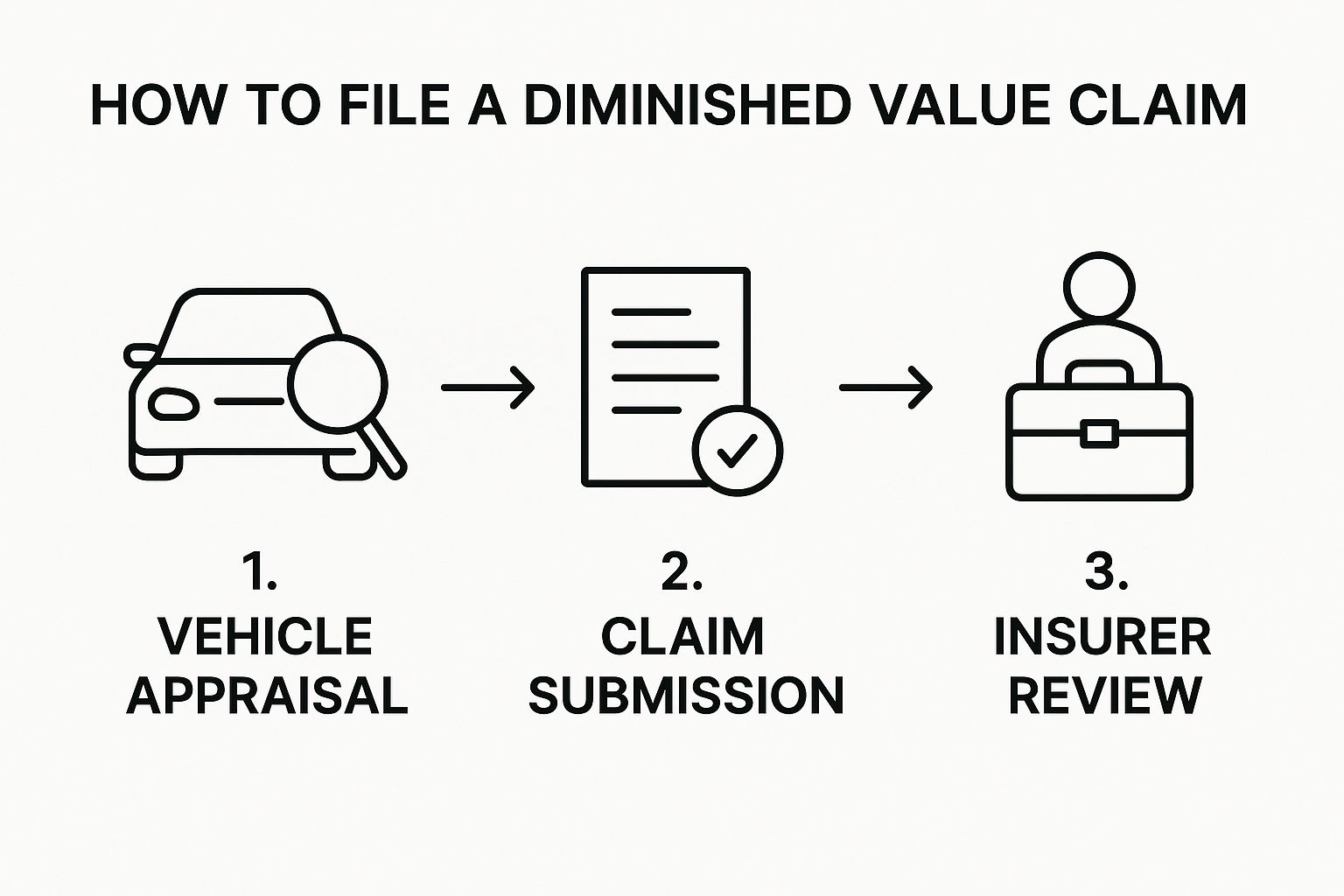
As you can see, a successful claim is built on a logical foundation, starting with solid evidence and ending with a firm negotiation.

Disclaimer: This article is for informational purposes and not to be construed as legal advice. No attorney-client relationship exists based on the review of this article, and none of the information in this article is legal advice.

Filing Your Car Insurance Claim in California

Now, let’s break down the practical steps you’ll need to take after a car accident in California to get your claim off the ground:

  1. Document Everything Immediately
    Snap clear photos of the accident scene, vehicle damage, and any visible injuries. Exchange contact and insurance information with everyone involved, and collect statements from any witnesses while details are still fresh.
  2. Gather Essential Paperwork
    Secure a copy of the police report (if one was filed) and have your registration, driver’s license, and insurance card handy. Save repair estimates, towing receipts, and any correspondence from the other party’s insurer.
  3. Notify Your Insurance Company Promptly
    Call your insurer—GEICO, Progressive, State Farm, or whichever company you’re with—ideally within 24 hours. Provide all documentation, and give a straightforward account of what happened.
  4. Follow Up and Stay Organized
    Keep a log of all calls, emails, and paperwork. Track claim numbers, adjuster names, and timelines so nothing slips through the cracks.

By approaching the process one step at a time, you’ll set yourself up for a smoother experience—and a better shot at a fair payout for your losses.

What If You Were Injured in the Accident?

Filing Your Car Insurance Claim in California

Now, let’s break down the practical steps you’ll need to take after a car accident in California to get your claim off the ground:

  1. Document Everything Immediately
    Snap clear photos of the accident scene, vehicle damage, and any visible injuries. Exchange contact and insurance information with everyone involved, and collect statements from any witnesses while details are still fresh.
  2. Gather Essential Paperwork
    Secure a copy of the police report (if one was filed) and have your registration, driver’s license, and insurance card handy. Save repair estimates, towing receipts, and any correspondence from the other party’s insurer.
  3. Notify Your Insurance Company Promptly
    Call your insurer—GEICO, Progressive, State Farm, or whichever company you’re with—ideally within 24 hours. Provide all documentation, and give a straightforward account of what happened.
  4. Follow Up and Stay Organized
    Keep a log of all calls, emails, and paperwork. Track claim numbers, adjuster names, and timelines so nothing slips through the cracks.

By approaching the process one step at a time, you’ll set yourself up for a smoother experience—and a better shot at a fair payout for your losses.

Filing Your Car Insurance Claim in California

Now, let’s break down the practical steps you’ll need to take after a car accident in California to get your claim off the ground:

  1. Document Everything Immediately
    Snap clear photos of the accident scene, vehicle damage, and any visible injuries. Exchange contact and insurance information with everyone involved, and collect statements from any witnesses while details are still fresh.
  2. Gather Essential Paperwork
    Secure a copy of the police report (if one was filed) and have your registration, driver’s license, and insurance card handy. Save repair estimates, towing receipts, and any correspondence from the other party’s insurer.
  3. Notify Your Insurance Company Promptly
    Call your insurer—GEICO, Progressive, State Farm, or whichever company you’re with—ideally within 24 hours. Provide all documentation, and give a straightforward account of what happened.
  4. Follow Up and Stay Organized
    Keep a log of all calls, emails, and paperwork. Track claim numbers, adjuster names, and timelines so nothing slips through the cracks.

By approaching the process one step at a time, you’ll set yourself up for a smoother experience—and a better shot at a fair payout for your losses.

Steps to Filing a Diminished Value Claim in California

Now, let’s break down the specific steps you’ll need to follow if you’re making your claim in the Golden State. While the overall approach is broadly similar everywhere, California has its own quirks—so staying organized is key.

1. Gather Evidence of Your Loss
Start by securing a thorough, independent appraisal showing how much value your vehicle lost due to the accident. Look for credentialed professionals or reputable firms (think: CCC, Mitchell, or a veteran appraiser), and hang on to every bit of documentation. The more objective your numbers, the stronger your case.

2. Submit Your Claim to the Insurer
Next, submit a formal demand letter along with your appraisal report to the at-fault party’s insurance provider. This letter should clearly outline your case, include supporting evidence, and, of course, specify the amount you’re claiming. Double-check all attachments before you send anything off—missing paperwork can mean the difference between a quick payout and endless delays.

3. Enter Negotiations
Once your documents are in, expect an offer—but don’t necessarily accept the first number that comes across your desk. Insurance companies will sometimes offer less than what you deserve right off the bat. Be ready to counter with facts, figures, and steadfast politeness. Remember, persistence is essential; most insurers expect a little back-and-forth before settling.

4. Consider Legal Options if Needed
If you hit a wall and negotiations stall, don’t be afraid to escalate—especially if you have strong evidence on your side. Consulting a California attorney with experience in auto claims can help clarify your options and may speed things along if the insurance company is digging in.

With these steps, you’ll be well-equipped to navigate California’s process and advocate for the dollars you deserve.

What to Expect: The Diminished Value Claim Process and Timeline

Navigating your diminished value claim might sound intimidating, but breaking it down makes it a whole lot easier—and faster. Here’s how the process usually unfolds from start to finish:

Step 1: Choose the Right Appraiser

Start by researching reputable vehicle appraisers who know their stuff when it comes to diminished value. It pays to look up online ratings, check the Better Business Bureau, or even ask your insurance agent for suggestions. Word-of-mouth from friends or family who’ve been through a claim doesn’t hurt either.

Step 2: Gather Your Evidence

A strong claim lives and dies by its documentation. Before you schedule anything, collect:

  • Photos of your car before and after the repairs
  • Repair invoices, itemized estimates, or receipts
  • The police accident report (if one was filed)
  • Your vehicle’s registration and title

This paperwork will serve as the backbone of your claim.

Step 3: Schedule and Complete Your Appraisal

Once you’ve picked an appraiser, set up an appointment. Some may require you to bring your vehicle to their shop, while others can work from detailed photos and repair records. The appraiser will inspect your vehicle and crunch the numbers to determine how much value was lost due to the accident and repairs.

Step 4: Review the Report and File Your Claim

After the appraisal, review the report closely. Make sure every detail is accurate. If all looks good, submit the report and supporting documents to your insurance carrier as part of your formal diminished value claim.

Step 5: Negotiate and Wait for Compensation

Once the insurer receives your paperwork, expect an initial offer. Be prepared to negotiate—insurers almost always start low. With solid documentation in hand, you’ll be in a stronger position to push for fair compensation.

How Long Does It Take?

How Long Does It Take?

Timelines vary, but most people can expect to complete the appraisal and documentation process within a week or two, depending on how quickly you get your paperwork in order. Once the claim is submitted, insurers often respond within 30 days—but it can be faster or slower depending on your location and the complexity of your claim. Acting quickly is key, since insurance companies often have strict time limits for submitting diminished value claims.

That said, the time it takes to settle a car accident claim can also depend on a few other factors, like the severity of the damage, how clear the evidence is, and whether there are any hiccups with the insurance company. Claims involving more serious injuries or disputed facts tend to take longer, while straightforward cases may wrap up more quickly.

Staying organized and moving fast helps you build momentum—and keeps your claim from falling through the cracks.

What Happens After You Submit Your Claim?

So, you’ve turned in your appraisal and supporting documents—now what? Once your claim lands on the insurer’s desk, you’ll typically see one of three outcomes:

  • Full Approval: In the best-case scenario, the insurance company agrees with your appraisal and pays out the full diminished value amount you’ve requested.
  • Counteroffer: More commonly, you’ll receive a lower offer than your appraiser’s valuation. This is where your negotiation skills come into play. Be ready to present your evidence and justify your number.
  • Denial: Sometimes, insurers may reject the claim altogether, challenging the documentation or disputing liability.

If you hit a roadblock, don’t panic. Many drivers succeed on appeal or by escalating their case—sometimes with help from third-party advocates or reviewing state insurance guidelines. The important thing is to stay persistent and keep your paperwork handy.

Step 1: Confirm You Are Not at Fault

First thing’s first. You absolutely must confirm the other driver was at fault for the accident. A diminished value claim is filed against the at-fault party’s liability insurance. If you caused the wreck, you generally can’t file this type of claim against your own policy.

The police report is your golden ticket here. It’s the most critical document for establishing fault. Get a copy and triple-check that it accurately describes what happened. This single piece of paper is the bedrock of your entire claim.

The Golden Rules: What To Do (and Avoid) After a Car Accident in California

Before you even start wrangling paperwork or talking to insurance adjusters, knowing the essential dos and don’ts can save you time—and headaches—down the road. Think of these as your post-accident commandments:

What to Do:

  • Contact Law Enforcement: Always call the police and ensure a report is filed, even for minor collisions. That report is your ace in the hole when it comes to insurance and proving fault.
  • Seek Medical Care: Don’t play hero. If you feel even the slightest ache, see a doctor as soon as possible. This protects both your well-being and your legal footing should injuries surface later.
  • Notify Your Insurance: Let your insurer know about the accident promptly—even if you’re not planning to file a claim through them. Delays can complicate things.
  • Document Everything: Snap photos at the scene (think vehicles, license plates, any damage, and the broader environment), collect witness info, and hang onto every scrap of paperwork.

What NOT to Do:

  • Don’t Admit Fault: Never apologize or speculate about blame at the scene. Let the official investigation (and your documentation) do the talking.
  • Don’t Rush Into Settlements: It might be tempting to accept a check right away, but don’t sign or agree to anything until you know the full extent of the damage and your rights.
  • Stay Off Social Media: Resist the urge to post about your accident online. Insurers and opposing parties love to comb your accounts for anything that could undermine your claim.

Playing your cards right in those first few hours and days can make all the difference—both in protecting your interests and setting yourself up for a smooth claims process.

What If You Were Injured in the Accident?

If you walked away from the collision with more than just a battered car—say, a sore neck or worse—you’ll want to take a few extra steps. Don’t try to muscle through! Documenting any injuries right away is just as important as gathering paperwork for your vehicle claim.

Here’s your personal injury action plan:

  • Get Medical Attention: Even if you feel “fine,” see a healthcare professional as soon as possible. Some injuries (like whiplash or concussions) might not show symptoms immediately. Plus, your medical records will be crucial if you need to pursue a claim for your injuries.
  • Keep Detailed Records: Start a file for every bill, prescription, medical report, and doctor’s note. Document your pain, how the injury affects your daily life, and any time you miss from work. The more thorough you are, the better.
  • Notify the Insurance Company: Tell the at-fault driver’s insurer about your injuries when you report property damage. This opens a separate bodily injury claim, which will follow a slightly different process.
  • Consider Legal Help: If your injuries are serious or the claim turns into a hassle, it might be worth consulting a personal injury attorney. Many offer free initial consultations and can help you understand your options—especially if you’re juggling both car and injury claims.

Bottom line: Taking care of your health comes first. Don’t put off treatment or skip documentation—your recovery and any possible compensation may depend on it. Once you’ve covered these bases, you’ll be in a much stronger position to negotiate both your vehicle and injury claims.

Step 2: Gather All Essential Documents

Next, it’s time to become a document collector. You need every single piece of paperwork related to the accident and the repairs. Staying organized is key—a well-documented file signals to the insurance adjuster that you’re serious and prepared. If you need a refresher on the basics, this guide on how to file a general car insurance claim is a great place to start.

Here’s your document checklist:

  • The Police Report: This is your official proof of who was at fault.
  • Repair Estimates and Invoices: The itemized bills show the extent of the damage and exactly what was fixed.
  • Photographs: Collect pictures of the damage before the repairs, and if you can, after they’re done.
  • Vehicle Title and Registration: These prove you actually own the car.

Step 3: Obtain a Credible Independent Appraisal

This is, without a doubt, the most important step. You can’t just pull a number out of thin air for your car’s lost value. You need a certified, independent appraisal from a professional who specializes in diminished value. Don’t skip this.

An expert appraisal gives you an unbiased, evidence-based calculation of your loss. A true professional will look at your car’s pre-accident value, the severity of the damage, the quality of the repairs, and local market trends. This report is your primary weapon and your strongest negotiating tool against the inevitable lowball offer from the insurer.

Step 4: Write and Send a Powerful Demand Letter

With your appraisal and documents in hand, it’s time to formally ask for your money. You’ll do this with a demand letter. This is a professional document you send to the at-fault driver’s insurance adjuster that clearly lays out your case and states the specific amount you’re seeking.

Your letter should be clear, concise, and professional. Make sure it includes:

  1. The basic facts of the accident (date, location, at-fault driver).
  2. The insurance claim number.
  3. A clear statement that you are making a diminished value claim.
  4. The exact dollar amount of diminished value, supported by your appraisal.
  5. Copies of all your supporting documents, especially the appraisal report.

To help you get started, here’s a simple structure you can follow for your diminished value demand letter:

Your Information

  • Your Name
  • Your Address
  • Your Phone Number
  • Your Email Address

Insurance Company Information

  • Insurance Company Name
  • Claims Adjuster’s Name
  • Claims Adjuster’s Address
  • Claim Number

Date

Subject: Vehicle Diminished Value Claim – [Your Vehicle’s VIN]

Introduction

  • Briefly describe the accident and the resulting damage to your vehicle.
  • Reference the claim number so there’s no confusion.

Vehicle Information

  • Make, Model, Year
  • Vehicle Identification Number (VIN)
  • Mileage at time of accident

Description of Damage

  • Detail the specific areas of damage to your vehicle, including any structural damage.
  • Mention any attached photos or repair estimates.

Diminished Value Claim

  • Explain that your vehicle has lost value due to the accident—even after repairs.
  • Reference your professional appraisal that quantifies this loss.

Requested Compensation

  • Clearly state the dollar amount you’re seeking for the diminished value.

Supporting Documentation

  • Police report
  • Repair estimates and receipts
  • Photos of the damage before and after repairs
  • Vehicle appraisal report

Conclusion

  • Reiterate your request for compensation.
  • Provide your contact information for further communication.
  • Express your willingness to cooperate to resolve the claim.

Sending a formal demand letter creates a paper trail and shows the insurer you’re handling this professionally, much like a lawyer would. This simple act often gets you a much more serious and timely response from the adjuster.

To make your demand letter truly effective, keep these tips in mind:

  • State your intent and amount clearly: Open with a straightforward statement that you are pursuing a diminished value claim and specify the exact sum you’re seeking.
  • Lay out the evidence: Attach all relevant documentation—repair estimates, before-and-after photos, the independent appraisal, the police report, and any other supporting materials.
  • Describe the impact: Briefly explain how the accident has reduced your vehicle’s market value. Mention factors such as decreased resale value, potential lingering mechanical issues, or cosmetic imperfections that remain even after repairs.
  • Reference legal support: If applicable, mention any state laws or court precedents that back up your right to a diminished value claim. This adds legal weight to your request.
  • Maintain professionalism and persistence: Use a businesslike tone and keep your letter free of emotional language. Be polite but firm, and follow up regularly if you don’t hear back promptly.

Sending a formal demand letter creates a paper trail and shows the insurer you’re handling this professionally, much like a lawyer would. This simple act often gets you a much more serious and timely response from the adjuster.

Common Mistakes to Avoid with Diminished Value Claims

Even with your paperwork polished and your demand letter ready, it’s easy to fumble the ball at this stage. Here’s where many claimants trip themselves up—and how you can sidestep these avoidable pitfalls:

  • Being Too Vague: If your letter is light on details, it’s as good as sending a wishlist to the North Pole. Avoid generic statements; back up every claim with specific documents and dollar amounts. The more thorough your case, the better.
  • Forgetting Key Documents: Missing the appraisal report, police report, or repair invoices? That’s like showing up to a bake-off without your pie. Double-check your file before sending anything.
  • Overlooking the Impact on Value: Don’t just say your car is worth less—show how and why. Bring up actual market comparables or quotes proving the reduced resale value or persistent repair problems.
  • Ignoring Legal Support: Each state has its own quirks, and precedents matter. If you’re aware of relevant case law (like the Georgia Court of Appeals’ ruling in Mabry v. State Farm), mention it, especially if you’re dealing with a stubborn insurer.
  • Dropping the Ball on Follow-up: After you send your claim, don’t disappear. Checking in shows you’re serious and keeps your demand from gathering dust on someone’s desk.
  • Letting Frustration Take Over: Stay polite and professional, even when the process drags on. Losing your cool can set negotiations back and make the adjuster less willing to work with you.

Steering clear of these missteps gives your claim the best shot at success and keeps the adjuster focused on the facts—not the flaws in your submission.

Sending Your Demand Letter and Evidence

When everything is ready, package up your demand letter along with every piece of evidence you’ve gathered—your appraisal, photos, repair invoices, the works. Make absolutely sure nothing is missing. Then, send your entire claim package to the at-fault driver’s insurance company. The best practice? Use certified mail with a return receipt requested, so you have proof that your materials actually arrived (and when). This way, there’s no chance the insurer can claim they never received your demand.

Hang onto all mailing receipts and correspondence for your records—these little details can make a big difference if your claim faces any delays or disputes.

Sample Diminished Value Demand Letter Formats

So, how exactly should a diminished value demand letter look? Good news: you don’t need to hire a lawyer or reinvent the wheel—just follow a proven structure. There are two common styles you can use, and both will get the job done as long as you include the essentials.

1. Formal Letter Format

If you like to keep things professional and buttoned-up, a formal letter can lend authority to your request. Think of this as the blueprint attorneys often use. Here’s what to include:

  • Your contact information: Name,
    address

    , phone, email

  • Date and recipient details: Adjuster’s name, insurance company, claim number
  • Opening statement: Clearly state you’re requesting compensation for diminished value
  • Accident details: Date, location, vehicle information (year, make, model, VIN)
  • Summary of damages: Briefly describe what was repaired
  • Reference to appraisal: Name of professional appraiser and the calculated diminished value
  • Specific request: The dollar amount you’re seeking, with key documents attached
  • Professional close: Politely ask for prompt review and payment

If you’re a fan of organization, it helps to include a list of enclosures at the end (appraisal, repair estimates, photos, police report).

2. Straightforward and Friendly Format

Don’t feel like going full legal eagle? No problem—a less formal approach can still be effective, especially if you prefer a clear and direct tone. This style is less rigid but covers the same ground:

  • Date and claim details at the top
  • Brief summary of what happened and who was at fault
  • A concise explanation of your vehicle’s loss in value, citing your third-party appraisal
  • The amount you’re requesting, with the breakdown if you’re also claiming the appraisal fee
  • A request for timely payment (it’s reasonable to give a 15-day window)
  • A friendly closing that invites communication if there are any questions

Again, be sure to attach all supporting documents.

Key Takeaway

Regardless of which format you choose, the most important thing is to be crystal clear, polite, and thorough. As long as your letter includes the accident facts, claim number, appraisal, and supporting evidence, you’re on the right track. Save a copy for your records, send it by certified mail if possible, and you’ll be ready for whatever response the insurance company sends your way.

Building an Unbeatable Case with Strong Evidence

Think of it this way: a diminished value claim without solid proof is just an opinion. And in the world of insurance, opinions don’t get you very far. To get the insurance company to take you seriously, you need to build a case that’s so well-documented it becomes undeniable. Your job is to transform a simple request into a compelling, evidence-backed demand.

You have to put on your detective hat. Every piece of paper, every photograph, and every professional report adds another layer of credibility to your story. The insurance adjuster you’re up against reviews claims all day, every day. A disorganized or unsupported claim is the easiest thing in the world for them to dismiss. But a file packed with organized, convincing evidence? That forces them to stop and pay attention.

Disclaimer: This article is for informational purposes and not to be construed as legal advice. No attorney-client relationship exists based on the review of this article, and none of the information in this article is legal advice.

Your Essential Evidence Checklist

Gathering the right documents is, without a doubt, the most critical part of preparing your claim. Some of these items are completely non-negotiable, while others just add extra weight to your argument. The key is to be thorough.

Here’s a breakdown of the evidence you absolutely need to collect:

  • The Police Report: This is your foundation. It officially establishes who was at fault for the accident, which is a must-have for filing a third-party diminished value claim in the first place.
  • Itemized Repair Bills: These detailed invoices do more than just show the total cost. They prove the true extent of the damage, listing every single part that was replaced and every hour of labor. This detail helps justify a significant loss in value. The quality of the work matters, too, so understanding how to work with the best body shops in Chatsworth when navigating collision repairs can be a huge advantage.
  • Photos of the Damage: This is crucial. Take pictures of your vehicle from every possible angle before any repairs are done. A visual of a crumpled bumper or bent frame is infinitely more powerful than just words on a page.
  • Independent Diminished Value Appraisal: This is your secret weapon. A professional report from a certified, independent appraiser gives you an expert, unbiased valuation of your financial loss. It lends your claim immediate, undeniable credibility.

A proper auto appraisal goes beyond just glancing at your car—it digs deep into your vehicle’s full history, from previous accidents to maintenance records, upgrades, and market demand for your specific make and model. The result? An expert opinion on value that you can confidently share with banks, credit unions, insurance companies, or even prospective buyers. With this in hand, you’re armed with the documentation needed to ensure you’re compensated fairly for your unique vehicle.

To make this easier, here’s a quick-glance table to help you organize your evidence-gathering process. Think of it as your case file checklist.

Essential Evidence Checklist for Your Claim

Evidence Type Why It’s Important Where to Get It
Police Report Establishes fault and officially documents the accident. The police department that responded to the scene.
Itemized Repair Invoices Details the full extent of the damage and repairs performed. The auto body shop that repaired your vehicle.
Pre-Repair Photos Provides clear, visual proof of the severity of the damage. Your own smartphone or camera at the accident scene.
Independent Appraisal Offers an expert, third-party valuation of your lost value. A certified, independent auto appraiser specializing in DV.
Dealership Trade-In Offers Shows real-world market proof of the value reduction. Used car managers at several local car dealerships.

Having these documents neatly organized and ready to go will show the adjuster that you are serious and have done your homework, making them far more likely to offer a fair settlement.

Proving Market Value Loss

The final piece of the puzzle—and often the most persuasive—is getting real-world proof of your car’s lost value. The most effective way to do this is by taking a trip to a few local car dealerships.

Go to the used car manager and ask for two written offers for your vehicle:

  1. One quote based on its current, post-repair condition with its known accident history.
  2. A second quote for what they would have offered for the exact same car if it had a clean record with no accident.

The difference between those two numbers is your diminished value, demonstrated in plain, undeniable market terms. When you can hand an insurance adjuster written offers from people in their own industry showing a clear financial loss, it makes your claim incredibly difficult to lowball or ignore.

Why Fair Market Value Matters

To strengthen your case even further, it’s helpful to understand how “fair market value” is defined. In the insurance and auto world, fair market value is the highest price your vehicle would reasonably fetch after being exposed to the open market—meaning there’s time to find a willing buyer, and everyone knows the car’s full accident history and potential uses. This isn’t about a rushed trade-in or a lowball offer from a single source. It’s about what a knowledgeable buyer would pay for your car, fully aware of its past.

So, when you present dealership offers reflecting both the repaired (accident history disclosed) and the “clean” versions of your car, you’re showing the true gap in fair market value. This approach leaves little room for an adjuster to argue—because you’re speaking their language and backing it up with hard evidence from the real world.

Success Stories: Real Results from Diminished Value and Total Loss Claims

Curious how these strategies actually work in real life? Here’s a glimpse at what some determined drivers achieved by pressing forward with diminished value and total loss claims—plus a few lessons learned along the way.

  • A California car owner, after months of back-and-forth with Allstate, received a $3,000 offer for diminished value. Not satisfied, he brought in an independent appraiser, negotiated with the support of expert insights, and ultimately secured a $15,900 settlement. Persistence and quality documentation paid off—literally.
  • Another driver had their Toyota Prius undervalued by thousands by their insurance company, Mercury. With thorough research and the help of a professional report, they were able to get an additional $6,000 on top of the insurer’s initial offer by pointing out missing options and undervalued trim levels.
  • In San Francisco, a Honda Civic owner doubled their total loss settlement—going from a disappointing initial offer to a final payout twice as high—by providing robust market comparisons and written dealer trade-in quotes. It turns out, arming yourself with industry data can be a game changer.
  • A Sacramento driver’s agent referred them directly to a reputable appraiser for help after witnessing previous successful outcomes. With an expertly prepared diminished value report, they settled with State Farm for $5,800, far exceeding initial expectations.
  • Across several cases, common threads emerge: Written trade-in offers from local dealerships, high-quality repair documentation, and timely professional appraisals consistently helped drivers reclaim thousands more than insurers first put on the table.

These real-world wins prove it’s absolutely possible to counter lowball offers. Drivers who document every step, know their worth, and aren’t afraid to negotiate—or bring in professional help—often walk away with settlements that truly reflect their loss.

Diminished Value & Loss of Use Recoveries: Luxury and Exotic Car Examples

Still wondering if these tactics work for high-end vehicles? The answer is a resounding yes—sometimes to the tune of six figures. While every case is unique, here’s a snapshot of what determined owners of luxury and exotic cars have recovered in diminished value and loss of use settlements:

  • A Ferrari owner rebounding from an accident walked away with $80,000 in diminished value after persistent negotiations and strong independent evidence.
  • A driver of a late-model Lamborghini secured a $100,000 recovery, tapping into policy limits and leveraging a combination of precise documentation and third-party appraisals.
  • Aston Martin and McLaren owners in similar situations each received settlements of $100,000 when they provided robust market data and didn’t accept initial low offers.
  • High-performance Porsche and Mercedes models have also seen six-figure diminished value recoveries, particularly when owners demonstrated clear losses from their vehicles’ accident histories.

The takeaway? Whether you’re driving a supercar or a luxury daily driver, the same principles apply: documented trade-in offers, expert assessments, and refusing to settle for less can yield dramatic results. Expensive vehicles with pristine histories bring a premium in the open market—so when that history changes, your claim’s true value can be substantial.


Once you’ve submitted your diminished value claim, brace yourself. The insurance adjuster on the other end isn’t just a paper-pusher; they’re a trained negotiator whose primary goal is to pay out as little as possible. They have a well-worn playbook of tactics designed to poke holes in your claim, chip away at its value, or simply frustrate you into giving up.

Knowing what’s coming is the best way to prepare.

One of the first things you’ll probably hear is that the repairs made your car “good as new.” They’ll argue that since they paid to fix the dents and replace the bumper, your car’s value is completely restored. This argument conveniently ignores the entire concept of inherent diminished value—the simple fact that a car with an accident on its record is worth less than one without.

Another favorite move is to pull out a flawed, internal formula to calculate your loss. Many insurers lean on something like the controversial “Rule 17c,” which is notorious for using arbitrary caps and multipliers that always seem to work out in their favor. They’ll present this lowball number to you as if it’s the final, undeniable truth, hoping you’ll just take it.

But don’t be discouraged—drivers have gone up against these tactics before and come out on top. Take, for example, Ed from Sacramento, who was initially offered a much lower payout by his insurer, only to ultimately secure $5,800 for his diminished value claim after presenting strong evidence. Or Scott, whose insurer didn’t even have his vehicle’s correct package on file, but after pushing back with accurate documentation, received over $6,000 more than the original offer. Even Jill in San Francisco, facing a total loss claim with her 1995 Honda Civic, was able to double her settlement by refusing to settle for less and insisting on a fair valuation.

Standing Your Ground with Facts

The secret to pushing back against these tactics isn’t to get angry—it’s to get organized. Keep your cool, be firm, and let your evidence do the talking for you.

When the adjuster hits you with the “good as new” line, your response should be direct and factual. This is where you pull out your independent appraisal report and the written trade-in quotes from dealerships. You can say something like, “I understand the physical repairs were completed, but these documents from market experts show a clear and measurable loss in resale value because of the accident history.”

And what about that lowball offer based on their secret formula? Don’t even bother arguing about it.

Your best move is to refuse to debate the merits of their flawed calculation. Instead, pivot the conversation right back to your professional appraisal, which is grounded in real-world market data, not some self-serving formula.

Delay tactics are another classic. Adjusters know that dragging out a claim for weeks or months can wear you down. The more frustrated you get, the more likely you are to accept a bad offer just to be done with it all. To counter this, document every single interaction. Follow up on phone calls with a summary email, and set clear deadlines for when you expect a response.

Persistence Pays Off

Be persistent and professional throughout the process. Don’t let long silences or vague promises discourage you. Consistently follow up with your insurance company, always keeping your tone courteous and businesslike—even when you’re frustrated. Staying organized and maintaining a record of every conversation not only keeps your claim moving but also shows the insurer you’re serious about getting a fair settlement.

Communicate Effectively and Persistently

  • Be persistent and polite: Stand your ground, but don’t let frustration take over. Consistent, professional communication keeps the process moving and shows you mean business.
  • Provide timely documentation: Have your paperwork ready—appraisals, repair invoices, trade-in quotes, and any correspondence. Send everything promptly to avoid giving the insurer any excuses for delay.
  • Be prepared to negotiate: Know the basis for your claim inside and out. If the adjuster tries to steer you off course, calmly bring them back to your evidence and the facts supporting your diminished value.

The goal here is to level the playing field. You do that by replacing their opinions and stall tactics with your undeniable proof—and, just as others have done, holding your ground until you get the fair settlement you deserve. For a deeper dive into these strategies, our guide on how to negotiate an insurance settlement offers even more valuable insights.

Stay Informed and Strengthen Your Case

Beyond wrangling with the adjuster, make it your mission to stay updated on the latest industry standards and legal precedents related to diminished value claims. Insurance companies are betting you haven’t done your homework, but the more informed you are, the better armed you’ll be. Research recent court decisions, browse forums where other claimants share their strategies, and don’t hesitate to consult with independent appraisers or attorneys who specialize in this area. The more current your knowledge, the stronger your negotiating position.

The goal here is to level the playing field. You do that by replacing their opinions and stall tactics with your undeniable proof—and, just as others have done, holding your ground until you get the fair settlement you deserve.

When to Consider Legal Counsel

Sometimes, despite your best efforts, the insurance company just won’t budge. If you’ve supplied all your evidence, negotiated in good faith, and they still refuse to make a fair offer, it may be time to escalate:

  • Consult with an attorney: An experienced attorney who specializes in insurance or property damage can help you understand your rights, communicate with the insurer, and, if needed, step in to negotiate directly on your behalf.
  • Filing a lawsuit: While this is rarely the first step, sometimes it becomes necessary to file a lawsuit to recover the full diminished value you’re owed. An attorney can guide you through this process and help evaluate whether legal action makes sense for your situation.

Don’t view this as an aggressive move—it’s simply another tool in your arsenal if the insurer refuses to play fair. Many drivers have seen their settlements increase significantly once legal counsel is involved, and sometimes the mere mention of an attorney can prompt the insurer to reconsider their position. The key is to keep the process moving and never accept less than your claim is truly worth.

Frequently Asked Questions About Diminished Value

When you’re trying to get a handle on diminished value, a few key questions always come up. Let’s tackle some of the most common ones right now.

Disclaimer: This article is for informational purposes and not to be construed as legal advice. No attorney-client relationship exists based on the review of this article, and none of the information in this article is legal advice.

How Long Do I Have to File a Claim?

Time is definitely a factor. Every state has a deadline for filing property damage claims, which is known as the statute of limitations.

This window varies pretty widely, but you can generally expect it to be somewhere between two and four years from the date the accident happened. It’s critical to check the specific laws in your state, because if you miss that deadline, you lose your right to file a claim for good.

For example, in California, you’re required to file suit against the at-fault party within three years of the accident in order to pursue a diminished value claim. Other states set different deadlines—so don’t assume you have plenty of time just because it feels far off.

Bottom line: Don’t wait. As soon as you suspect you have a diminished value claim, do your homework and find out your state’s specific statute of limitations. Missing the window means your claim is dead in the water, no matter how strong your evidence is.

Are the Deadlines Different If My Claim Involves a Government Vehicle?

Great catch—yes, there’s a twist if you’re dealing with a government entity. While the standard deadline in California gives you three years to file a diminished value claim, things move at a much faster pace if the other party is a government agency or employee.

In those cases, you only have one year from the date of the accident to submit your property damage claim. Miss that shorter window, and you’re out of luck—no matter how solid your evidence is. The bottom line: If a city, county, or state vehicle was involved in your crash, move fast and double-check any special procedures your local agency might require. Waiting can seriously cost you.

Are the Deadlines Different If My Claim Involves a Government Vehicle?

Great catch—yes, there’s a twist if you’re dealing with a government entity. While the standard deadline in California gives you three years to file a diminished value claim, things move at a much faster pace if the other party is a government agency or employee.

In those cases, you only have one year from the date of the accident to submit your property damage claim. Miss that shorter window, and you’re out of luck—no matter how solid your evidence is. The bottom line: If a city, county, or state vehicle was involved in your crash, move fast and double-check any special procedures your local agency might require. Waiting can seriously cost you.

Are the Deadlines Different If My Claim Involves a Government Vehicle?

Great catch—yes, there’s a twist if you’re dealing with a government entity. While the standard deadline in California gives you three years to file a diminished value claim, things move at a much faster pace if the other party is a government agency or employee.

In those cases, you only have one year from the date of the accident to submit your property damage claim. Miss that shorter window, and you’re out of luck—no matter how solid your evidence is. The bottom line: If a city, county, or state vehicle was involved in your crash, move fast and double-check any special procedures your local agency might require. Waiting can seriously cost you.

What Exactly is Diminished Value?

Diminished value is the difference between your car’s market value right before the accident and its reduced value right after repairs have been completed. Even if your car looks brand new post-repair, buyers (and dealerships) will nearly always prefer a vehicle with a clean history over one that’s been in a crash. No matter how flawless the repair job, your car is almost always worth less once it’s got an accident on record.

To actually prove diminished value, you’ll typically need to hire an appraiser who can determine your vehicle’s fair market value both before the collision and immediately after repairs. Don’t be surprised if the insurance company resists—many still try to deny these damages or argue (incorrectly) that you can’t recover diminished value in certain states, or that you have to sell your car first to claim the loss. Stand your ground, and point to real-world market data—not their self-serving formulas.

Can I File a Claim If the Accident Was My Fault?

Can I File a Claim If the Accident Was My Fault?

Can I File a Claim If the Accident Was My Fault? This is a common point of confusion, but the answer is almost always no. A diminished value claim is something you file against the at-fault driver’s insurance policy.

Your own insurance policy is a “first-party” contract, and it typically doesn’t cover the diminished value of your vehicle after an accident you caused. The idea is to hold the responsible party accountable for all the damage they caused, including the drop in your car’s market value.

Even after your car has been fully repaired and looks as good as new, its value may still take a hit simply because it now has an accident history. Buyers and dealers alike tend to steer clear of vehicles with a blemished record, regardless of how flawless the repair job was. That loss in resale or trade-in value is exactly what diminished value claims are designed to address.

It’s also important to note that diminished value compensation is generally only available when you file against the at-fault driver’s insurance—not through your own collision coverage. Most states, including California, require you to file this type of claim within a specific window—usually between two and four years from the date of the accident, but always check your local laws to be sure. The amount you can recover is usually the difference between your car’s fair market value just before the accident and its value after repairs, not including the cost of repairs themselves.

What If You’re Partially at Fault?

Worth noting: in some states, including California, the law follows a “pure comparative negligence” rule. This means you can still pursue a diminished value claim even if you were partially at fault for the accident. However, your compensation will be reduced by your share of the blame. For example, if you’re found 30% responsible for the crash, you’ll only be eligible to recover 70% of the diminished value.

When Is a Diminished Value Claim Worthwhile?

Not every accident leads to a worthwhile diminished value claim. These claims tend to make the most sense if:

  • Your car is relatively new (the newer, the bigger the hit in value)
  • Your vehicle had a high market value before the accident
  • The damage to your car was significant (think: frame damage, major bodywork, or airbag deployment)

On the other hand, if you’re driving an older car or one with high mileage, the diminished value might not be large enough to justify the hassle.

First-Party Claims: Rare Exceptions

Diminished value claims are typically not an option if you’re filing with your own insurer—unless your policy specifically allows it (which is rare). If you’re at fault, or if you’re seeking to recover diminished value under your own collision coverage, check your policy language, but don’t be surprised if it’s excluded.

In short: diminished value claims are all about holding the other driver’s insurance accountable for the full extent of your loss, but only when they’re at fault—or at least mostly at fault—for the accident.

What If You’re Partially at Fault?

Worth noting: in some states, including California, the law follows a “pure comparative negligence” rule. This means you can still pursue a diminished value claim even if you were partially at fault for the accident. However, your compensation will be reduced by your share of the blame. For example, if you’re found 30% responsible for the crash, you’ll only be eligible to recover 70% of the diminished value.

When Is a Diminished Value Claim Worthwhile?

Not every accident leads to a worthwhile diminished value claim. These claims tend to make the most sense if:

  • Your car is relatively new (the newer, the bigger the hit in value)
  • Your vehicle had a high market value before the accident
  • The damage to your car was significant (think: frame damage, major bodywork, or airbag deployment)

On the other hand, if you’re driving an older car or one with high mileage, the diminished value might not be large enough to justify the hassle.

First-Party Claims: Rare Exceptions

Diminished value claims are typically not an option if you’re filing with your own insurer—unless your policy specifically allows it (which is rare). If you’re at fault, or if you’re seeking to recover diminished value under your own collision coverage, check your policy language, but don’t be surprised if it’s excluded.

In short: diminished value claims are all about holding the other driver’s insurance accountable for the full extent of your loss, but only when they’re at fault—or at least mostly at fault—for the accident.

What If You’re Partially at Fault?

Worth noting: in some states, including California, the law follows a “pure comparative negligence” rule. This means you can still pursue a diminished value claim even if you were partially at fault for the accident. However, your compensation will be reduced by your share of the blame. For example, if you’re found 30% responsible for the crash, you’ll only be eligible to recover 70% of the diminished value.

When Is a Diminished Value Claim Worthwhile?

Not every accident leads to a worthwhile diminished value claim. These claims tend to make the most sense if:

  • Your car is relatively new (the newer, the bigger the hit in value)
  • Your vehicle had a high market value before the accident
  • The damage to your car was significant (think: frame damage, major bodywork, or airbag deployment)

On the other hand, if you’re driving an older car or one with high mileage, the diminished value might not be large enough to justify the hassle.

First-Party Claims: Rare Exceptions

Diminished value claims are typically not an option if you’re filing with your own insurer—unless your policy specifically allows it (which is rare). If you’re at fault, or if you’re seeking to recover diminished value under your own collision coverage, check your policy language, but don’t be surprised if it’s excluded.

In short: diminished value claims are all about holding the other driver’s insurance accountable for the full extent of your loss, but only when they’re at fault—or at least mostly at fault—for the accident.

Don’t Overlook Loss of Use

While you’re at it, don’t ignore your right to Loss of Use damages. This covers the reasonable rental value of a similar car while yours is being repaired or replaced. For standard vehicles, this might not seem like much, but if you drive a new, luxury, or exotic car, rental costs can skyrocket—sometimes $1,000 or more per day. If repairs drag on for weeks or even months, that adds up fast and could represent a significant chunk of your claim.

The key takeaway: When you’re pursuing a diminished value claim, know the deadlines, document everything, and don’t let the insurance company brush aside the real losses you’ve suffered—including both diminished value and loss of use.

If you’re convinced your car is worth less than it should be, don’t just accept the insurance company’s first offer. Arm yourself with hard market data and be prepared to negotiate for the real loss in value.

Should I Get a Lawyer Involved?

It really depends on your specific situation. If you’re dealing with a relatively small claim on a standard vehicle, the cost of hiring an attorney might eat up a significant portion of your potential settlement, making it less practical.

However, if your car is a high-value, luxury, or classic model, or if the damage was extensive, bringing in a lawyer can be a very smart move. An attorney becomes especially valuable if the insurance company is giving you the runaround or has outright denied a claim you believe is fair.

What About Collector or Classic Cars?

If you drive a collector or classic car, there are some extra steps to protect your investment. Standard insurance policies often fall short when it comes to rare or collectible vehicles, sometimes paying out less than half of what your car is truly worth. That’s why most owners of collector cars opt for specialized collector car insurance, which uses a professional appraisal to establish an agreed-upon value.

If you haven’t secured a special policy, it’s wise to have your car professionally appraised and make sure your insurance company has that appraisal on file. You can also request a specific endorsement to cover your vehicle at its true value, helping to avoid any surprises if you ever need to file a claim.

So, whether you’re dealing with a luxury sedan, a vintage Mustang, or a limited-edition Ferrari, taking these extra precautions—and possibly enlisting legal help—can make all the difference in protecting your prized vehicle.

What If I Want to Handle My Diminished Value Claim Myself?

Thinking about tackling your diminished value claim solo? In California, you have the option to take your case to small claims court. The current limit for these cases is $12,500—which covers most standard and even some higher-end vehicle claims without getting into protracted legal battles.

One thing to keep in mind: attorneys aren’t allowed to represent you in California small claims court. This setup is designed to keep things straightforward and accessible for everyday people, but it also means you’ll be presenting your case and evidence directly to the judge. If the result isn’t in your favor, you do have the right to appeal the decision within 30 days.

Small claims court can be an effective way to seek compensation, especially if your losses are significant but don’t justify the expense of full legal action. Just be sure to organize your documentation—think repair estimates, appraisals, comparable sales, and any expert opinions—so you’re fully prepared to advocate for your side.

Will Filing a Diminished Value Claim Make My Premiums Go Up?

That’s a fair question, and one that makes a lot of folks nervous. The good news: filing a diminished value claim—especially against the at-fault driver’s insurance—usually won’t jack up your own premiums, since you’re not making a claim against your own collision coverage. It’s considered a property damage issue, not a strike against your driving record.

However, if you do file a substantial claim under your own policy (say, in one of those rare scenarios where your policy allows it), there’s always a chance your insurer might reexamine your overall risk. Translation: if you suddenly cost them a ton of money, they could use it as a reason to review your premiums at renewal—no guarantees, but it’s possible.

Bottom line: for most people pursuing diminished value claims, especially when another driver is at fault, worrying about a premium increase shouldn’t keep you from seeking fair compensation for your lost value.

Why Are Diminished Value and Loss of Use Damages So Significant for Luxury and Exotic Cars?

Let’s talk numbers—and reality. When you own a luxury or exotic car, the financial stakes after an accident are much higher than with a standard family sedan, and that’s true in ways you might not expect.

First, diminished value can hit especially hard. These vehicles don’t just lose a few hundred dollars on paper; the resale drop can be tens of thousands simply because high-end buyers demand pristine, accident-free histories. Even a perfectly repaired Bentley or Lamborghini will often end up with buyers raising an eyebrow, and dealers may offer far less than before the accident.

But the pain doesn’t stop there. Loss of use damages—what it costs to rent a comparable car while yours is in the shop—can quickly snowball. We’re not talking about a $50-a-day compact from Hertz. Renting something like a Porsche 911 or a Rolls-Royce Phantom from luxury rental agencies can easily run over $1,000 a day. And if repairs stretch on for weeks or even months (which isn’t unusual for these kinds of cars due to specialty parts and labor), you could be looking at a jaw-dropping total bill just because you’re unable to drive your own vehicle.

So, in the world of high-value cars, both diminished value and loss of use can add up very quickly—sometimes reaching into six figures. That’s why it’s critical for owners of luxury, exotic, and classic vehicles to understand these damages and ensure they’re fully documented and properly pursued in any claim.


Navigating a diminished value claim can feel complicated and frustrating, especially when dealing with insurance companies. But you don’t have to go through it alone. The experienced team at LA Law Group, APLC is here to help you get the full compensation you’re entitled to. Contact us today for a free consultation and let’s discuss your case.

If you’re ever uncertain about your next steps, remember: seeking professional advice is always a smart move. You’re not alone in recovering from a situation that wasn’t your fault—support and guidance are available every step of the way.

Take Action with Confidence

While the process might seem daunting at first, the right guidance—and a little determination—can make all the difference. Gather as much evidence as possible, keep detailed records, and don’t hesitate to seek professional advice when you need it. Remember: you’re not alone in recovering from an accident that wasn’t your fault. Armed with a strong case and a clear plan, you may be able to recover more than you think.

If you have questions or need support, reach out for expert help. With the right strategy, there’s no reason you can’t handle the process and get the compensation you deserve.

Search for:

Recent Blogs