
How to Sue for Negligence A Practical California Guide

When someone’s carelessness upends your life, the thought of a lawsuit can feel incredibly daunting. This guide is designed to cut through the legal jargon and walk you through the real-world process of a negligence claim in California.
Filing a lawsuit isn’t just about showing up in court. It’s a strategic process that starts with gathering the right evidence, hitting strict deadlines, and making smart choices about how to tell your story. We’ll break it all down, step by step, so you understand what a negligence lawsuit really involves. For a broader look, you can also check out our guide on how to file a personal injury claim.
Disclaimer: This article is for informational purposes only and is not to be construed as legal advice. No attorney-client relationship exists based on the review of this article, and none of the information in this article is legal advice.
The Legal Building Blocks of Your Case
At its heart, a negligence lawsuit is a civil action. That means you’re seeking money to cover the harm you’ve suffered, not trying to get someone thrown in jail. The entire case hinges on one central idea: proving the other person (the defendant) failed to act with reasonable care, and that failure directly caused your injuries.
This simple concept applies to countless situations we see every day:
- Car Accidents: A driver who was texting runs a red light and T-bones another car.
- Slip and Falls: A grocery store manager knows about a leaky freezer but doesn’t put up a warning sign, causing a shopper to fall and break their hip.
- Medical Malpractice: A surgeon operates on the wrong limb, leaving a patient with a permanent disability.
To win, you have to prove four specific things. These are the legal pillars of your claim.
The Four Elements of a Negligence Claim
Think of these four elements as a checklist. You have to prove every single one to have a successful case. If even one is missing, the claim falls apart.
| Legal Element | What It Means | Example |
|---|---|---|
| Duty | The other person had a legal responsibility to act with a certain level of care toward you. | Every driver on the road has a duty to obey traffic laws and drive safely. |
| Breach | They failed to meet that responsibility. Their actions (or inaction) were careless. | A driver who is speeding and weaving through traffic has breached their duty. |
| Causation | Their specific failure (the breach) directly caused your injuries. | The speeding driver ran a stop sign and crashed into your car, breaking your arm. |
| Damages | You suffered actual, measurable harm as a result, like medical bills or lost income. | You have $25,000 in hospital bills and lost $5,000 in wages from being unable to work. |
Proving these elements requires collecting evidence, from police reports and medical records to witness statements. It’s a meticulous process, and having professional support can make a huge difference. In fact, understanding what a litigation paralegal does gives you a good idea of the detailed work that goes into preparing a case for trial.
A successful negligence claim isn’t just about showing you got hurt. It’s about methodically connecting the dots to prove that another person’s specific failure is the direct reason for your pain and financial losses.
This guide will walk you through each phase, from gathering your initial proof to navigating the final stages of trial or settlement, giving you a clear roadmap of the journey ahead.
Proving Your Case: The Four Pillars of Negligence
Disclaimer: This article is for informational purposes only and is not to be construed as legal advice. No attorney-client relationship exists based on the review of this article, and none of the information in this article is legal advice.

To win a negligence lawsuit, you can’t just tell a story about what happened. You need to build a solid legal argument, and that argument rests on four essential elements. Think of them as the four legs of a table, if even one is missing or wobbly, the whole case falls apart.
Successfully proving each one isn’t just a good idea; it’s an absolute requirement. These pillars give your case structure, whether you were hurt in a car crash on the 405, slipped in a grocery store, or were harmed by a defective product.
Pillar 1: Duty of Care
First things first, you have to show that the person who hurt you had a Duty of Care. This is a legal responsibility to act with a certain level of caution to avoid harming others.
In many real-world scenarios, this duty is automatically in place. For example:
- Every driver on the road has a duty to operate their vehicle safely and follow traffic laws for the sake of everyone else, other drivers, cyclists, and pedestrians.
- A doctor has a professional duty to provide a competent standard of care to their patients.
- A business owner has a duty to keep their property reasonably safe for customers and visitors.
Establishing this duty is often the most straightforward part of the claim because these responsibilities are already well-defined by law.
Pillar 2: Breach of Duty
Once you’ve established a duty existed, the next step is proving a Breach of Duty. This is where you show that the defendant failed to live up to that legal obligation. You have to prove that their actions, or sometimes, their failure to act, fell short of what a reasonably careful person would have done in the same situation.
This is where the specific details of your incident become critical. A breach isn’t just “something bad happened.” It’s about a specific failure.
- Real-world example: A driver who looks down to text and plows through a red light has clearly breached their duty to drive safely.
- Real-world example: A restaurant manager who knows a freezer is leaking but fails to put up a “wet floor” sign or mop the puddle has breached their duty to keep the premises safe for patrons.
To prove a breach, you need hard evidence like traffic camera footage, eyewitness accounts, maintenance logs, or internal company memos that show a clear failure to act responsibly.
Pillar 3: Causation
This third pillar, Causation, is often the trickiest to prove. You must draw a direct line connecting the defendant’s breach of duty to your specific injuries. It’s not enough to show they were careless and you got hurt; their carelessness must be the reason you got hurt.
Causation is really a two-part test in California courts:
- Actual Cause (or “Cause-in-Fact”): This is the “but-for” test. We have to show that “but for” the defendant’s actions, the injury would not have happened. But for the driver running the red light, the collision never would have occurred.
- Proximate Cause (or “Legal Cause”): This asks whether your injury was a reasonably foreseeable consequence of what the defendant did. The harm has to be a natural and direct result of their screw-up.
For instance, if a negligent driver causes a fender-bender and you suffer whiplash, that’s a foreseeable injury. But if the ambulance taking you to the hospital is struck by a meteor, that’s not a foreseeable result of the initial car accident. Causation is the bridge that connects their mistake to your suffering.
At its core, causation is the bridge between the defendant’s mistake and your suffering. Without this crucial link, even the most obvious breach of duty won’t lead to a successful claim.
Pillar 4: Damages
The final pillar is Damages. Here, you must prove the actual, measurable harm and losses you’ve suffered because of the defendant’s negligence. If there are no damages, there’s nothing for the court to compensate you for, and the lawsuit has no purpose.
Damages are typically sorted into two main buckets:
- Economic Damages: These are the tangible financial losses you can calculate with receipts and pay stubs, like medical bills, lost wages, and property damage to your car.
- Non-Economic Damages: These are the intangible losses that don’t have a price tag, such as your physical pain and suffering, emotional distress, and loss of enjoyment of life.
The scope of these claims is massive. Across the U.S., personal injury negligence cases result in nearly 400,000 state court filings every year. What’s telling, however, is that about 95% of these cases settle out of court. This statistic underscores how critical it is to build a rock-solid case on all four pillars from the very beginning to secure a fair settlement.
To get a better sense of how courts have interpreted these concepts over time, you can explore key principles from landmark tort cases.
Building a Strong Claim Before You File
Disclaimer: This article is for informational purposes only and is not to be construed as legal advice. No attorney-client relationship exists based on the review of this article, and none of the information in this article is legal advice.
Before you even think about stepping into a courtroom, you need to understand something crucial: your case is won or lost in the hours and days right after the incident. This is where the foundation of your claim is built. Acting quickly and deliberately is the single best thing you can do to protect your rights.
The scene of an accident is often pure chaos, but it’s also a goldmine of evidence. Memories get fuzzy, witnesses disappear, and physical proof gets cleaned up or thrown away. What you do right then and there can make all the difference.
Document Everything Immediately
Your smartphone is your best friend in this situation. It’s the most powerful evidence-gathering tool you have.
- Photos and Videos: Don’t just take one picture. Capture the entire scene from every angle imaginable. Get wide shots to show context and then zoom in on the specifics, the spilled liquid on the floor, the broken step, the damage to the vehicles.
- Witness Information: If anyone saw what happened, you need to talk to them. Get their name and phone number. A neutral, third-party account of the events is incredibly powerful and can shut down any attempt by the other side to change the story later.
- Preserve Physical Evidence: If you can, hold onto anything directly involved. This could be the ripped shirt from a dog attack or the faulty product that caused your injury. Don’t wash it or throw it away.
This initial documentation freezes the moment in time, creating a factual record that’s tough for an insurance company or defense attorney to dispute.
The Critical Role of Medical Attention
Seeing a doctor right away is non-negotiable, and it’s about more than just your health, though that is absolutely the top priority. Serious issues like internal bleeding or a concussion might not show obvious symptoms at first.
From a legal standpoint, a medical record is a rock-solid piece of evidence. It creates an official, time-stamped link between the incident and your injuries. If you wait days or weeks to get checked out, you’re handing the other side a defense on a silver platter. They will argue your injuries happened somewhere else. Always follow your doctor’s treatment plan to the letter; it proves the seriousness of your harm.
Getting a medical evaluation immediately after an incident does more than just protect your health, it creates an undeniable link between the negligent act and the damages you suffered, which is essential for a successful claim.
Think about it in a high-stakes area like medical malpractice. Proving that the doctor’s mistake caused the harm is often difficult, and prompt, detailed medical records can help.
Sending a Formal Demand Letter
Once you have a handle on the incident and your injuries, it’s time to send a demand letter. This is a formal, professional letter to the at-fault person or, more likely, their insurance company. It’s your first official move.
A strong demand letter needs to be clear and concise. It should:
- Lay out the facts of what happened.
- Explain exactly why they are legally at fault.
- Detail your injuries and the treatment you’ve undergone.
- List all your financial losses (damages), like medical bills and lost paychecks.
- Make a specific, reasonable demand for a settlement amount.
This letter puts them on formal notice and kicks off the negotiation process. A well-written demand can often lead to a fair settlement without ever having to file a lawsuit.
Don’t Miss Your Deadline: The Statute of Limitations
This is the part that can end your case before it even starts. You have to pay close attention to the statute of limitations. It’s a hard, legally-enforced deadline to file your lawsuit.
In California, you generally have just two years from the date of the injury to file a negligence lawsuit.
If you miss this deadline, your case is almost certainly over. The court will throw it out, and you will lose your right to recover anything, forever. There are very few exceptions. For a detailed breakdown, you can learn more about the statute of limitations for California negligence cases in our dedicated article.
Navigating the California Court System
Disclaimer: This article is for informational purposes only and is not to be construed as legal advice. No attorney-client relationship exists based on the review of this article, and none of the information in this article is legal advice.
So, you’ve sent a demand letter, you’ve tried to negotiate, and the other side just isn’t offering a fair resolution. What now? The next move is to file a formal lawsuit. This takes your dispute out of the world of private back-and-forth and into the official California court system, an arena with strict rules, deadlines, and procedures.
Filing a lawsuit is a serious step. It signals to the defendant that you are fully prepared to fight for the compensation you’re owed. From this point forward, it’s less about friendly persuasion and more about legal strategy and evidence.
Choosing the Right Court: Small Claims vs. Superior Court
One of the first big decisions you’ll make is where to file your case. In California, your choice boils down to how much money is at stake.
- Small Claims Court: Think of this as the people’s court. It’s designed for simpler, lower-value disputes. For an individual in California, the cap is $12,500. The process is quicker, the rules are less formal, and you can’t have an attorney represent you during the hearing.
- Superior Court (Civil Court): If your damages are more than the small claims limit, you’ll need to file in Superior Court. This is where the more complex, high-value cases are heard. Expect formal rules of evidence, structured procedures, and lawyers on both sides.
While Small Claims is tempting because it’s faster, that $12,500 ceiling is a hard limit on what you can recover. If your medical bills, lost income, and other damages add up to more, Superior Court is your only option, even though it’s a much longer and more involved journey.
Drafting and Filing the Complaint
The document that officially kicks off your lawsuit is the Complaint. This isn’t just a simple letter; it’s a formal legal document that lays out the entire foundation of your case for the court and the defendant.
A properly drafted Complaint has to clearly state a few key things:
- The Parties: Who you are (the Plaintiff) and who you’re suing (the Defendant).
- The Facts: A clear, concise summary of what happened, how the defendant’s negligent actions led directly to your injuries.
- The Legal Claims: The specific legal theories you are suing under, like “Negligence.”
- The Relief Sought: What you’re asking the court to do, which is usually to award you monetary damages.
Once it’s written, you have to file the Complaint with the clerk at the correct county courthouse and pay a filing fee. That simple act officially opens your case file and gets the wheels of justice turning.
A well-drafted Complaint is more than a formality; it’s the blueprint for your entire case. It sets the boundaries of your legal arguments and establishes the factual foundation upon which everything else will be built.
The Rules of Serving the Lawsuit
After filing the Complaint, you can’t just text or email it to the defendant. The law requires you to follow very strict rules for what’s called Service of Process. This is the formal procedure for delivering the lawsuit documents to the defendant, giving them official notice that they are being sued.
Typically, this is handled by a professional process server or a sheriff’s deputy who personally delivers the summons and complaint. Getting service right is absolutely critical. If it’s done incorrectly, the defendant can ask the judge to throw your entire case out on a technicality.
Uncovering the Facts During Discovery
Once the defendant is served and files their response (called an “Answer”), the lawsuit enters the Discovery phase. Be prepared, this is often the longest and most intensive part of the litigation process. It’s where both sides are required to exchange information and evidence. The idea is to make sure there are no “gotcha” moments or surprises at trial.
Common tools used during discovery include:
- Interrogatories: These are written questions that the other party must answer in writing, under oath.
- Requests for Production of Documents: This is a formal demand for relevant documents, like a trucking company’s maintenance logs, a property owner’s inspection reports, or internal emails.
- Depositions: This is out-of-court testimony where lawyers get to question witnesses and the opposing party under oath. Everything is recorded word-for-word by a court reporter.
Discovery is where the real work of building a case happens. You find out what evidence the other side has, you lock in their story, and you uncover the strengths and weaknesses of their arguments. It’s a meticulous process that is absolutely essential for positioning your case for a strong settlement or a win at trial.
The infographic below shows how these early steps are all connected.
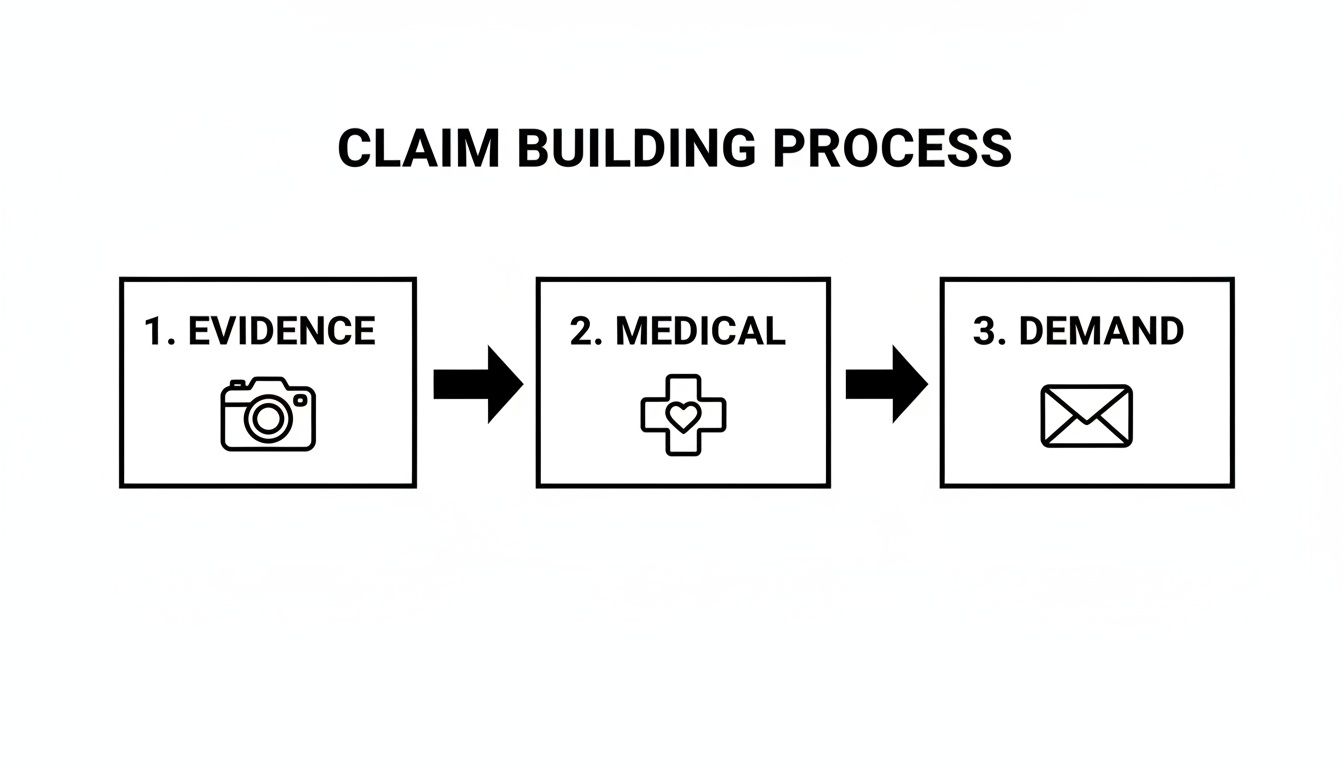
As you can see, the work of gathering evidence, getting medical treatment, and sending a demand letter is the critical groundwork you lay before a lawsuit is even on the table. Each step is a building block that strengthens your position as you head into the more formal litigation process.
Calculating Compensation and Comparative Fault
Disclaimer: This article is for informational purposes only and is not to be construed as legal advice. No attorney-client relationship exists based on the review of this article, and none of the information in this article is legal advice.

If you’ve managed to prove the four key elements of negligence, you’ve reached the final hurdle: figuring out what your claim is actually worth. In a lawsuit, the money awarded to you is called damages. It’s meant to cover everything you lost because someone else was careless.
The goal is simple: to make you “whole” again, at least financially.
But calculating these damages isn’t just a matter of adding up bills. It requires a hard look at every single part of your life affected by the incident. Getting this right is crucial because it shapes your expectations and sets the stage for any settlement talks.
What Are Economic Damages?
Let’s start with the easy part: Economic Damages. Think of them as the black-and-white numbers of your case.
Common examples include:
- Medical Expenses: Every penny spent on hospital stays, doctor visits, surgery, physical therapy, medication, and any future medical care you’ll need.
- Lost Wages: All the income you missed out on from being unable to work. This includes future income if your ability to earn a living has been permanently impacted.
- Property Damage: The cost to repair or replace your car or any other personal items destroyed in the incident.
These losses are concrete. Adding them up gives you a solid financial baseline for your claim. This is especially vital in high-stakes cases like medical malpractice, an area where liability losses have climbed past $26 billion in recent years.
What Are Non-Economic Damages?
Now for the tougher part. Non-Economic Damages are just as real, but they don’t come with a neat price tag. How can you put a dollar value on constant pain or the emotional fallout from a traumatic event? It’s complicated, but it’s a critical piece of your compensation.
This category is all about your personal suffering:
- Pain and Suffering: The physical pain, discomfort, and daily limitations you’ve been forced to endure.
- Emotional Distress: The anxiety, depression, fear, and mental anguish the incident has caused.
- Loss of Enjoyment of Life: Your inability to go back to the hobbies, activities, or relationships you once loved.
To calculate these, lawyers often use a “multiplier” method. We take the total economic damages and multiply them by a number (usually between 1.5 and 5) that reflects how severe your injuries are and how profoundly they’ve impacted your life.
Non-economic damages acknowledge a simple truth: the true cost of an injury goes far beyond medical bills. It’s about the lost moments, the daily pain, and the emotional toll that forever alters your quality of life.
To give you a clearer picture, damages in a California negligence claim fall into several distinct categories. Each one is designed to address a different aspect of your loss.
| Types of Damages in a California Negligence Case |
|---|
| Damage Type |
| Economic Damages (Special Damages) |
| Non-Economic Damages (General Damages) |
| Punitive Damages (Exemplary Damages) |
Understanding these categories is the first step toward building a comprehensive demand for compensation that truly reflects what you’ve been through.
How California’s Comparative Fault Rule Works
Here’s a critical twist you need to know about. California follows a legal doctrine called Pure Comparative Negligence. This rule comes into play when there’s a possibility that you were also partially responsible for the accident.
So, what does that mean for your case? It means you can still get compensation even if you were partly at fault. However, whatever amount you’re awarded will be reduced by your percentage of blame.
Let’s look at a real-world scenario. Say you’re in a car accident and your total damages come out to $100,000. After reviewing all the evidence, a jury decides the other driver was 80% at fault for speeding, but you were 20% at fault for making an unsafe lane change.
Under California’s rule, your $100,000 award gets reduced by your 20% share of the fault. You would walk away with $80,000. This rule is a massive factor in every negotiation, and it’s something insurance adjusters will always try to use against you. You can learn more about pure comparative negligence in our article.
Common Questions About Negligence Lawsuits
Disclaimer: This article is for informational purposes only and is not to be construed as legal advice. No attorney-client relationship exists based on the review of this article, and none of the information in this article is legal advice.
When you’re dealing with an injury caused by someone else’s carelessness, a million questions probably run through your head. The path to suing for negligence can feel overwhelming, but getting clear, direct answers makes a world of difference. This section tackles some of the most frequent questions we hear from people in your exact situation.
Every case has its own unique twists and turns, but understanding these core concepts will give you a solid foundation. It helps pull back the curtain on the legal process so you can move forward with confidence.
How Much Does It Cost to Sue for Negligence?
This is usually the first thing people ask, and for good reason. The great news is that almost all personal injury lawyers handle negligence cases on a contingency fee basis. It is worth asking how fees and case costs work and getting the terms in writing.
This setup was designed specifically for people who are already getting hit with medical bills and losing income. Your lawyer only gets paid if they win your case, and their fee is just a percentage of your final settlement or court award.
How Long Do I Have to File a Lawsuit in California?
Pay close attention to this one, because the deadline is absolute. In California, the statute of limitations for most personal injury cases, including negligence, is typically two years from the date you were injured.
Missing this deadline is catastrophic for your case. If you file a lawsuit even a single day late, the court will almost certainly throw it out. You’ll permanently lose your right to ever seek compensation for that injury.
The statute of limitations isn’t a suggestion, it’s a hard stop. Acting fast is the single best way to protect your legal rights.
While two years is the general rule, some exceptions can change the timeline. For instance, if you’re suing a city or government agency, you might have only six months to file an initial government claim. This is why it’s so critical to figure out the specific deadline that applies to your situation right away.
What Is the Difference Between Negligence and an Intentional Tort?
The answer all comes down to the defendant’s mindset. The core difference is intent.
- Negligence: This is all about carelessness. The person who hurt you didn’t mean to do it, but they failed to act with reasonable caution, and that failure led to your injuries. A classic example is a driver who runs a red light because they were texting.
- Intentional Tort: This involves a deliberate, purposeful act. The person who harmed you did it on purpose. Think of assault, battery, or defamation, the harm was the goal.
When we prove negligence, we’re showing that the defendant breached their duty of care, not that they were trying to cause harm. Getting this distinction right is fundamental to building a strong legal argument.
Can I Sue if I Was Partially at Fault for the Accident?
Yes, absolutely. California follows a legal doctrine called “pure comparative negligence,” which is very friendly to injury victims. This rule allows you to recover damages even if you share some of the blame for what happened.
Here’s how it plays out in the real world. Let’s say you’re awarded $100,000 for injuries you sustained in a slip-and-fall. The court, however, finds you were 10% at fault because you were looking down at your phone when you fell.
Under pure comparative negligence, your $100,000 award would be reduced by your percentage of fault (10%, or $10,000). You would still walk away with $90,000. This rule is so favorable that even if you were found 99% responsible, you could technically still recover 1% of your damages. It ensures a minor mistake on your part doesn’t completely prevent you from getting compensation.
If you or a loved one has been injured due to someone else’s negligence, you don’t have to navigate the complex legal system alone. We offer direct access to attorneys who will personally handle your case and keep you informed every step of the way. Call (866) 625-2529.
Attorney Advertising. This article is general information, not legal advice, and does not create an attorney-client relationship. Prior results do not guarantee a similar outcome.