
What Is Product Liability Insurance and Why You Need It

Disclaimer: This article is for informational purposes and not to be construed as legal advice. No attorney-client relationship exists based on the review of this article, and none of the information in this article is legal advice.
Product liability insurance is a financial safety net for your business. In short, if a product you design, manufacture, or sell causes bodily injury or property damage to a third party, this insurance covers the associated legal costs, settlements, and court awards.
It’s the essential protection that stands between a single product defect claim and a potential business-ending lawsuit.
Decoding Product Liability Insurance

Imagine you own a company that sells kitchen blenders online. You’ve implemented quality control and believe your product is perfectly safe. One day, a customer files a lawsuit claiming the blender’s blade broke during use, causing a serious injury.
Even if you believe the claim is baseless, you are now facing a mountain of legal defense costs. Without insurance, you’d be paying for attorneys, court fees, and any potential settlement right out of your own pocket. A single lawsuit can easily cost tens or even hundreds of thousands of dollars just to defend.
Product liability insurance is designed for precisely this scenario. It acts as a shield, covering those defense costs and any resulting financial obligations.
For a quick overview of what this insurance entails, here’s a look at its core components.
Product Liability Insurance at a Glance
| Aspect | Description | Who It Protects |
|---|---|---|
| Core Coverage | Financial protection against claims of bodily injury or property damage caused by your product. | Manufacturers, distributors, wholesalers, and retailers. |
| Legal Defense | Covers attorney fees, court costs, and other legal expenses, regardless of fault. | Your business and its financial stability. |
| Settlements | Pays for settlements or court-awarded judgments up to the policy’s limits. | Your company’s assets and future revenue. |
This table simplifies the concept, but the real value is in how these protections work together when a claim hits your desk.
The Scope of Protection
This type of insurance isn’t just for manufacturers. Liability can extend to any business in the product’s “stream of commerce.”
This includes:
- Manufacturers: The company that physically creates the product.
- Distributors and Wholesalers: The middlemen who move the product from the factory to the retailer.
- Retailers: Both online stores like Amazon sellers and physical brick-and-mortar shops that sell the final product.
Essentially, if your business plays any role in getting a product into a customer’s hands, you carry a portion of the risk. A lawsuit can name multiple parties in the supply chain, which is why this coverage is so critical. To really get a handle on this, check out this essential guide to product liability and insurance.
Legal Disclaimer: This article is for informational purposes only and is not to be construed as legal advice. No attorney client relationship exists based on the review of this this article and none of the information in this article is legal advice.
Why It’s More Than Just a Policy
Understanding what product liability insurance is goes beyond a simple definition. Think of it as a strategic tool that safeguards your company’s financial health and reputation. When a claim arises, the policy doesn’t just provide a check; it gives you access to a legal team experienced in defending these specific types of cases.
This allows you to keep your focus on running your business, knowing that the complex legal battle is being managed by professionals. For any entrepreneur, that peace of mind is invaluable.
Who Needs Product Liability Insurance?
It’s a common misconception that product liability insurance is just for huge, multinational manufacturers. The truth is, risk follows a product every step of the way, from the drawing board to the customer’s hands. Any business that so much as touches a product on its journey can be held financially responsible if something goes wrong.
This legal idea is often called the “stream of commerce.” Think of it like a river—liability doesn’t just stay at the source (the factory). It flows downstream, and every company involved in designing, making, distributing, or selling a product is in that river, sharing the potential legal exposure.
Even with the tightest quality control, mistakes happen. A single bad batch of materials or a tiny design oversight can snowball into a massive problem.
Manufacturers and Designers
The most obvious folks who need this coverage are the ones actually creating the products. A flaw can sneak in at two key stages:
- Design Defects: This is when a product’s very blueprint is unsafe, no matter how perfectly it’s made. A classic example is a child’s toy designed with small, detachable parts that are a clear choking hazard.
- Manufacturing Defects: This happens when a perfectly good design becomes dangerous because of a mistake during production. Think of a batch of food getting contaminated at the factory, causing widespread illness.
Manufacturers are on the front line, holding the main responsibility for a product’s safety. For them, this insurance is absolutely non-negotiable.
Retailers—Both Online and Brick-and-Mortar
Retailers are the last stop before a product gets to the customer, and that position comes with a surprising amount of risk. It doesn’t matter if you didn’t design or build the item; as the seller, you can be pulled into a lawsuit.
Imagine you’re an Amazon seller importing electronic gadgets from an overseas supplier. If one of those gadgets overheats and starts a fire, the injured customer isn’t going to track down a factory halfway across the world. They’re coming after the most accessible person: you, the seller they bought it from. Without insurance, that legal battle could wipe out your business.
Legal Disclaimer: This article is for informational purposes only and is not to be construed as legal advice. No attorney-client relationship exists based on the review of this this article and none of the information in this article is legal advice.
The same goes for a local artisan selling handmade soaps at a farmers market. If a customer has a severe allergic reaction to an ingredient that wasn’t disclosed, a lawsuit could follow. From small-scale sellers to boutique shops, everyone is exposed. The courts often view retailers as a guarantor of the products they sell.
Distributors and Wholesalers
What about all the businesses in the middle? The distributors, importers, and wholesalers are also critical links in that stream of commerce. They are responsible for moving and storing goods safely and can be held liable for problems that crop up on their watch.
For instance, if a distributor fails to keep a shipment of perishable food at the right temperature, causing it to spoil and make people sick, that distributor can be found at fault. They are a necessary part of the supply chain, and that role comes with its own legal duties and potential liabilities.
At the end of the day, if you profit from a product, you can be held accountable for the harm it causes.
Understanding What Your Policy Actually Covers
Let’s be honest, an insurance policy can look like an intimidating stack of legal documents. It’s often filled with dense terms that are anything but straightforward. But figuring out what your product liability insurance actually covers is absolutely critical to making sure your business is properly protected.
Instead of getting lost in the jargon, let’s break down the key pieces in practical, real-world terms.

At its heart, your policy is built on two fundamental pillars of protection: bodily injury and property damage. These aren’t just abstract legal concepts; they are tangible risks that can sink a business.
Imagine you sell a popular line of organic skincare products. A customer uses your brand-new face cream and suffers a severe allergic reaction, racking up medical bills and losing wages while they recover. That’s a classic case of bodily injury. Your policy would jump in to cover the legal fees to defend your company and pay for any settlement or judgment.
Now, let’s picture a different scenario. Your company builds a “smart” coffee maker, but a flaw in its wiring causes it to short-circuit. It starts a small kitchen fire that damages the customer’s countertops and cabinets. That’s property damage, and your insurance would be there to cover the costs to repair or replace the customer’s damaged property.
Decoding Key Policy Terms
Beyond those two core coverages, you’ll run into a few other terms that define the scope of your protection. Getting a handle on these will help you know exactly what you’re paying for.
- Policy Limits: This is the absolute maximum your insurer will pay for a covered claim. You’ll often see two numbers, like $1 million per occurrence and $2 million in aggregate. “Per occurrence” is the cap for a single incident, while “aggregate” is the total ceiling for all claims during your policy period.
- Deductible: Think of this as your contribution. It’s the amount you have to pay out-of-pocket before the insurance company starts paying. A higher deductible usually gets you a lower premium, but it also means you shoulder more of the initial cost if a claim pops up.
- Exclusions: Pay close attention to this section. Exclusions are the specific situations, damages, or types of claims your policy will not cover. Common ones include intentional acts, criminal behavior, and damage to your own products (that’s usually handled by a different kind of policy).
Legal Disclaimer: This article is for informational purposes only and is not to be construed as legal advice. No attorney-client relationship exists based on the review of this this article and none of the information in this article is legal advice.
Claims-Made vs. Occurrence Policies
Another critical fork in the road is the type of policy you choose. The difference between a “claims-made” and an “occurrence” policy comes down to when your coverage is active, and it’s a big deal.
An occurrence policy is straightforward. It covers claims for incidents that happened during the policy period, no matter when the claim is actually filed. So, if an incident happens in 2023 while your policy is active, you’re covered even if the lawsuit doesn’t land until 2025—long after that policy has expired. It provides lasting peace of mind.
A claims-made policy, on the other hand, only covers claims that are filed while the policy is active. If you cancel it, you typically lose coverage for any past incidents that haven’t turned into a claim yet.
For businesses looking to get a fuller picture of their insurance needs, our guide on liability insurance coverage offers more great insights. And remember, product liability is just one piece of the puzzle; things like shipping insurance for high-risk products can be just as crucial for protecting your assets in transit.
The Legal Landscape of Product Liability in California
California is famous for having some of the strongest consumer protection laws in the country. For any business selling products in the state, this isn’t just a fun fact—it creates a unique set of challenges and risks you absolutely have to be ready for. Getting a handle on the local rules isn’t just a good idea; it’s a matter of survival.
At the very core of California’s system is a legal concept called strict liability. This single principle is a complete game-changer. It means your company can be held responsible for harm caused by a product, even if you weren’t negligent or careless in any way.
The entire focus shifts away from your company’s actions and onto the product’s safety. If you sold a product with a defect that injured someone, you could be on the hook. Period.
The Landmark Case That Shaped California Law
The idea of strict liability wasn’t just pulled out of thin air. It was solidified by a landmark 1963 case, Greenman v. Yuba Power Products. In that case, a man was seriously injured by a power tool he’d received as a gift. The court’s decision was groundbreaking: it ruled the manufacturer was liable simply because the tool was defective and unsafe for its intended use.
This case set a powerful precedent. It established that a manufacturer is strictly liable when an item they put on the market—knowing it will be used without being inspected for defects—turns out to have a flaw that hurts someone. This ruling laid the foundation for how California handles product liability today and even influenced laws across the nation. It’s a major reason why North America now dominates the product liability insurance market with a 46% share; the high risk of lawsuits from consumer-friendly laws like strict liability drives the demand.
Legal Disclaimer: This article is for informational purposes only and is not to be construed as legal advice. No attorney-client relationship exists based on the review of this this article and none of the information in this article is legal advice.
The Three Types of Product Defects
Under California law, a product is considered “defective” if it falls into one of three specific buckets. To win a product liability lawsuit, someone has to prove the product had one of these defects and that the defect was a direct cause of their injury.
Let’s break them down with some real-world examples you can actually picture.
-
1. Manufacturing Defects A manufacturing defect is a fluke. It happens when a product comes off the assembly line different from its intended design, making it dangerous. Think of it as a one-off mistake during production that makes a specific unit or batch unsafe, even if the overall design was solid.
- Example: Imagine a batch of spinach gets contaminated with E. coli at the processing plant. The spinach itself isn’t designed to be harmful, but a failure in the manufacturing process created a dangerous defect, making anyone who eats it sick.
-
2. Design Defects A design defect is the opposite of a manufacturing mistake. Here, the product is built exactly as planned, but the blueprint itself is flawed. The problem isn’t a slip-up in production; the danger is baked into the product’s very design.
- Example: An electric space heater is designed without an automatic shut-off switch to stop it from overheating. It might be assembled perfectly, but this fundamental design flaw creates a massive fire risk.
-
3. Warning Defects (Failure to Warn) This kind of defect happens when a product is sold without the right warnings or instructions about its potential dangers. The product might be designed and built perfectly, but the company failed to tell consumers about the risks involved in using it.
- Example: A company sells a powerful, industrial-strength cleaning solvent at a regular store without a clear label warning users to wear gloves and use it in a well-ventilated area. Someone uses it in their bathroom and ends up with chemical burns and respiratory problems.
For businesses selling in California, especially through platforms like Amazon, the warning requirements get even more complicated. Our guide on Proposition 65 for Amazon sellers dives deeper into these specific state rules. Staying ahead in this legal environment means taking risk management seriously, and understanding these three defect types is your first and most important step.
Why Product Liability Claims and Premiums Are Rising
If you feel like the cost of doing business is climbing, you’re not imagining it. For anyone who makes, distributes, or sells products, one specific cost is on a steep incline: product liability insurance. This isn’t just a random price hike; it’s a direct reflection of powerful economic and social forces making product-related claims more common and much more expensive.
Understanding what’s driving this trend is key. This isn’t about fear-mongering—it’s about smart, strategic planning. When you know why that financial shield is getting pricier, it becomes crystal clear why going without one is a bigger gamble than ever before.
The Impact of Economic Pressures
Modern business doesn’t happen in a vacuum. Broader economic trends are tangling the risk landscape, making both products and the legal claims that follow them more complex.
- Global Supply Chains: Today’s products are rarely made in one place. You might source components from three different countries, assemble them in a fourth, and sell the final product in a fifth. This complexity creates countless opportunities for defects to slip through the cracks. It also makes tracing the source of a problem a logistical and legal nightmare.
- Inflation: Plain and simple, inflation drives up the cost of everything, and legal claims are no exception. The cost of medical care for injuries, repairs for damaged property, and lawyers’ fees have all shot up. That means the potential dollar value of a single claim is significantly higher than it was just a few years ago.
These factors create a perfect storm, where one simple defect can spiral into a costly international investigation and a high-dollar lawsuit. The market data tells the story loud and clear. From 2020 to 2023, US product liability direct premiums written jumped from $3.24 billion to $4.45 billion—a staggering 37% increase. The sharpest single-year rise hit in 2022 when premiums shot up 20.4% as inflation and post-pandemic supply chain chaos peaked. You can explore more data on the liability insurance market to see the full picture.
The Rise of Social Inflation
Beyond hard economics, a powerful social trend is also pushing costs skyward. This phenomenon, known as “social inflation,” points to the rising costs of insurance claims that stem directly from societal attitudes toward lawsuits.
Social inflation isn’t about more claims; it’s about more expensive claims. It reflects a growing tendency for juries to be more sympathetic to plaintiffs and award larger, often multi-million dollar verdicts against corporations.
This shift in public sentiment has emboldened plaintiffs’ attorneys. They’re now pursuing bigger settlements and are more willing to take cases to trial, confident that juries might just side with the individual over the company. The result? The potential financial fallout from a single lawsuit has become much more severe, forcing insurers to raise premiums to cover this massive new risk.
Ultimately, these rising costs change the conversation entirely. The question is no longer “what is product liability insurance?” but “how can we afford not to have it?” Paying a predictable, albeit rising, premium is a calculated business move. It’s a hedge against the unpredictable, potentially catastrophic expense of a legal battle in today’s high-stakes world. It’s the difference between managing a known cost and gambling your entire business on avoiding an unknown disaster.
Disclaimer: This article is for informational purposes and not to be construed as legal advice. No attorney-client relationship exists based on the review of this article, and none of the information in this article is legal advice.
How the Product Liability Claim Process Works
Getting served with a legal notice can make any business owner’s stomach drop. It’s a stressful, confusing moment that feels like a direct threat to everything you’ve worked so hard to build. This is exactly when your product liability insurance shifts from a “nice-to-have” to an absolute necessity.
The good news? Your policy is more than just a checkbook. It’s a roadmap and a team of experts ready to jump in and guide you. Let’s walk through the claims journey, from the first customer complaint all the way to a final resolution.
Step 1: Notification and Initial Assessment
The process kicks off the instant an incident is reported. This might be a formal legal complaint, or it could be a customer reaching out directly about an injury or property damage they claim your product caused.
Your first move is critical: notify your insurance provider immediately. Most policies are strict about timely notification. If you wait too long, you could actually put your coverage at risk.
Once you’ve made the call, the insurer assigns a claims adjuster to your case. This person will do an initial review, check the specifics of your policy, and confirm that the claim is something your coverage handles.
Step 2: The Investigation Begins
With the initial report filed, the insurance company launches a full-blown investigation. The whole point is to get all the facts on the table and figure out if the claim has any merit. Think of it as the evidence-gathering stage.
The investigation usually involves a few key steps:
- Collecting Documentation: You’ll need to hand over records related to the product—things like design specs, manufacturing logs, quality control reports, and sales records.
- Interviewing Parties: The adjuster will probably talk to you, your employees, the claimant (the person who was hurt), and anyone who witnessed the incident.
- Product Examination: Experts will examine the product in question to hunt for any potential defects in its design, how it was made, or the warnings it came with.
This part of the process is incredibly thorough and can take some time. Your insurer needs the complete picture to build a solid defense, and what they find here will shape the entire legal strategy.
Legal Disclaimer: This article is for informational purposes only and is not to be construed as legal advice. No attorney-client relationship exists based on the review of this this article and none of the information in this article is legal advice.
Step 3: Mounting the Legal Defense
This is where your product liability insurance really proves its worth. If the claim turns into a full-fledged lawsuit, your insurer will hire—and pay for—a legal team that specializes in these types of cases to defend your business.
These defense costs alone can be financially devastating. We’re talking attorney fees, court costs, and expert witness fees that can easily hit tens or even hundreds of thousands of dollars. Your policy covers these expenses right up to your limit, whether you win or lose the case. For many businesses, this protection is the only thing standing between them and bankruptcy.
The legal team takes over from here, handling everything from filing responses to managing evidence and representing you in court. To get a better sense of how complex this can be, you can learn more about the specifics of handling product liability cases from legal pros who live and breathe this stuff.
This infographic shows some of the economic pressures that are making legal defense and claims more expensive across the board.
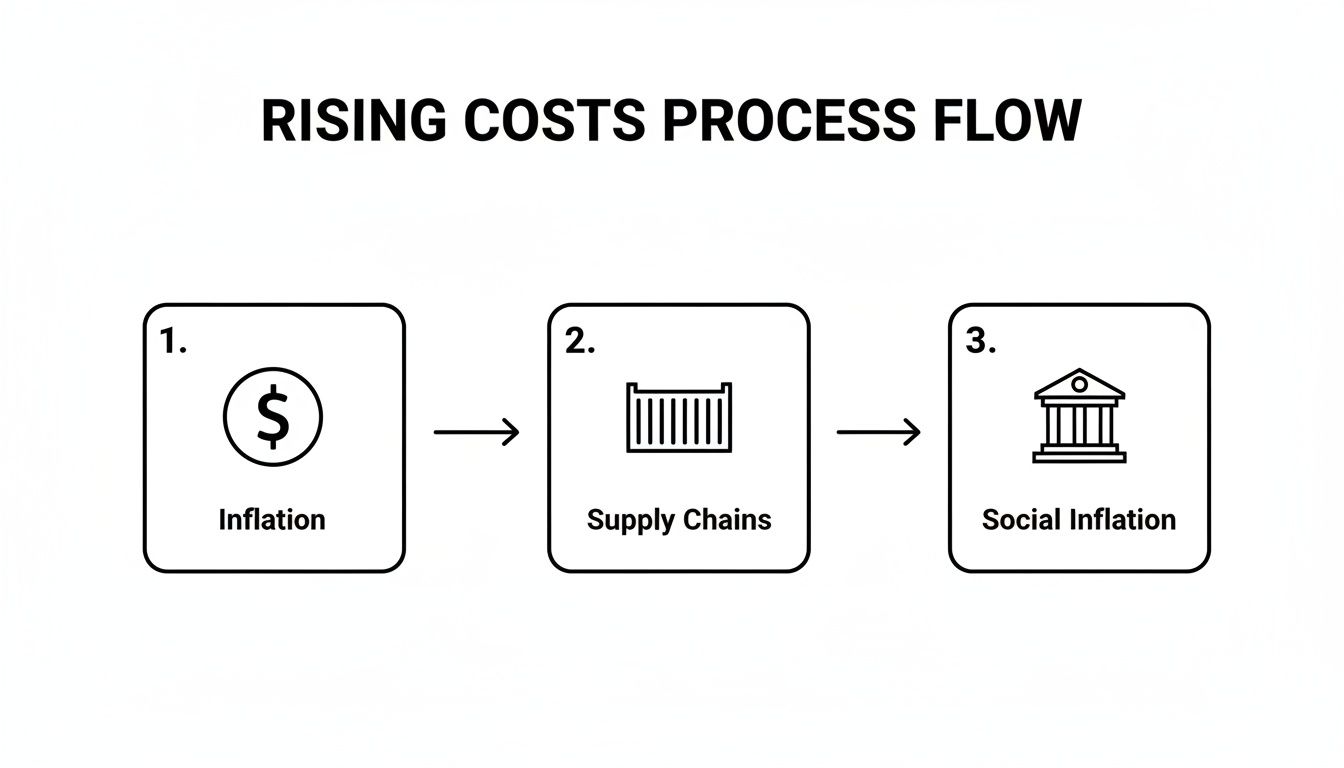
As you can see, general inflation, supply chain problems, and social inflation (meaning bigger jury awards) all work together to drive up the cost of product claims.
Step 4: Settlement or Trial
The vast majority of product liability claims—over 95%, in fact—never actually make it to a courtroom. Backed by your insurer, your legal team will usually enter into negotiations with the claimant’s attorney to try and reach a settlement.
A settlement is just a mutual agreement. Your insurer pays an agreed-upon amount to the claimant, and in return, they drop the lawsuit. This is often the smartest route, saving everyone the time, uncertainty, and massive expense of a trial.
But if a fair settlement can’t be reached, the case goes to trial. At that point, your legal team will present your defense in court. If the court decides your business is liable, your insurance policy will pay the damages awarded, right up to your policy’s coverage limit.
Frequently Asked Questions
When you’re running a business, navigating the world of insurance can feel like learning a new language. We get it. Below are some straightforward answers to the questions we hear most often from business owners about product liability insurance.
Does General Liability Insurance Cover Product Issues?
It’s a common misconception, but the answer is usually no—at least not in the way you’d need it to. While a general liability policy might throw in a sliver of product-related coverage, it’s rarely enough to handle the unique and often massive risks that come with a defective product claim.
Think of it this way: general liability is your all-purpose safety net for slips and falls on your property. A dedicated product liability policy is specialized gear designed specifically to protect you from the financial fallout of your products causing harm. It provides far broader and more reliable protection.
What if I Sell Products Made by Another Company?
Even if you’re just the retailer or distributor, you’re still in the legal line of fire. There’s a legal concept called the “stream of commerce,” which basically means any business that helped get a product into a consumer’s hands can be named in a lawsuit.
It doesn’t matter who actually manufactured the item. If you sold it, you’re part of the chain. That’s why product liability insurance is so crucial—it protects your specific role in that supply chain.
How Much Product Liability Coverage Do I Need?
There’s no one-size-fits-all answer here; the right amount of coverage really depends on your specific business. Key factors that will shape your needs include the type of products you sell, your annual sales volume, and the general risk level of your industry.
A few examples to put it in perspective:
- A business selling children’s toys or consumer electronics is playing in a higher-risk field and will likely need higher coverage limits than a company selling something like office supplies.
- Similarly, high-volume sellers simply have more exposure. The more products you have out in the world, the more robust your policy needs to be.
Legal Disclaimer: This article is for informational purposes only and is not to be construed as legal advice. No attorney-client relationship exists based on the review of this this article and none of the information in this article is legal advice.
The best way forward is to have a real conversation with an insurance professional. They can help you take a hard look at your business’s specific risks and figure out the right coverage amount to safeguard your assets and your future.
Navigating product liability claims requires deep legal and business insight. The team at LA Law Group, APLC works to protect your interests. If you’re facing a complex legal challenge, visit us at https://www.bizlawpro.com for a consultation.
Attorney Advertising. This article is general information, not legal advice, and does not create an attorney-client relationship. Prior results do not guarantee a similar outcome.