
Brand Protection Enforcement: A Practical Guide for Sellers
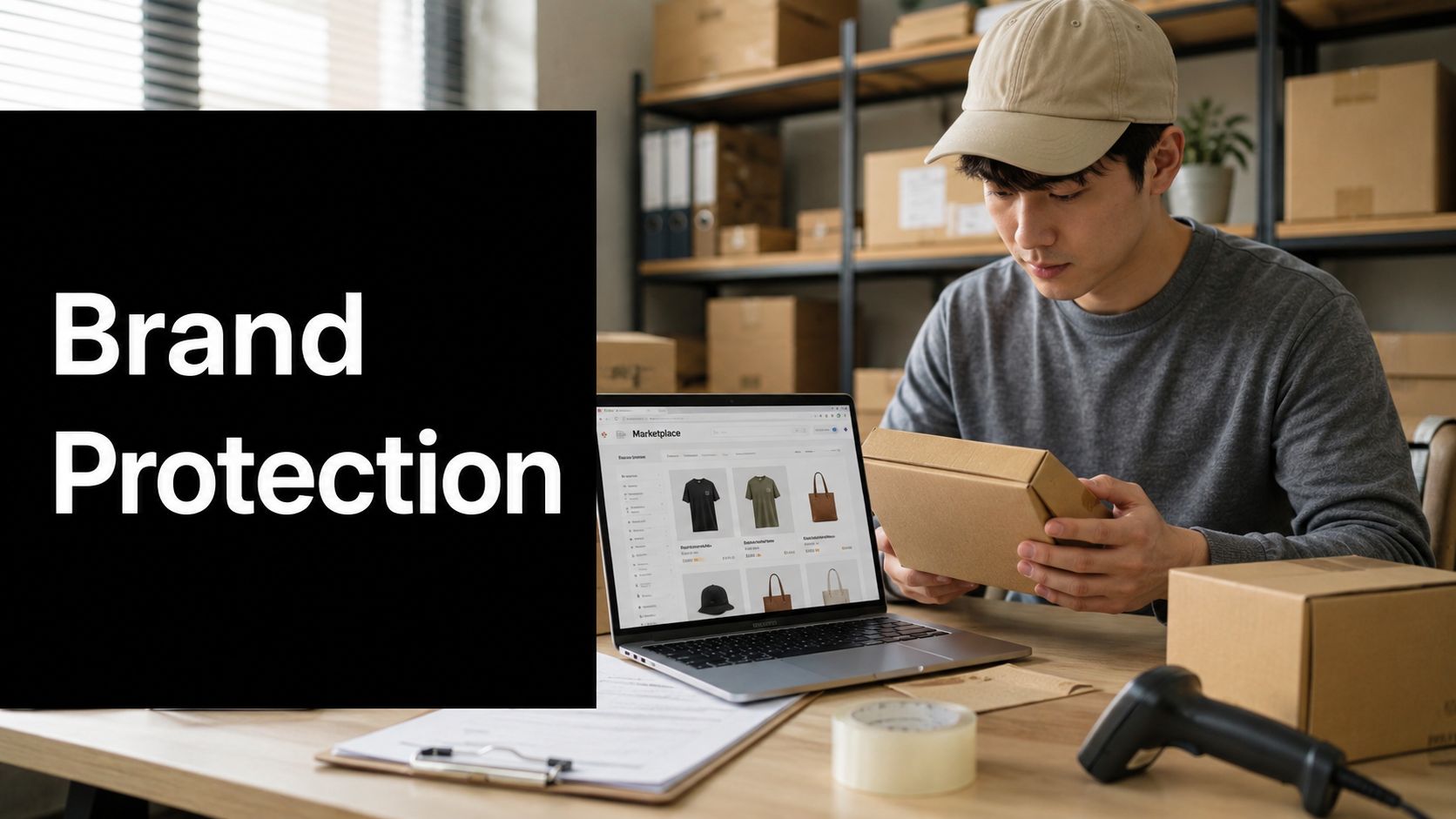
You find your product listed by an unfamiliar seller, using your photographs, your product description, and a price that undercuts your authorized channel. Then a customer sends a photo of a counterfeit item that looks close enough to confuse buyers. The immediate reaction is understandable: report everything, threaten everyone, and consider filing a lawsuit.
A better response starts with brand protection enforcement as an escalation program. You need to identify the violation, preserve evidence, assess the threat, and choose the channel that can produce a practical result without consuming resources the business can’t justify. The right response may be a marketplace report, customs intervention, a formal demand, or litigation. Often, it’s a sequence of several measures.
What Brand Protection Enforcement Actually Means
A seller notices an unauthorized Amazon offer attached to an existing listing. At first, the problem appears limited to a pricing dispute. After ordering the product, however, the seller discovers packaging defects, an altered serial number, and a product that doesn’t match the genuine inventory. The same storefront has copied listings on another marketplace and appears to be using the brand name in paid advertising.
That situation illustrates the scope of brand protection enforcement. It isn’t sending a takedown request after finding a copied image. It’s the organized process of identifying unauthorized use, documenting intellectual property violations, and selecting proportionate measures to stop conduct that threatens a brand, its customers, or its distribution system.
A practical program usually includes:
- Monitoring: Search marketplaces, social platforms, websites, domains, advertisements, and customer communications for suspicious use.
- Evidence collection: Preserve screenshots, URLs, seller information, purchase records, packaging, communications, and product comparisons.
- Channel selection: Match the response to the conduct, whether that means marketplace reporting, a cease-and-desist letter, customs action, or court proceedings.
- Follow-through: Track repeat activity, related accounts, replacement listings, and compliance after an intervention.
The problem is broader than counterfeit inventory
Unauthorized sellers aren’t always counterfeiters. Some may be reselling genuine goods outside an authorized distribution arrangement. Others may be misusing trademarks, copying copyrighted photographs, diverting customers through a confusing domain, or making false claims about affiliation. Each theory can require different evidence and a different remedy.
Amazon sellers should also distinguish between a listing violation and an account-level problem. A copied product page may call for an intellectual property report, while repeated counterfeit offers may justify a broader seller investigation. Guidance on eligibility and documentation for Amazon brand tools is available in this overview of Amazon Brand Registry requirements.
The scale of the problem explains why isolated reactions often fail. The OECD’s overview of counterfeit and pirated goods estimates that counterfeit and pirated goods reached USD 467 billion in 2021, representing 2.3% of global imports. Enforcement programs cannot practically pursue every suspected listing through court. They must prioritize threats and use the least expensive effective tool first.
Practical rule: Treat each incident as evidence about a larger pattern, not as a standalone nuisance.
This article is for informational purposes only and isn’t legal advice. No attorney-client relationship exists based on your review of this article, and none of the information in it is legal advice. A qualified attorney should evaluate the facts, rights, jurisdiction, and objectives of your specific situation.
Enforcement Channels Available to Brand Owners
No single enforcement channel reaches every infringer. A marketplace can remove a listing but may not stop the same operator from using another account. Customs can intercept suspected goods before entry, but border action doesn’t necessarily address domestic inventory or online advertising. Litigation can produce broader relief, but it requires stronger evidence, more time, and a budget suited to formal proceedings.
Marketplace reports and notice-and-takedown procedures
For an Amazon seller, a platform report is often the fastest first response when a seller uses a registered trademark improperly, copies protected images, or offers counterfeit goods. Amazon Brand Registry can support reporting workflows for eligible rights holders, while copyright-based complaints may involve notice-and-takedown procedures. The report should identify the protected right, the exact listing or offer, the specific violation, and the evidence connecting the seller to the conduct.
The OECD’s e-commerce study identifies useful platform enforcement KPIs, including monitored alleged counterfeit offers, listings removed, and seller restrictions imposed. It also describes notice-and-takedown and proactive scanning as important mechanisms. A removal without account-level disruption may provide only temporary relief, so track what happens after the report.
Customs recordation and border intervention
U.S. Customs and Border Protection provides a more preventive option for owners of federally registered marks. Through its e-Recordation system and border-enforcement materials, trademark and copyright owners can record rights so suspected infringing goods may be screened, excluded, detained, or seized.
This channel matters when goods enter the United States through repeat importers, freight channels, or cross-border e-commerce. CBP reported that the quantity of goods seized for intellectual property violations more than doubled from FY 2020 to FY 2024, and that 97% of IPR seizures in the cargo environment occurred in de minimis shipments in FY 2024. The same report identified China and Hong Kong as accounting for about 90% of seized quantity. Those figures show why small parcels deserve attention alongside traditional commercial shipments. CBP’s FY 2024 seizure statistics provide the underlying data.

Letters and litigation
A cease-and-desist letter can be appropriate when the operator is identifiable, the conduct is concentrated, and a clear demand may resolve the dispute without immediate filing. It can also preserve a record that the recipient received notice. The letter shouldn’t overstate rights or threaten remedies the brand owner isn’t prepared to pursue.
Litigation becomes more attractive when the conduct is willful, repeated, commercially significant, or resistant to administrative measures. A court may provide remedies that platforms and customs authorities can’t, including injunctive relief, discovery, and potential damages, subject to the applicable claims and proof.
Amazon reported that it identified, seized, and properly disposed of more than 15 million counterfeit products worldwide in 2024, and that cooperation with U.S. and Japanese customs agencies helped stop more than 90,000 counterfeits from entering domestic supply chains. Those figures, reported in the EU summary of coordinated anti-counterfeiting enforcement, illustrate why platform and government channels can complement one another rather than operate as isolated tactics.
Building Your Monitoring and Evidence Collection System
Evidence quality determines whether a complaint looks credible, complete, and actionable. A vague statement that a seller is “fake” gives a platform or agency little to evaluate. A dated record showing the listing, seller identity, purchase path, product differences, and protected rights creates a much stronger foundation.
Start with detection. Automated monitoring tools can flag brand names, logos, product titles, images, and suspicious price or seller changes across marketplaces. Automation is useful for scale, but it can’t replace manual review. Search the major platforms directly, examine seller storefronts, and ask customer service teams to route suspected counterfeit reports into a central process.
Customer reports often reveal what an automated system misses. Ask customers to preserve packaging, receipts, order details, photographs, and the seller or listing information. Don’t ask them to confront the seller. Their role is to preserve facts and provide them through a controlled channel.

Preserve the record before reporting
A platform may remove or change a listing after receiving a complaint. Capture the evidence first.
- Save the complete listing: Take timestamped screenshots showing the product title, images, description, seller name, price, reviews, fulfillment information, and any trademark or copyright misuse.
- Record the location: Preserve the product page URL, storefront URL, seller identification, order path, and the date and time of observation.
- Make a controlled purchase: When appropriate, buy the product through the ordinary customer process. Keep the order confirmation, shipping label, package, invoice, product, and communications.
- Compare systematically: Photograph genuine and suspected counterfeit products side by side. Note packaging, labels, serial numbers, materials, instructions, safety markings, and other objective differences.
- Protect authenticity evidence: Keep records showing your own manufacturing, distribution, registration, and authorized seller information.
For unauthorized use of an Amazon listing, preserve the ASIN, the specific offer, the seller ID, the copied images or text, and evidence showing why the product or offer violates your rights. A focused guide on documenting and responding to counterfeit goods on Amazon can help organize that review.
Build a case file that another person can understand
Use a spreadsheet or case-management folder with one entry per incident. Include the date, platform, seller, URL, suspected violation, evidence location, report number, response, and follow-up date. Store original files without editing them, then create working copies for annotations.
A good case file lets a platform reviewer, customs official, or attorney answer basic questions quickly: What right is being enforced? What did the seller do? When did it happen? What evidence proves it? What remedy is requested? That structure reduces contradictory reports and makes patterns visible across accounts and platforms.
Making Smart Escalation Decisions
Escalation should be proportional to the threat, but proportionality doesn’t mean waiting until the damage becomes severe. The useful question is whether the chosen measure can stop the conduct at a reasonable cost and preserve stronger options if it doesn’t.
Start with the lowest effective intervention
A single unauthorized seller offering what appears to be genuine inventory may not justify immediate litigation. First verify the product, seller relationship, distribution terms, and type of violation. If the problem is confined to one listing and the evidence is clear, a platform report may be the sensible opening move.
A direct seller contact can work when the operator is identifiable and the conduct may result from misunderstanding, outdated authorization, or improper use of copyrighted material. Use a controlled written communication, avoid unnecessary admissions, and keep a copy of the response. If the seller ignores the demand, relists the product, or expands activity, the failure itself becomes part of the escalation record.
The first response should be inexpensive, reversible, and evidence-building whenever the threat permits it.
Move upward when the pattern changes
A formal cease-and-desist letter is more appropriate when the seller repeats the conduct, uses multiple listings, or continues after a platform action. The letter can identify the rights, describe the conduct, demand specific corrective steps, and set a response deadline. It should be drafted with the possibility of later litigation in mind.
Customs recordation is a strategic choice for brands facing imported counterfeit goods, particularly where shipping records or recurring import patterns can help authorities identify shipments. The United States isn’t the only jurisdiction with formal border procedures. Singapore permits a trademark owner or licensee to submit a written customs notice for suspected infringement, with required forms, a statutory declaration, a S$200 fee, and security, as described in Singapore Customs’ border-enforcement guidance.
Taiwan illustrates a different trade-off. Its rules require the rights holder to identify suspected goods within 4 hours for export air cargo and within 24 hours for specified sea and air cargo categories, followed by evidence within 3 business days, according to Taiwan Customs’ border-enforcement information. The lesson is operational: border remedies can be powerful, but only if the brand has people and procedures ready to meet local deadlines.

Reserve court action for threats that justify it
Federal litigation and injunctive relief may be warranted when the infringement is willful, causes significant commercial or safety harm, involves a coordinated network, or continues despite reports and demands. A network requires a different response from a lone seller. Map related accounts, domains, payment information, shipment routes, product sources, and repeating content before deciding whether one case or multiple actions make sense.
A plan should also account for platform-specific submissions and business consequences. For Amazon sellers, an intellectual property complaint or account-related action can affect listings, inventory, funds, and seller relationships. A structured intellectual property complaints plan of action can help separate the immediate corrective response from the broader enforcement strategy.
Understanding Costs and Risk Factors
The cheapest enforcement option isn’t always the least expensive outcome. Platform reporting may not require a filing fee, but it consumes staff time, requires repeated evidence preparation, and may produce a narrow remedy. If the operator replaces a removed listing immediately, the brand pays the operational cost again without addressing the source of the conduct.
Customs recordation introduces administrative work, possible filing expenses, and the need to respond when authorities identify suspected goods. The process can be worthwhile for an import-driven problem, but it won’t substitute for online monitoring or domestic action. A brand should ask whether it can identify genuine products, answer customs inquiries, and provide timely comparison evidence.
Litigation requires a separate budget analysis. Legal fees, investigator expenses, test purchases, translations, service costs, expert analysis, discovery, and emergency motion practice can all affect the total. The appropriate budget depends on the claims, jurisdiction, number of defendants, evidence, expected remedies, and whether the opposing party has recoverable assets. Avoid relying on a generic estimate such as “litigation costs a few thousand dollars” or “will cost hundreds of thousands.” Those figures aren’t reliable without facts.
Risk isn’t limited to legal fees
Several risks deserve attention before escalation:
- Counterclaims: An aggressive complaint can invite challenges to the validity, ownership, scope, or use of the asserted rights.
- Jurisdiction: An international seller may be difficult to identify, serve, or pursue effectively, even when the online conduct is clear.
- Platform consequences: An inaccurate or unsupported report can damage credibility and create disputes with the platform.
- Business diversion: Employees who gather evidence and manage complaints aren’t working on fulfillment, product development, or customer retention.
- Operational deadlines: Canadian border detention, for example, is generally limited to 10 working days, or 5 days for perishable goods, unless the rights holder acts. The rights holder must respond to Customs within 3 business days of first contact, according to Canadian border-enforcement guidance.
Set priorities using business impact, consumer risk, repeat activity, evidence strength, and the availability of a remedy. A written budget should include both the cost of action and the cost of leaving the conduct unaddressed.
When to Seek Professional Legal Counsel
Legal counsel becomes essential when the response requires a remedy that a platform or agency can’t provide. If you need an injunction, damages recovery, federal discovery, expedited asset information, or coordinated action against multiple defendants, the procedural choices can determine whether the case moves forward effectively.
International infringement is another clear trigger. Rights are territorial, customs rules differ, service requirements vary, and a notice that works in one country may have little effect in another. A lawyer can help determine where the conduct occurred, where the defendant can be reached, which rights are registered, and whether a border or court strategy is practical.
Counterfeiters also justify early advice. Operators who rotate storefronts, copy legitimate reviews, use multiple domains, alter packaging, or distribute through several jurisdictions can overwhelm an informal process. Counsel can help preserve evidence, structure test purchases, coordinate investigators, prepare platform submissions, and avoid communications that undermine later claims.
Early advice preserves options
Waiting until every platform report fails can make the eventual case harder. Evidence may disappear, sellers may move inventory, domains may change hands, and deadlines may expire. A lawyer can help establish a preservation protocol and decide whether a demand, customs filing, negotiated resolution, or court application best fits the available facts.
Professional counsel also adds value when the business must choose among competing priorities. Not every copied image deserves a lawsuit, and not every counterfeit network can be handled through routine takedowns. The useful advice is often strategic: which targets matter most, which evidence is missing, which remedy is available, and what the business can realistically fund.
This article is informational only and isn’t legal advice. No attorney-client relationship exists based on reviewing it, and none of the information in it is legal advice. Consult a qualified attorney before acting on a specific infringement, customs, marketplace, or litigation issue.
LA Law Group, APLC offers brand protection support through its eCommerce and intellectual property services, including infringement response strategy, takedown campaigns, trademark and copyright matters, and litigation planning. Visit LA Law Group, APLC to discuss your enforcement options and arrange a focused review of your brand protection needs.
Attorney Advertising. This article is general information, not legal advice, and does not create an attorney-client relationship. Prior results do not guarantee a similar outcome.