
Intellectual Property Complaints Plan of Action: 2026 Guide

You open Seller Central, or your email, and everything narrows to one line. A listing has been removed. An ASIN is under review. An intellectual property complaint has been filed. Sometimes it’s one product. Sometimes it’s the product that carries most of your revenue. Either way, the reaction is the same. Panic first, analysis later.
Most sellers make their biggest mistake in that first wave of stress. They write back too fast. They deny everything. They send a long emotional message. They paste in a generic template they found online. On Amazon, that usually goes nowhere. The platform’s enforcement process is built around documents, not frustration.
If you’re dealing with a complaint that sounds close to a counterfeit accusation, this breakdown of an Amazon seller’s worst nightmare, the counterfeit complaint is also worth reviewing because the evidence burden can be severe.
This article is for informational purposes only. It is not legal advice, should not be construed as legal advice, and does not create an attorney-client relationship. No attorney-client relationship exists based on your review of this article.
The Moment Every Seller Dreads An IP Complaint Arrives
A seller often sees the complaint before they understand it. The notice says intellectual property. The platform removes the listing. Funds may already feel at risk. The seller’s first instinct is to explain that the product is real, that the complaint is unfair, or that the brand is overreaching.
That instinct is understandable. It’s also usually unhelpful.
An intellectual property complaints plan of action works only when you stop treating the notice like a personal accusation and start treating it like a compliance file. Amazon, in particular, doesn’t want a speech. It wants a structured response tied to the actual allegation.
The first shift you need to make
Your problem is not “Amazon is being unreasonable.” Your problem is narrower. You need to answer four practical questions:
- Who complained
- What right they claim was violated
- Which listings are affected
- What proof you can produce
That sounds simple, but sellers skip it all the time. They assume all IP complaints are basically the same. They aren’t. A trademark complaint about using a brand name in a listing is different from a patent complaint about the product itself. A copyright issue involving images is different from a counterfeit allegation tied to sourcing.
Practical rule: Don’t draft your appeal until you can summarize the complaint in one short paragraph without guessing.
What helps right away
Do three things before writing anything to Amazon or the rights owner:
- Download and save the notice from the platform.
- Pull every document connected to the listing, including invoices, supplier communications, packaging photos, and authorization records.
- Freeze improvisation. Don’t let a team member “fix” the listing in ways that could make the record worse.
A calm response beats a fast one. The sellers who recover best usually do one thing well. They slow the situation down long enough to understand what they’re defending.
Deconstructing the Intellectual Property Complaint Notice
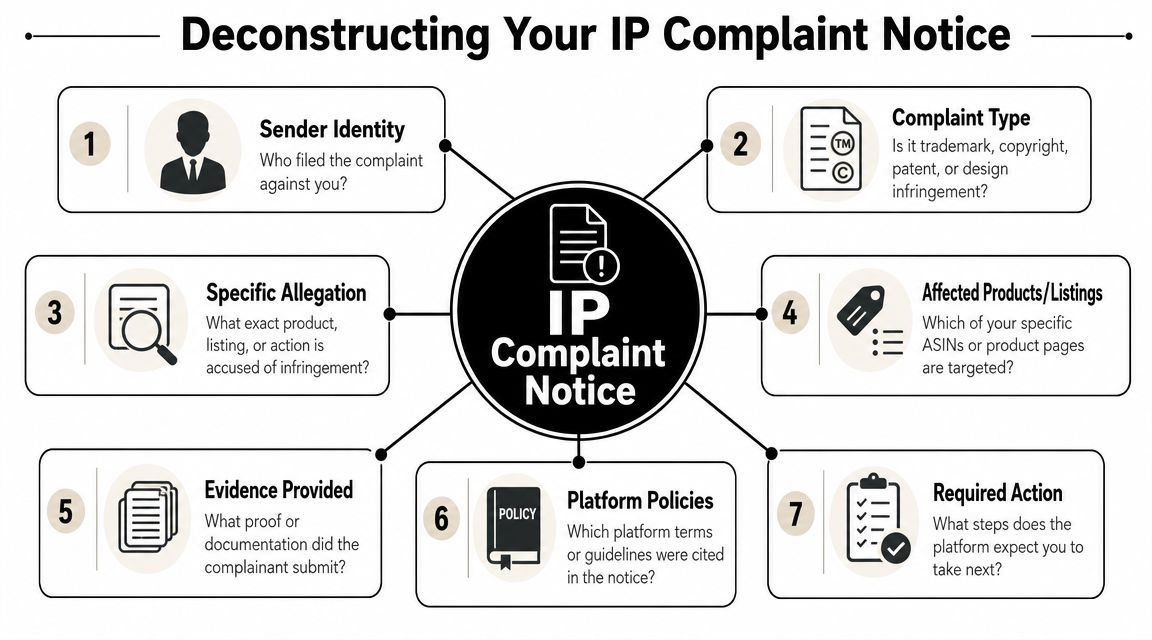
Before you can respond well, you need to read the notice like an investigator. Sellers often skim it, focus on the scary language, and miss the details that control the outcome.
A useful way to think about the notice is this. It isn’t just bad news. It’s a blueprint for your response.
If you need a plain-language refresher on the categories involved, this primer on what is intellectual property infringement helps frame the difference between the rights being asserted.
Pull out the facts that matter
Every complaint notice should be broken into a short fact sheet. I usually want sellers to extract the following:
- Complainant identity. Is it the brand owner, a law firm, or a platform-generated notice tied to a rights-owner report?
- Complaint type. Is this trademark, copyright, patent, or counterfeit-related?
- Reference information. Save the complaint ID, case number, or notice number exactly as shown.
- Affected products. Identify every ASIN, SKU, or listing page involved.
- Stated reason. What exactly does the notice say was infringing?
- Requested or implied next step. Appeal through platform tools, contact the rights owner, submit documents, or stop selling the item.
Missing any one of those can weaken the response.
Why the complaint type changes everything
Generic advice often proves insufficient. “Write a strong POA” sounds useful, but it skips the hard part. Different IP rights require different defenses.
Here are common examples:
| Complaint type | What the issue usually targets | What that often means for your response |
|---|---|---|
| Trademark | Brand name, logo, packaging, branding language | You may need sourcing proof, authorization, or listing corrections tied to branding |
| Copyright | Photos, written copy, graphics, packaging artwork | You may need a license, proof of original creation, or content removal |
| Patent | Product design or functional feature | You may need to assess the product itself, not just the listing text |
| Counterfeit-related allegation | Authenticity and supply chain legitimacy | You may need invoices, authorization, and chain-of-sourcing support |
A seller who receives a trademark complaint and responds with “we have removed the image” may miss the problem entirely. A seller who receives a patent complaint and rewrites the bullet points may do even worse.
When the complaint targets the product itself, listing edits usually don’t solve the core problem.
Create your internal case summary
Before drafting the appeal, write a short internal summary. Not a story. Just the core facts. For example:
- The complaint was filed by the brand owner.
- It targets two ASINs.
- The allegation appears to concern trademark use in the title and packaging.
- The products came from Supplier A.
- Current records include invoices but no brand authorization letter.
- Listings were removed pending review.
That short summary becomes the backbone of your evidence request and your eventual POA. It also helps you spot the primary weakness early. Many cases turn not on whether the seller believes they did anything wrong, but on whether they can prove their position with records that match the complaint.
Assembling Your Arsenal of Evidence
A weak appeal usually fails for one reason. It asks Amazon to trust you without giving Amazon a reason to do that.
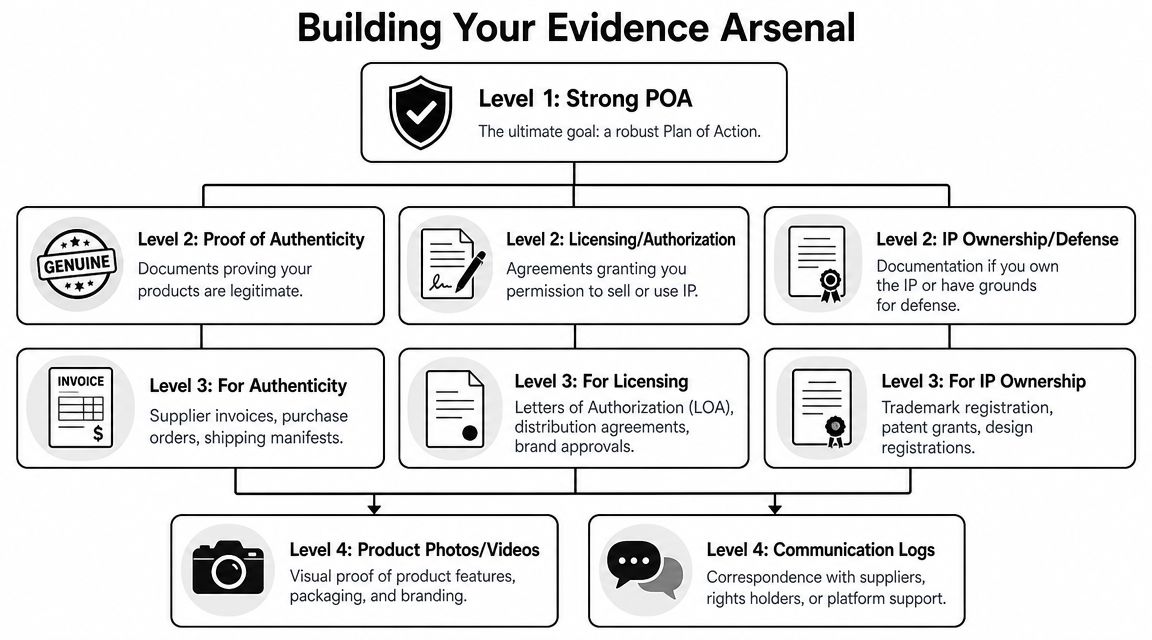
An effective intellectual property complaints plan of action is built around documents. For trademark complaints, invoices proving source are important. For patent disputes, stronger submissions often include a claim-by-claim analysis. Over-attaching documents can hurt clarity, so each exhibit should map to a specific allegation.
Match the evidence to the right problem
Don’t gather documents randomly. Gather them with a theory in mind. What are you trying to prove?
The table below helps organize that.
| Complaint Type | Primary Evidence Required | Goal of Evidence |
|---|---|---|
| Trademark | Invoices, purchase orders, letters of authorization, distribution records | Show authentic sourcing and permission to sell or use brand-related material where applicable |
| Copyright | License agreements, original files, authorship records, permission emails, proof removed content | Show you had the right to use the content or that the challenged material has been taken down and controlled |
| Patent | Product specifications, technical comparisons, redesign documents, license records, claim-focused analysis | Show the product does not infringe, has been removed, redesigned, or licensed |
| Counterfeit-related complaint | Supplier invoices, chain-of-custody records, shipping records, brand authorization, product photos | Show the goods are genuine and came through a legitimate supply chain |
What strong evidence looks like
Strong evidence is specific, readable, and connected to the actual listing.
Use this checklist:
- Invoices that match the product. The item description, supplier identity, and timeframe should line up with the listing under complaint.
- Authorization documents that are current and readable. If you have a letter of authorization, it should clearly identify who granted it and what products or brand rights it covers.
- Photos that prove what was sold. Packaging, labels, UPCs, and product details can matter.
- Internal records that show correction. If you removed images, changed suppliers, or suspended a product internally, keep records of that.
- Communication records with the rights owner. If you asked for clarification or retraction, preserve the correspondence.
What sellers often get wrong
Sellers either submit too little or too much.
Too little means a short apology with no proof. Too much means dumping a stack of unrelated PDFs into the appeal portal and hoping volume looks persuasive. It usually doesn’t. Amazon reviewers are looking for a clean connection between allegation, document, and fix.
Evidence rule: Every attachment should answer a specific question raised by the complaint. If you can’t explain why a document is included, leave it out.
Evidence by complaint type
Trademark complaints
Trademark cases often turn on source and authorization. If the issue is authenticity or authorized resale, invoices and supplier records matter. If the issue is how you used a brand name or logo in the listing, then screenshots of revised content and internal controls matter too.
Look for:
- invoices
- purchase orders
- supplier contact information
- authorization letters
- product and packaging photos
- screenshots of listing changes, if relevant
Copyright complaints
Copyright problems often involve listing images, graphics, A+ content, or written copy. These files are easier to remove than a patented product, but sellers still need to prove the fix.
Useful items can include:
- content license agreements
- written permission from the creator or rights holder
- original source files if you created the work
- records showing the content was removed and replaced
Patent complaints
Patent complaints require a different mindset. A key question may be whether the product itself creates exposure. That’s why a patent case often calls for technical review, a comparison to the patent claim or protected design, and sometimes pulling the listing while you assess risk.
Useful items can include:
- product drawings or specifications
- side-by-side technical comparison
- redesign evidence
- licensing records
- a focused non-infringement analysis when appropriate
Build an exhibit map
Before submitting, create a simple list:
- Exhibit A: Invoice from supplier for affected product
- Exhibit B: Letter of authorization from brand
- Exhibit C: Screenshot showing listing removal
- Exhibit D: Internal supplier vetting policy update
That one page helps in two ways. It keeps your submission organized, and it forces you to see gaps before Amazon sees them first.
Drafting Your Three-Part Plan of Action
Once the documents are organized, the writing gets easier. The POA isn’t the place to sound passionate. It’s the place to sound reliable.
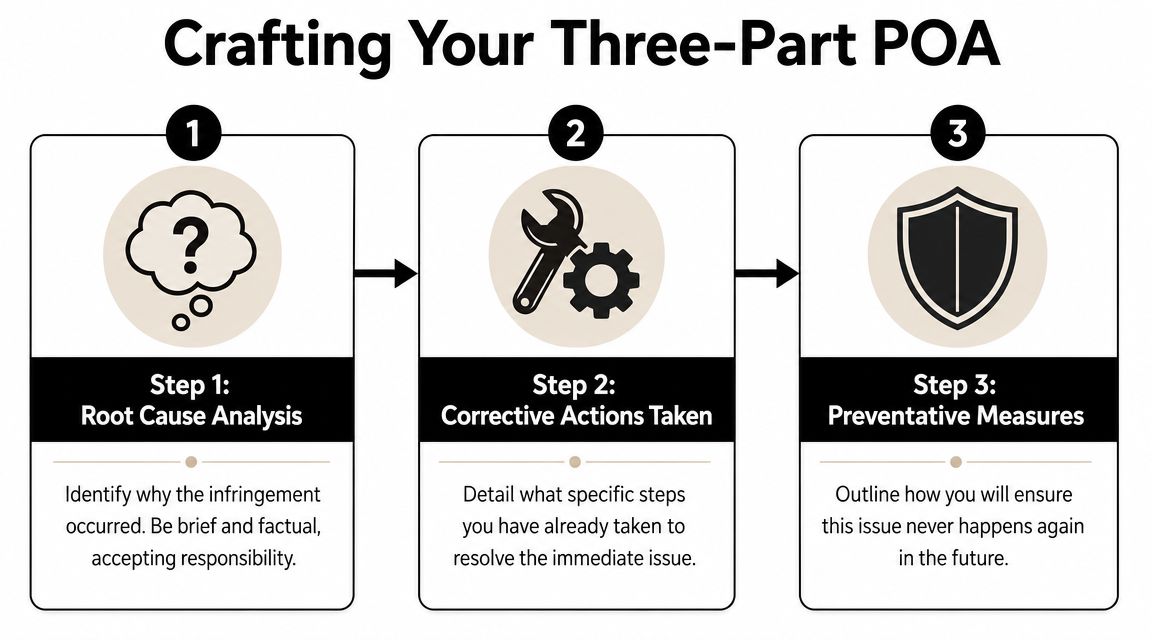
Amazon seller guidance and forum reporting consistently point to the same structure. For IP complaints, the expected POA should identify the complaint type, include supporting evidence such as invoices or retraction requests, and follow a three-part format of root cause, corrective actions, and preventive measures, as reflected in this Amazon seller forum discussion on IP and trademark deactivation appeals.
Use a working framework like this Amazon Plan of Action template only as a starting point. The essential work is tailoring it to the exact complaint.
A visual summary helps before you draft:
Root cause analysis
The root cause section answers one question. Why did this happen?
That doesn’t mean writing a dramatic confession. It means identifying the process failure. Amazon wants to know whether you understand what went wrong.
Good root causes are concrete:
- the team sourced from a supplier without verifying authorization
- the listing team used protected images supplied by a vendor without license confirmation
- a new product was listed without an IP review for design or patent exposure
- branding language was copied from prior marketplace content without legal review
Bad root causes are evasive:
- “We believe the complaint was filed by mistake”
- “A competitor targeted us”
- “We did not intend to violate any rights”
- “This issue was caused by a misunderstanding”
Intent is not the point. Process is.
A root cause should identify the business failure, not your feelings about the complaint.
Immediate corrective actions
This section tells Amazon what you already did. Not what you plan to do someday. What you did once you learned of the problem.
Examples of useful corrective actions include:
- Removed or paused the affected listings
- Stopped shipping the implicated inventory while reviewing sourcing or infringement risk
- Reviewed all related ASINs for similar issues
- Requested supporting documents from the supplier
- Contacted the rights owner for clarification or retraction where appropriate
- Replaced unlicensed content or withdrew the product pending redesign
Notice the pattern. These are actions, not promises.
If the complaint is patent-based, immediate action may need to be more aggressive because editing the listing text won’t necessarily solve the problem. If the complaint is tied to content, corrective action may focus on removing the disputed material and documenting who approved it in the first place.
Here’s a useful drafting formula:
- State the action.
- State when it was taken.
- Connect it to the complaint.
- Tie it to an exhibit if available.
For example: the affected ASINs were removed from sale pending verification of supplier authorization, supported by attached internal removal records and updated supplier correspondence.
To see how practitioners explain POA drafting in video form, review this overview:
Preventive measures
This is usually the most important part because it tells Amazon whether reinstating you creates future risk.
Weak preventive measures sound like this:
- we will be more careful
- we will monitor listings
- we will train staff
Those phrases are too vague. Strong preventive measures describe systems.
Examples:
| Weak statement | Stronger version |
|---|---|
| We will review suppliers better | We implemented a supplier verification process that requires invoices, company identification, and authorization review before products go live |
| We will check listings more carefully | We added a pre-publication checklist for brand references, images, and packaging claims |
| We will train our team | We assigned listing approvals to a designated compliance reviewer and documented the approval workflow |
| We will prevent future issues | We now hold products with unresolved IP documentation and do not relist until the file is complete |
A simple structure that works
When drafting, keep each section tight:
Root cause
One short paragraph. Identify the specific internal failure.
Corrective action
A short list or compact paragraph. Focus on completed steps.
Preventive measures
Use bullets if needed. This is where structure helps clarity.
For example:
- Supplier controls. No new branded inventory is accepted without matching invoices and authorization review.
- Content approval. Product images and copy must be cleared for ownership or license before publication.
- Product review. Listings with increased design or functionality risk are held for additional assessment before launch.
Tone matters more than sellers expect
A good POA is factual, calm, and specific. It doesn’t argue every point unless the facts support a direct challenge. It doesn’t attack the complainant. It doesn’t plead.
If you have a valid defense, present it with documents. If you made a preventable mistake, acknowledge the process failure and show the fix. That’s what gives a submission credibility.
Critical Mistakes That Guarantee Rejection
The biggest myth in this space is that any well-written template can solve any IP complaint. It can’t.
Patent, trademark, copyright, and counterfeit-related complaints aren’t different versions of the same problem. They can require different evidence, different corrective actions, and in some cases a different legal posture altogether. For patent matters, editing a listing alone can be ineffective. Sellers may need to pull the listing, provide a claim chart analysis, or show evidence of a redesign.
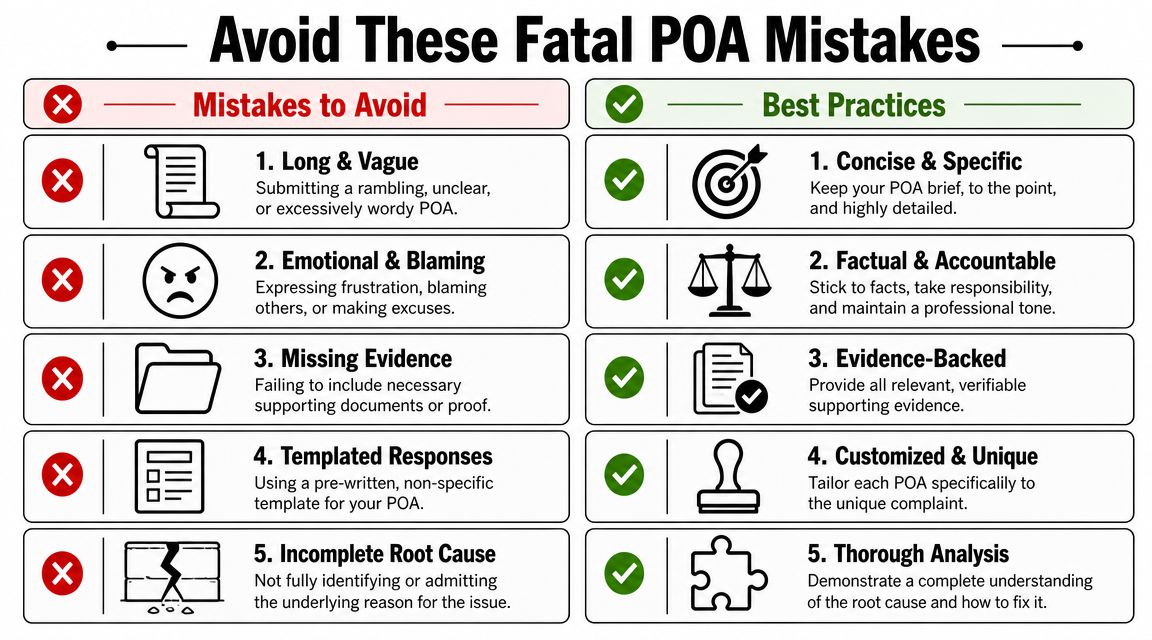
The mistakes that sink most appeals
Long emotional narratives
Amazon reviewers aren’t grading sincerity. They’re looking for a compliance response. A two-page story about how hard you worked to build your store usually weakens the submission.
Better approach: use short factual paragraphs and direct exhibits.
Blaming the platform, customer, or complainant
Maybe the complaint is unfair. Maybe the brand is aggressive. Maybe the platform acted too fast. None of that helps if your POA doesn’t address the allegation.
Better approach: describe what you verified, what you changed, and what you can prove.
Generic copy-and-paste templates
This one causes enormous damage. Sellers lift a template from a forum, swap in their ASIN, and submit it. The result often reads like it was written for a different complaint type entirely.
Better approach: tailor the POA to the asserted right and the exact conduct at issue.
The wrong fix for the wrong complaint
Here’s where sellers lose time.
| Complaint scenario | Common wrong move | Better response direction |
|---|---|---|
| Trademark complaint tied to authenticity | Editing the title only | Focus on invoices, source verification, and authorization |
| Copyright complaint over images | Sending supplier invoice only | Address content rights, permission, or removal records |
| Patent complaint against product design | Revising bullet points | Assess the product, consider delisting, redesign, or technical analysis |
| Counterfeit-related allegation | Arguing that customer reviews are positive | Provide supply-chain documents and authenticity proof |
Reality check: The wrong corrective action can make Amazon think you still don’t understand the complaint.
Documents that raise red flags
Some sellers get desperate and start “cleaning up” records. That’s dangerous. If an invoice looks altered, incomplete, or inconsistent with the listing, it can damage credibility beyond the original complaint.
Avoid:
- cropped records that hide material details
- documents with inconsistent dates
- authorization letters that don’t clearly identify the product or seller
- attachments unrelated to the complaint just to make the file look larger
What a professional submission usually does instead
A strong submission tends to have these traits:
- It identifies the right complaint category
- It states a believable root cause
- It includes documents that match the allegation
- It shows completed corrective action
- It describes preventive controls in operational terms
Notice what’s missing. Drama. Recycled language. Empty promises.
Some are. Some aren’t. When the allegation goes to sourcing, authenticity, product design, or licensed use, the response has to go there too.
Knowing When You Need Professional Legal Help
Some sellers can resolve an IP complaint with a clean internal review, strong records, and a disciplined appeal. Others hit a wall quickly. The hard part is knowing when you’ve crossed from a platform support problem into a legal and business risk problem.
Signs the DIY route is no longer working
A seller should seriously consider legal help when any of these are true:
- You’ve received multiple rejections and the responses are generic or circular.
- The complaint involves a patent, especially when the product design or function is the target.
- A rights owner or law firm is making direct allegations beyond the simple platform notice.
- A large amount of inventory or withheld funds is tied up, and delay is becoming expensive.
- You’re being asked for documents or technical analysis you can’t confidently prepare yourself.
At that point, repeated self-submissions can make the record worse, not better.
What legal help changes
A lawyer who understands marketplace enforcement can do more than rewrite your grammar. The value is usually in strategy.
That can include:
- evaluating whether the complaint has legal merit
- deciding whether to contact the rights owner directly
- structuring a rights-specific POA
- helping assemble the record so the evidence supports the position being taken
- assessing when delisting, redesign, retraction efforts, or a firmer legal response makes sense
In some situations, support staff can also help organize the case file before attorney review. If you’re trying to manage a large set of invoices, communications, and exhibits, working with Legal assistants can be a practical way to keep documents organized and submission-ready.
When specialized marketplace counsel matters
Not every business attorney understands Amazon’s internal enforcement culture. Not every IP lawyer understands seller operations. That gap matters.
For sellers dealing with complex reinstatement or rights-owner disputes, one option is LA Law Group, APLC, which handles eCommerce-related legal issues including Amazon account reinstatement, brand protection, and intellectual property matters. What matters most is choosing counsel that can read the complaint both as a legal issue and as a platform enforcement issue. If the response ignores either side, it often misses the mark.
Frequently Asked Questions About IP Complaint POAs
How long should I wait after submitting a POA
Response times vary, so there isn’t a reliable universal deadline to expect. What matters more is the quality of the first submission. If you send a rushed POA and then keep uploading revised versions without fixing the core issue, you can muddy the record.
A practical approach is to monitor the case closely, preserve every submission, and avoid replacing a focused appeal with a weaker follow-up written out of frustration.
What if the rights owner won’t respond or refuses to retract
That happens often. A retraction can help in some cases, but not every rights owner will cooperate. If they don’t respond, you still need to build the strongest platform-facing record you can with the documents available.
That usually means tightening the evidence package, clarifying the complaint type, and making sure your corrective actions and preventive measures fit the allegation.
Can I just delete the listing and relist it
Usually, that’s a bad idea. Relisting without resolving the underlying complaint can make the situation worse. Platforms may treat it as an attempt to evade enforcement rather than fix the problem.
If the issue involves the product, source, branding, or protected content, relisting under a fresh page won’t cure the underlying risk.
What’s the difference between a counterfeit complaint and a trademark complaint
They can overlap, but they aren’t the same thing. A trademark complaint may focus on use of a brand name, logo, or confusingly similar branding. A counterfeit-related complaint goes harder at authenticity and source. It suggests the item itself is not genuine or is being sold outside legitimate authorization in a way the platform treats as high risk.
That difference matters because the documents you need are not always identical.
Should I contact the complainant directly
Sometimes yes, sometimes no. If the complaint appears mistaken and a retraction is realistically possible, direct contact may be useful. But a careless message can create admissions or confusion that hurt later.
If the claim is aggressive, technical, or tied to a law firm, it’s often smarter to get legal guidance before opening that conversation.
Do I need a different POA for patent complaints
Yes, in practice, you usually do. Patent complaints often require product-level analysis rather than listing cleanup. If the claim concerns the design or function of the item, the response may involve delisting, redesign, license review, or a focused non-infringement position rather than simple edits.
Is this article legal advice
No. This article is for informational purposes only. It is not legal advice, should not be construed as legal advice, and does not create an attorney-client relationship. No attorney-client relationship exists based on reading it.
If you’re dealing with an Amazon IP complaint, withheld inventory concerns, or a POA that keeps getting rejected, LA Law Group, APLC may be able to help assess the complaint, organize the evidence, and determine whether the issue is a platform compliance problem, a rights-owner dispute, or both.
Attorney Advertising. This article is general information, not legal advice, and does not create an attorney-client relationship. Prior results do not guarantee a similar outcome.