
California Statute of Limitations Explained

In California, a statute of limitations is a critical legal deadline for filing a lawsuit. Think of it as a ticking clock that starts the moment a legal issue arises. If that clock runs out before you file your claim, the courthouse doors will likely be closed to you forever, no matter how strong your case is.
These time limits are different for every type of case, which is why it’s so important to understand the specific deadline that applies to your situation.
Disclaimer: This article is for informational purposes and not to be construed as legal advice. No attorney client relationship exists based on the review of this this article and none of the information in this article is legal advice.
What Is a Statute of Limitations in California?
Knowing about the statute of limitations is like knowing the rules of the game before you start playing, it’s absolutely essential for protecting your legal rights. In plain English, it’s a law that puts a cap on how much time you have to start legal proceedings after something happens.
So, why do these deadlines exist? They serve two main purposes. First, they push people to bring their claims forward while evidence is still fresh and witnesses can actually remember what happened. Second, they give potential defendants peace of mind, establishing a point where they are no longer at risk of being sued for something that happened years ago. It brings a sense of finality to legal disputes.
Key Deadlines to Know
While the specifics can get complicated, a few common time limits form the bedrock of California’s legal system. These apply to some of the most frequent disputes that individuals and businesses run into.
- Personal Injury: If you’ve been hurt in something like a car crash or a slip and fall, you generally have two years from the date of the injury to file a lawsuit.
- Written Contracts: When someone breaks a written agreement, the clock is a bit more generous. You typically have four years from the date the contract was breached to take legal action.
- Oral Agreements: For verbal contracts, the timeframe shrinks. You usually only have two years from the day the agreement was broken.
This quick overview shows just how much the deadlines can vary.
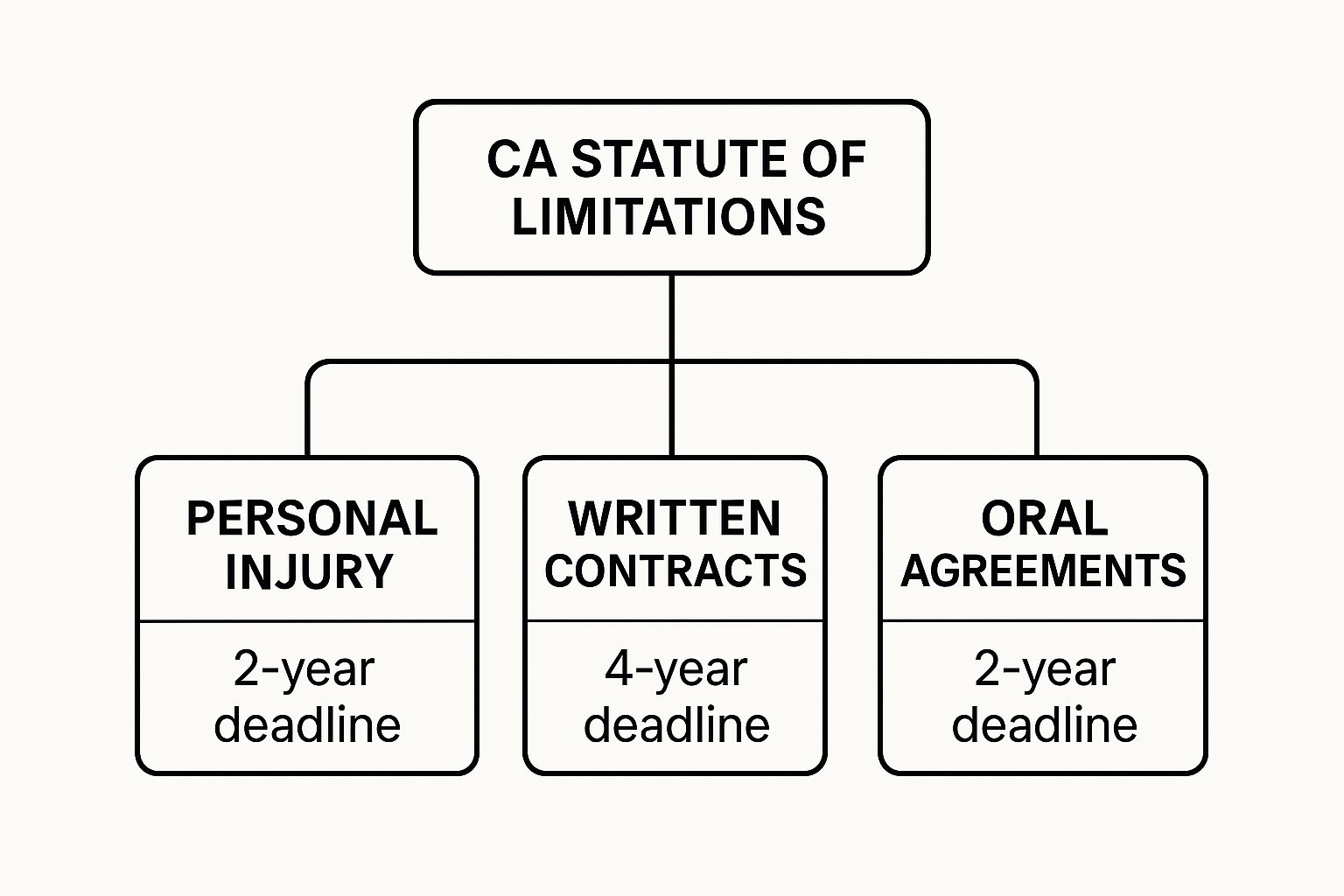
As you can see, having an agreement in writing can double the amount of time you have to enforce it. It’s a simple but powerful lesson in why written contracts are so important.
These rules aren’t flexible. Missing a deadline can permanently stop you from getting justice. To get a more detailed breakdown, you can dive deeper into the statute of limitations in California with our complete guide. For a look at how these rules work across the country, check out this resource on understanding legal time limits. The bottom line is clear: when it comes to legal deadlines, waiting is not an option.
Navigating Deadlines for Civil Lawsuits

Each type of case has its own unique countdown clock, and knowing which one applies is the first step toward protecting your rights. Think of it like a train schedule, missing your departure time by even a minute means you’ve missed your chance to get on board.
This section breaks down the specific time limits for some of the most common civil actions. From personal injuries and broken contracts to property damage, understanding the timeline that governs your situation is absolutely critical. We’ll explore not just the deadline itself but also the specific event that officially starts the clock ticking.
Personal Injury Claims: The Two-Year Rule
When it comes to personal injury cases, California law is pretty clear. If you’re hurt because of someone else’s carelessness, whether in a car crash, a slip and fall, or any other incident, you generally have two years from the date of the injury to file a lawsuit.
This two-year window is designed to ensure claims are brought forward while evidence is still fresh and memories are clear. The clock usually starts ticking the moment the accident happens.
But what if you don’t realize you’re injured right away? This is where the “discovery rule” can come into play. This important exception means the clock doesn’t start until you discover, or reasonably should have discovered, your injury. It’s a key detail in cases where the harm isn’t immediately obvious. You can learn more in our detailed article about the statute of limitations for negligence in California.
The framework for this deadline is set by California Code of Civil Procedure § 335.1. For example, if you’re in a car accident on May 1st, 2024, you typically have until May 1st, 2026, to file a lawsuit against the at-fault driver. This two-year period is crucial because it keeps the legal system moving efficiently.
Important Note: This article is for informational purposes and not to be construed as legal advice. No attorney client relationship exists based on the review of this this article and none of the information in this article is legal advice.
Breach of Contract Deadlines
Contract disputes are another huge area of civil law, but the deadlines here depend entirely on one simple question: Was the agreement in writing? California law draws a very clear line in the sand, giving you a powerful reason to always get things in writing.
A written contract creates a clear paper trail of what everyone agreed to. Because of that clarity, the law gives you much more time to act if someone breaks their promise.
- Written Contracts: You have four years from the date the contract was breached to file a lawsuit.
- Oral (Verbal) Contracts: The timeline is cut in half. You only get two years from the date of the breach.
Let’s put this into perspective. Imagine a freelance web developer signs a contract to build a website, but the client refuses to make the final payment. Because the agreement is in writing, that developer has four full years from the missed payment date to sue. If it was just a handshake deal, they’d only have two years to take action.
Property Damage and Other Civil Claims
Beyond personal injury and contracts, plenty of other civil claims have their own unique clocks. It’s just as important to keep these timelines in mind, because missing them has the same result: your case gets thrown out.
Here are a few other common deadlines:
- Damage to Personal Property: If someone wrecks your car in an accident but you aren’t injured, you generally have three years to file a claim for the vehicle damage.
- Professional Malpractice (non-medical): If you believe an attorney or accountant was negligent, the statute of limitations is typically one year from the date you discovered the mistake, or four years from the act itself, whichever comes first.
- Fraud: When you’ve been a victim of fraud, the deadline is three years after you discovered the facts that constitute the fraud.
These rules show how much the legal system values timely action. Every state crafts its laws to balance the rights of all parties, making it essential to know the specific rules where you live.
Understanding Criminal Case Time Limits
While the deadlines for civil lawsuits are strict, the rules for criminal prosecution operate on a whole different level. The California statute of limitations for criminal cases is all about striking a balance. On one hand, the state has a powerful interest in seeking justice. On the other, individuals have a right to be protected from facing charges based on evidence that has gone stale over time.
Unlike a civil claim where the deadline is usually set in stone, criminal law draws a critical line based on the severity of the crime. This approach helps make sure the most serious offenses are never beyond the reach of the law, reflecting our society’s belief that justice for truly heinous acts shouldn’t have an expiration date.
Crimes with No Time Limit
In California, some crimes are considered so severe they carry no statute of limitations at all. This means a prosecutor can bring charges against a suspect at any time, whether it’s a year or fifty years after the crime was committed. This rule is reserved for the most serious offenses imaginable.
The most obvious example is murder, where the hunt for justice never ends. Other offenses that fall into this category include:
- Embezzlement of public funds.
- Certain serious sex crimes, particularly those involving child victims where DNA evidence points to a specific person.
This powerful exception allows law enforcement to use future breakthroughs in technology, like DNA analysis, to solve cold cases that would otherwise be legally impossible to prosecute. It sends a clear message: for some acts, the clock on accountability never stops ticking.
A Note on Legal Guidance: This article is for informational purposes and not to be construed as legal advice. No attorney client relationship exists based on the review of this this article and none of the information in this article is legal advice.
Felonies and Misdemeanors Deadlines
For crimes that do have a time limit, the deadlines depend on whether the offense is a felony or a misdemeanor. The history of California’s felony statute of limitations is a long and winding road. It’s evolved quite a bit since it was first set up in 1872. Back then, most felonies had a three-year limit, but countless amendments, at least eleven since 1969, have created a much more nuanced system.
Here’s a general breakdown of the standard time limits for prosecution:
- Most Felonies: Prosecutors generally have three years to file charges from the date the crime occurred. This covers a wide range of offenses like burglary, grand theft, and assault with a deadly weapon.
- Felonies Punishable by 8+ Years in Prison: For more serious felonies, the statute of limitations is extended to six years.
- Misdemeanors: For less serious crimes, the deadline is much shorter. The prosecution typically has just one year to file charges.
But these timelines aren’t always so simple. For certain crimes, the “discovery rule” can come into play, meaning the clock doesn’t start ticking until the crime is actually discovered. This is especially relevant in cases like fraud or embezzlement, where the wrongdoing might not be obvious right away. Understanding these nuances is key to getting the full picture of California’s criminal statute of limitations.
How Debt Collection Deadlines Work

The statute of limitations for debt can feel like a confusing legal maze, but getting a handle on it is one of the best ways to protect your financial well-being. Here in California, most debts that come from a written contract, think credit cards, personal loans, or even old medical bills, fall under a four-year statute of limitations.
What does that mean? In simple terms, a creditor generally has a four-year window to sue you for an unpaid debt.
This four-year clock doesn’t start ticking the moment you open the credit card or take out the loan. Instead, it usually starts from the date of your last payment or the date the account first became delinquent. Once those four years are up, the debt is considered “time-barred.” A collector might still call you, but they’ve lost their legal power to use the courts to force you to pay.
The real catch, however, is something called “re-aging” the debt. Imagine that four-year deadline is a countdown clock. Certain actions you take can hit the reset button, snapping that clock right back to zero and giving the creditor a brand new four-year window to sue.
What Can Reset the Debt Clock
It’s incredibly important to understand what actions restart the California statute of limitations on debt. A small, seemingly innocent move could accidentally breathe new life into an old claim, giving a collector fresh legal leverage against you.
These are the most common ways people unintentionally reset the clock:
- Making a Payment: This is the big one. Sending any amount of money, no matter how small, is almost always seen as acknowledging the debt and will restart the four-year period.
- Acknowledging the Debt in Writing: If you send an email or letter admitting the debt is yours or making a promise to pay it, that can be enough to reset the clock.
- Entering a New Payment Plan: Agreeing to a new repayment schedule with a collector is treated like a new contract, which starts the countdown all over again.
This is a critical detail in debt collection law. California’s four-year statute of limitations for debt runs from the last payment or written acknowledgment. That means if you make a payment after years of no activity, the clock can start all over again, exposing you to a lawsuit. To get a deeper understanding of this, you can learn more about California’s debt limitation extensions and see how these rules affect both creditors and debtors.
Actions That Typically Do Not Reset the Clock
While you absolutely need to be cautious, not every conversation with a debt collector is a legal landmine. Knowing what won’t restart the clock can help you communicate with more confidence.
Important Reminder: This article is for informational purposes and not to be construed as legal advice. No attorney client relationship exists based on the review of this this article and none of the information in this article is legal advice.
Generally, you can take these actions without worrying about re-aging an old debt:
- Speaking with a Collector: Just talking to a collector on the phone or asking them to verify the debt does not reset the clock.
- Disputing the Debt: You have the right to dispute the validity of a debt. Sending a letter to do so does not count as an acknowledgment.
- Ignoring a Collector: While it might not be the most effective strategy, simply ignoring calls and letters from collectors won’t restart the statute of limitations.
Knowing these ground rules helps you navigate conversations with collectors safely. The main goal is to avoid saying or doing anything that could unintentionally give an old, time-barred debt a new lease on life.
Pausing the Clock With Tolling and Exceptions

What if the legal countdown clock could be temporarily stopped? In certain situations, it can. This legal principle is called tolling, and it’s a critical exception to the otherwise firm deadlines of the California statute of limitations. Think of tolling as hitting the “pause” button on the clock, extending the time you have to file a claim.
This concept exists to make sure the system is fair. It recognizes that sometimes, circumstances completely outside a person’s control make it impossible or impractical to file a lawsuit on time. Tolling is essentially a safety valve built into the legal system to ensure deadlines don’t unfairly punish people who are legally unable to protect their own interests.
Common Reasons for Tolling the Clock
California law spells out several specific scenarios where the statute of limitations clock is paused. These situations usually involve a plaintiff who doesn’t have the legal capacity to sue or a defendant who can’t be located to be served with a lawsuit. Knowing these rules is vital, as they can completely change a case’s timeline.
Here are a few of the most common reasons a statute of limitations might be tolled:
- Minority: If the injured person is under 18, the statute of limitations is often paused until they become a legal adult. This protects children who can’t legally file a lawsuit on their own.
- Mental Incapacity: When an individual is legally deemed mentally incompetent when their legal claim arises, the clock stops. It typically stays frozen until they regain their mental capacity.
- Defendant Leaves the State: If the person you need to sue leaves California after the incident, the clock can be tolled for the entire time they are gone. This rule prevents defendants from simply running away to avoid being held accountable.
These tolling provisions ensure that justice is still within reach, even when unique personal circumstances get in the way. They level the playing field, making sure a deadline doesn’t become an impossible barrier.
Disclaimer: This article is for informational purposes and not to be construed as legal advice. No attorney client relationship exists based on the review of this this article and none of the information in this article is legal advice.
The Powerful Discovery Rule
Beyond tolling, another major exception that can shift a legal deadline is the discovery rule. But it works a bit differently. While tolling pauses a running clock, the discovery rule delays the start of the clock altogether. It says that the statute of limitations doesn’t begin to run until the plaintiff discovers, or reasonably should have discovered, their injury and its cause.
This rule is an absolute game-changer in cases where the harm isn’t obvious right away.
Picture this: during surgery, a doctor accidentally leaves a small surgical instrument inside a patient. The patient might feel perfectly fine for months, or even years. If the clock started on the day of the surgery, the deadline to sue could pass before the patient even knows something is wrong.
The discovery rule prevents this kind of injustice. The clock wouldn’t start ticking on the surgery date. Instead, it would start on the day the patient discovers the instrument through an X-ray or starts experiencing symptoms. This powerful rule is often applied in cases involving:
- Medical Malpractice
- Exposure to toxic substances (like asbestos)
- Fraud and embezzlement
- Certain types of equal pay claims
Laws are always evolving to make these rules fairer. For instance, recent changes to California’s equal pay laws now make it clear that the discovery rule applies, delaying the start of the clock until an employee knew or should have known about a pay gap. These exceptions are crucial for ensuring that the real spirit of the law, promoting justice, is upheld, even when the facts of a case are complex and take time to come to light.
What Happens When You Miss the Deadline
Failing to file a lawsuit within the California statute of limitations isn’t a minor hiccup, it’s a game-ender. Think of the deadline as a locked door. Once it slams shut, it generally cannot be reopened, no matter how strong or valid your case might be.
The legal system is built on principles of finality and timely action, and these deadlines are strictly enforced. If you miss yours, a court will almost certainly dismiss your case. This means you lose your legal right to seek compensation or justice for that specific claim. Forever.
The Power of an Affirmative Defense
The statute of limitations isn’t just some dusty rule in a lawbook; it’s a powerful shield for the person you’re suing. It acts as an affirmative defense, which means the defendant can bring it up in court to get the case thrown out immediately. And they can do this without ever having to argue about whether they were actually at fault.
Let’s say someone owes you money on a written contract, but you wait five years to take them to court. The defendant doesn’t need to debate the debt. They can simply point out that the four-year deadline has passed, and the judge will likely dismiss the lawsuit on those grounds alone.
This is why understanding what happens if you wait too long to file a personal injury claim is so critical. The consequences are harsh because these laws are designed to ensure disputes are resolved while evidence is still fresh and memories are clear. Letting a deadline slip is one of the most common and heartbreaking ways that solid legal cases are lost before they even get started.
Disclaimer: This article is for informational purposes and not to be construed as legal advice. No attorney client relationship exists based on the review of this this article and none of the information in this article is legal advice.
Common Questions About California’s Deadlines
Wading through legal rules and deadlines can feel like a maze. To help clear things up, here are some straightforward answers to the questions we hear most often about the California statute of limitations. Getting a handle on these concepts is one of the most important things you can do to protect your right to file a claim.
Keep in mind, though, that every situation is different. These answers are a great starting point, but they’re no substitute for advice from a lawyer who knows the specifics of your case.
What Is the First Thing I Should Do If I Think I Have a Legal Claim?
Your absolute first move should be to talk with a qualified California attorney. Do it right away. These legal deadlines are incredibly strict and don’t come with second chances, so there’s no time to waste.
An attorney will dig into the details of your case, pinpoint the exact statute of limitations that applies, and map out your next steps. While this guide gives you the lay of the land, it isn’t legal advice for your unique circumstances.
Does the Discovery Rule Apply to Every Type of Case?
It’s typically reserved for specific situations where the injury, or what caused it, isn’t something you could have known about immediately.
Think of cases involving medical malpractice, hidden fraud, or long-term exposure to toxic substances. In a more straightforward personal injury case, like a car accident, the harm is usually obvious from day one, so the clock starts ticking on the date of the crash. A good lawyer can tell you if this crucial rule might apply to your situation.
Disclaimer: This article is for informational purposes and not to be construed as legal advice. No attorney client relationship exists based on the review of this this article and none of the information in this article is legal advice.
Can a Contract Change the Statute of Limitations?
Sometimes, yes. In California, people who sign a written contract can agree to shorten the standard four-year deadline for filing a lawsuit. But there’s a catch: the new, shorter period has to be legally “reasonable.” A contract can’t set a deadline so short that it makes it practically impossible for someone to actually file a claim.
On the flip side, you generally can’t agree to extend the legal deadline beyond what the law allows. It’s always smart to have an attorney review any contract clause that messes with these legal time limits before you sign anything. Those fine-print details can make or break your future rights.
At LA Law Group, APLC, we know that meeting deadlines is everything. Whether you’re facing a personal injury, a business dispute, or another legal fight, our team is ready to offer the direct, client-first support you need. We provide a free initial consultation to help you figure out your options and take action before it’s too late. Call (866) 625-2529.
Attorney Advertising. This article is general information, not legal advice, and does not create an attorney-client relationship. Prior results do not guarantee a similar outcome.