
Understanding the Jaywalking California Law

Disclaimer: This article is for informational purposes and not to be construed as legal advice. No attorney client relationship exists based on the review of this this article and none of the information in this article is legal advice.
Your Guide to California’s Jaywalking Law
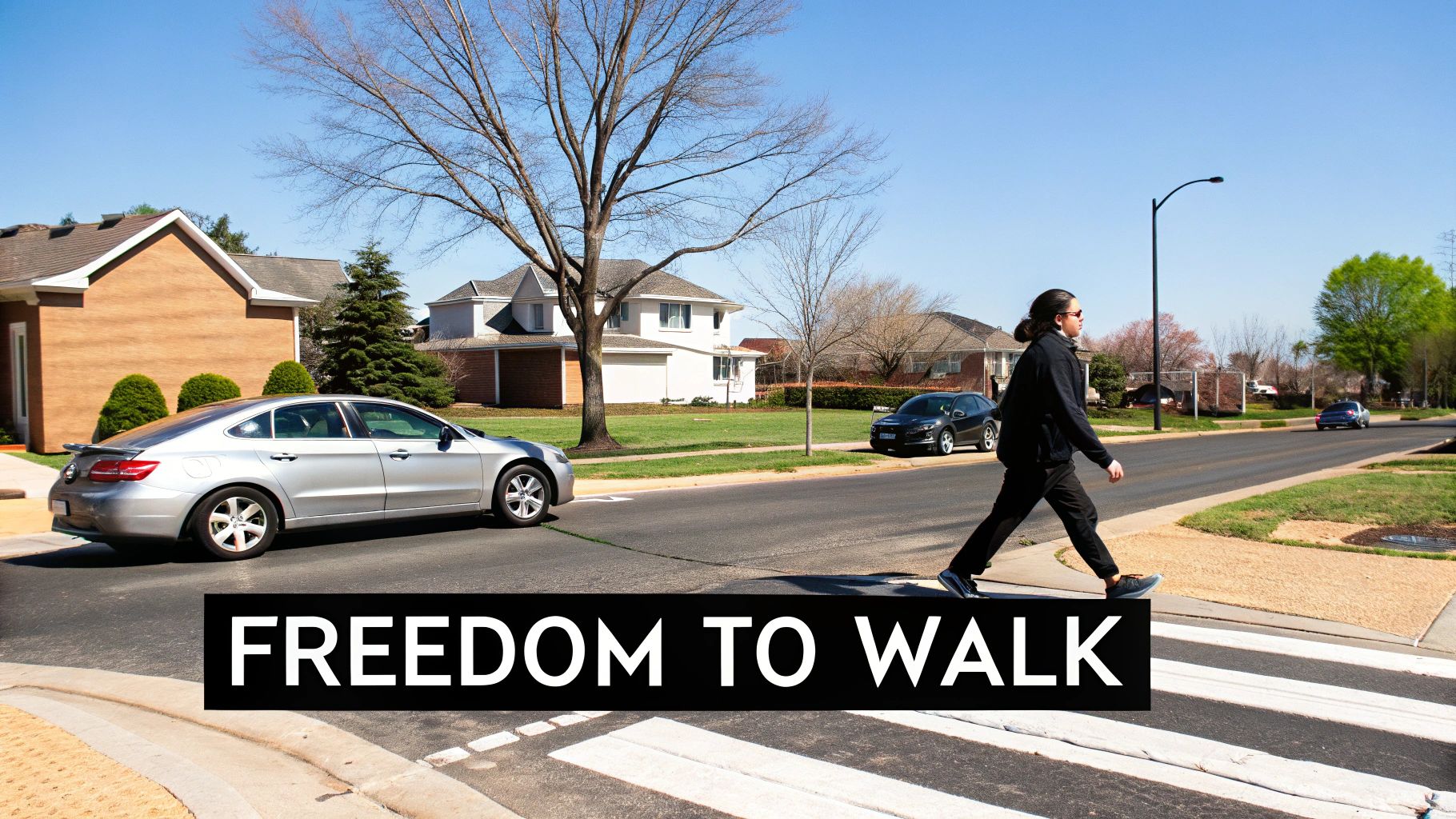
California’s approach to jaywalking has seen a massive shift recently. Thanks to the “Freedom to Walk” Act, the old rules have been tossed out, decriminalizing many mid-block crossings that used to get people ticketed.
What does this really mean for you? In short, you can no longer be cited just for crossing the street outside of a formal crosswalk. The key here is safety. The law now says that as long as it’s safe to cross and there’s no immediate danger of a collision, you’re in the clear.
This is a big change, and it’s critical for both pedestrians and drivers to understand exactly what their rights and responsibilities are now. Let’s break down what these new rules actually look like on the street.
What the ‘Freedom to Walk’ Act Means for You
Disclaimer: This article is for informational purposes and not to be construed as legal advice. No attorney-client relationship exists based on the review of this this article and none of the information in this article is legal advice.
California’s relationship with jaywalking changed dramatically with the “Freedom to Walk” Act, officially known as Assembly Bill 2147. This law, which kicked in on January 1, 2023, shifts the focus from where you cross the street to how you cross it.
In simple terms, you can now cross a street outside of a crosswalk without getting a ticket, as long as it’s safe. It’s a move away from rigid, sometimes nonsensical rules, and toward a more common-sense, safety-first approach.
Before this, technically speaking, crossing an empty side street mid-block was just as illegal as running across a six-lane highway. The new law finally injects some real-world logic into the equation.
The Heart of the Matter is ‘Immediate Hazard’
Everything in this new law boils down to one key phrase: “immediate hazard.” An officer can only write you a jaywalking ticket if your crossing creates an immediate risk of a collision.
What does that mean in practice? It means your actions would force a reasonably cautious driver to slam on their brakes, swerve, or otherwise make a sudden move to avoid hitting you.
Think about it this way: stepping off the curb to cross a quiet residential street at 10 AM with no cars in sight? Not an immediate hazard. On the other hand, jumping into the path of a fast-moving car on a busy boulevard? That’s a textbook immediate hazard.
The “Freedom to Walk” Act isn’t a free-for-all for pedestrians. It’s about decriminalizing the countless safe, everyday crossings that used to be ticketable. The focus is now on the safety of your action, not just the location of your crossing.
This change is a big deal, not just for avoiding tickets but also for how fault is determined if an accident does happen. While it gives pedestrians new protections, it doesn’t remove their responsibilities.
California Jaywalking Law Old vs New Rules
To make this crystal clear, let’s look at a few common situations and how the law applies now compared to before 2023.
| Scenario | Law Before January 1 2023 | Law After January 1 2023 |
|---|---|---|
| Crossing a quiet, empty street mid-block | Illegal. You could receive a ticket simply for not using a crosswalk. | Legal, as long as there is no “immediate hazard” from traffic. |
| Stepping off the curb, causing a car to brake hard | Illegal. This was considered jaywalking. | Still illegal. This creates an “immediate hazard” and is citable. |
| Crossing against a “Don’t Walk” sign | Illegal. A ticketable offense regardless of traffic. | Legal, if no vehicles are close enough to create an immediate danger. |
| Waiting for traffic to pass before crossing mid-block | Technically illegal, but enforcement varied. | Legal. This is the responsible way to cross under the new law. |
The takeaway is simple: the new law empowers you to use your own judgment, but that judgment must be sound and prioritize safety above all else.
What Hasn’t Changed for Pedestrians
While the law gives you more freedom, it’s crucial to understand what hasn’t changed. The core responsibilities of being a pedestrian remain the same.
- You must still yield to vehicles: If you’re crossing outside a crosswalk, cars have the right-of-way. You can’t just step into traffic and expect them to stop for you.
- Driver negligence is still a factor: This law doesn’t let drivers off the hook. They still have a duty to drive safely, pay attention, and not speed.
- Safety is your responsibility: Ultimately, the new law puts your safety in your hands. It trusts you to make a smart call on when and where to cross.
These rules are part of a broader push to improve road safety for everyone. In fact, other new laws are working toward the same goal. You can read more about new parking regulations to enhance pedestrian safety in our related article. While the updated jaywalking law is a huge step forward, it works best when both pedestrians and drivers stay alert.
Disclaimer: This article is for informational purposes and not to be construed as legal advice. No attorney-client relationship exists based on the review of this this article and none of the information in this article is legal advice.
The Surprising History of Jaywalking Laws
To really get a handle on the new jaywalking california law, you have to rewind the clock about a century. It’s hard to imagine now, but before the 1920s, city streets were truly public spaces. They belonged to everyone, pedestrians, horse-drawn carts, streetcars, and the few cars on the road. People crossed the street wherever it made sense. The concept of “jaywalking” simply didn’t exist.
Then the automobile exploded onto the scene, and everything changed. As cars flooded the streets, pedestrian deaths shot through the roof. The public was outraged, and their anger was aimed squarely at reckless drivers.
But the auto industry, growing more powerful by the day, had a different plan. They knew that to sell more cars, they had to transform our streets from shared community spaces into efficient highways for their products. That meant they had to completely change how people thought about and used their own roads.
The Auto Industry’s Campaign to Reshape the Streets
What followed was a brilliant, coordinated public relations blitz from automakers and their allies. Their goal was to redefine who owned the road by shifting the blame for accidents from drivers onto pedestrians. A huge part of this strategy was inventing and popularizing a new, derogatory term: “jaywalking.”
Back then, “jay” was slang for a clueless country bumpkin. By labeling anyone who crossed mid-block a “jay,” the auto industry painted the simple act of crossing the street as foolish, old-fashioned, and dangerous. They pushed this narrative hard through newspapers, safety campaigns, and even in schools, effectively shaming people for walking the way they always had.
This wasn’t just about changing public opinion, it was about changing the law. Jaywalking laws started popping up in California in the 1920s and 30s as part of this larger industry push to put cars first. In a pivotal move, the Automobile Club of Southern California convinced Los Angeles police in 1923 to order pedestrians to stick to sidewalks and marked crosswalks. That model caught on and spread like wildfire across the country. You can read more about this historic shift in this piece detailed by the LA Times.
This history is so important because it shows us that the original jaywalking laws were never really about keeping people safe. They were an economic tool designed to clear the streets for cars.
From Social Control to Modern Reform
The legacy of those laws has been long and damaging. For decades, they gave police a reason to ticket and fine people for something that was once perfectly normal. In more recent years, data revealed that these laws were disproportionately enforced in certain communities.
The concept of jaywalking was not born from a public safety crisis; it was manufactured by an industry campaign to claim the streets for cars. Understanding this history reframes the “Freedom to Walk” Act not as a radical new idea, but as a long-overdue correction.
Enforcing these century-old rules led to unfair outcomes and created needless, tense encounters between law enforcement and the public, especially in low-income neighborhoods and communities of color.
As more people became aware of the law’s true origins and its modern-day impact, the push for change gained real momentum. The passage of AB 2147, the “Freedom to Walk” Act, is a direct acknowledgment of this history. It’s a deliberate step away from a system built for cars and a move back toward a more balanced, common-sense approach, one that respects the right of pedestrians to move freely, as long as they do so with care.
Why Reform Was a Matter of Justice
The push to change California’s jaywalking law wasn’t just about convenience, it was a critical move toward fairness. For decades, these laws, which originally served the auto industry’s interests, were enforced in a way that disproportionately harmed specific communities. The “Freedom to Walk” Act was a direct answer to staggering data that showed a clear pattern of biased policing.
As researchers and advocates started digging into citation data, a deeply troubling picture came into focus. Jaywalking laws weren’t being applied evenly. Instead, they often became a pretext for police stops that overwhelmingly targeted people of color, especially Black pedestrians.
This selective enforcement had real, damaging consequences. It led to hefty fines that could easily spiral into significant debt for lower-income families. More than that, it fueled unnecessary, tense encounters with law enforcement, chipping away at community trust.
The Data Behind the Disparity
Statistics from all over California painted a picture of inequitable enforcement. Before the new law, data showed that Black Californians were ticketed for jaywalking at rates that were wildly out of proportion to their population numbers.
This wasn’t just anecdotal; study after study confirmed it. For instance, 2016 data from Sacramento showed that nearly 50% of all jaywalking tickets went to Black residents, who made up only 14% of the city’s population. It was the same story in Los Angeles, where LAPD records from 2010 to 2020 revealed that 31.5% of jaywalking citations were given to Black pedestrians, in a city where they are just 9% of the population. A wider analysis covering Long Beach, San Diego, and Bakersfield found that Black individuals were a staggering 5.18 times more likely to be cited.
This lopsided data is a major reason why advocates pushed so hard for change. Below is a look at just how skewed the numbers were in key cities before the reform took effect.
Jaywalking Citation Disparities in Key California Cities (Pre-Reform)
| Location | Black Population % | Black Share of Jaywalking Citations % | Disproportionate Rate |
|---|---|---|---|
| Los Angeles | 9% | 31.5% | 3.5x |
| Sacramento | 14% | 50% | 3.6x |
| San Diego | 6% | 22% | 3.7x |
| Long Beach | 12% | 30% | 2.5x |
| Bakersfield | 8% | 33% | 4.1x |
This data made it impossible to ignore that these laws had become a tool for racial profiling, turning a simple act of crossing the street into a risk.
The staggering statistical imbalance in jaywalking citations was a key driver for reform. It highlighted how a seemingly minor infraction could perpetuate systemic inequality, turning a simple street crossing into a potential catalyst for financial hardship and negative police encounters.
The infographic below puts this all into historical context, showing how streets that once belonged to everyone became dominated by cars, setting the stage for this kind of enforcement.
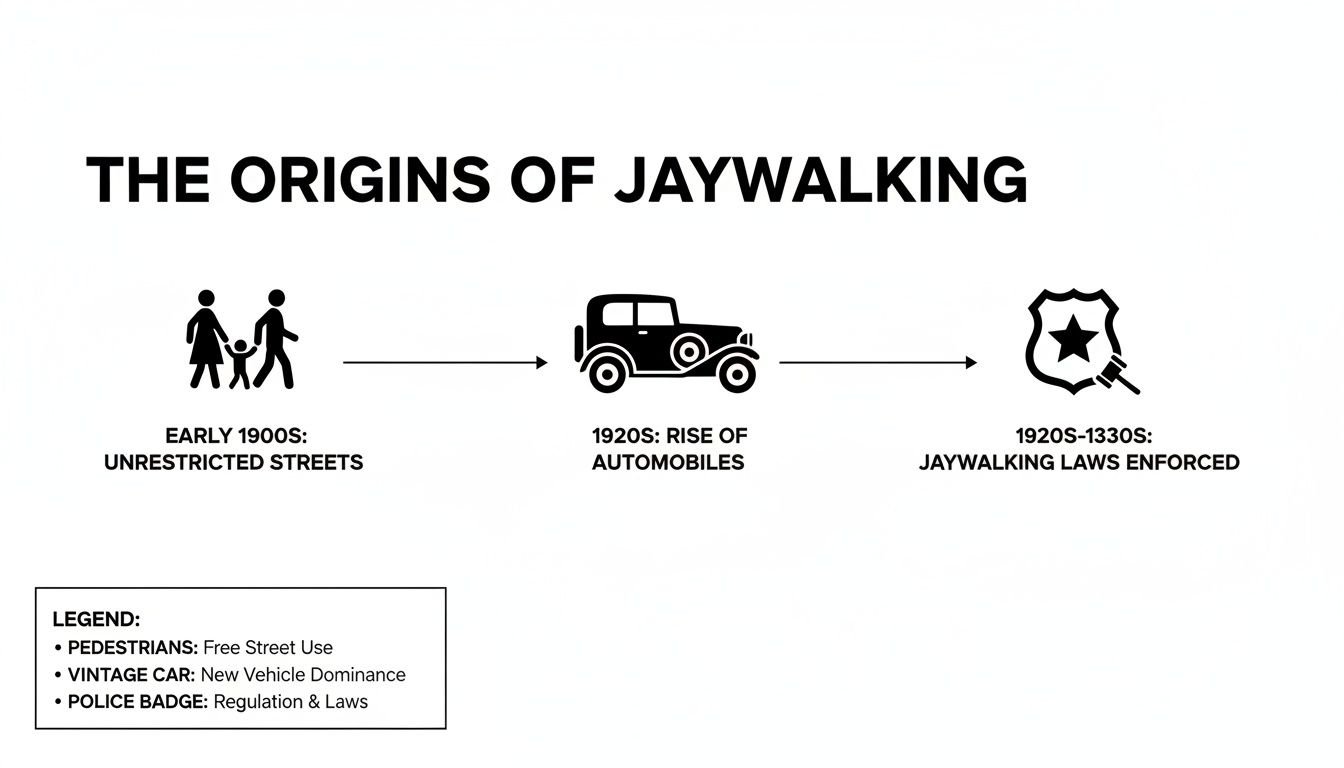
This timeline really drives home the shift from shared public spaces to car-first roads, which created an environment where inequitable enforcement could take root.
Infrastructure and Inequality
The problem went even deeper, tying into urban planning and infrastructure, especially in lower-income neighborhoods. These communities often have fewer marked crosswalks, longer blocks between safe intersections, and generally less pedestrian-friendly design.
This created a vicious cycle of inequality:
- Residents in underserved areas had fewer safe, designated places to cross the street.
- This meant they often had to cross mid-block out of sheer necessity, to get to a bus stop, a local store, or just to get home.
- This necessary act made them prime targets for a jaywalking ticket under the old law.
The law was, in effect, punishing people for navigating poorly designed streets. AB 2147 acknowledged this fundamental injustice. It was a crucial step in shifting the jaywalking California law away from being a tool of inequity and toward a policy built on common sense and fairness for everyone.
How to Navigate Your Rights as a Pedestrian
Disclaimer: This article is for informational purposes and not to be construed as legal advice. No attorney-client relationship exists based on the review of this this article and none of the information in this article is legal advice.
Understanding the new “Freedom to Walk” Act is one thing, but knowing how to use it on the street is another. Navigating your rights as a pedestrian in California is now a mix of new freedom and old-fashioned common sense. The real trick is translating the legal text into safe, practical actions.
While the new law gives you more power to use your own judgment, it doesn’t erase your responsibility. You still have a duty of care, which is a legal way of saying you must act reasonably to keep yourself, and others, safe. The location of your crossing isn’t the main issue anymore; the safety of your crossing is what truly matters.
Understanding ‘Immediate Hazard’ in Real Life
The entire law really boils down to one key phrase: “immediate hazard.” This isn’t just some vague legal term; it’s a practical test. An officer can only ticket you if your crossing forces a driver to make a sudden, evasive maneuver to avoid hitting you.
Think of it this way: if you step into the street and a car a block away continues driving normally without changing its speed, there’s no hazard. But if a car just a few yards away has to slam on its brakes or swerve into the next lane, you’ve definitely created an immediate hazard.
This means you need to be constantly aware of your surroundings.
- Assess Traffic Speed: A car moving at 45 mph is eating up pavement way faster than one going 25 mph. You have to give faster traffic a much wider berth.
- Consider Visibility: Is it dark? Raining? Are you near a blind curve? If it’s tough for a driver to see you, the risk of causing a hazard goes way up.
- Make Eye Contact: This is a simple but powerful tool. Whenever you can, lock eyes with a driver before you cross. It’s a non-verbal confirmation that they see you and know what you’re about to do.
What to Do If an Officer Stops You
Even with the new law in place, you might find yourself stopped by an officer who either misunderstands the rules or genuinely believes your crossing was unsafe. How you handle this interaction can make all the difference.
First and foremost, stay calm and be respectful. Getting into a shouting match on the side of the road won’t help your case. You absolutely have the right to politely explain your understanding of the law.
You could say something like, “Officer, with all due respect, I believed my crossing was safe under AB 2147 because I didn’t cause an immediate hazard.” Avoid arguing. If they decide to write the ticket anyway, take it quietly. Don’t admit to doing anything wrong.
The side of the road is not a courtroom. Your goal during a stop is to keep things calm, protect your rights, and take mental notes so you can contest the citation later if you decide to.
As soon as you can, jot down everything you remember. Note the time, location, weather, and traffic conditions. Write down exactly what you said and what the officer said. This kind of detailed record is gold if you end up fighting the ticket.
Your Responsibilities as a Pedestrian Have Not Changed
It’s critical to remember that the “Freedom to Walk” Act isn’t a free pass to ignore traffic. The core rules of the road haven’t gone anywhere. You can’t just dart out into the street or step off a curb without looking.
Even with these expanded rights, you can still be found partially or completely at fault if your actions lead to an accident. California law uses a concept called comparative negligence, which means your compensation in an accident could be reduced if your carelessness contributed to it. For a deeper dive into how fault is assigned, you can learn more by understanding hit-and-run laws in California, which often involves evaluating a pedestrian’s actions.
Ultimately, this law is about trusting your judgment to make safe choices. By knowing what a true hazard looks like and how to calmly assert your rights, you can walk with more freedom and confidence, all while keeping everyone on the road safe.
Disclaimer: This article is for informational purposes and not to be construed as legal advice. No attorney-client relationship exists based on the review of this this article and none of the information in this article is legal advice.
What to Do After a Pedestrian Accident
Disclaimer: This article is for informational purposes and not to be construed as legal advice. No attorney client relationship exists based on the review of this this article and none of the information in this article is legal advice.
While understanding the jaywalking california law is a great way to avoid a ticket, it’s even more important to know what steps to take if you’re ever in a pedestrian accident. The moments right after a collision are jarring and chaotic, but what you do next can make a world of difference for your health and your legal rights.
Even with the “Freedom to Walk” Act, these situations are rarely black and white. California operates under a system called comparative negligence, which basically means that fault can be split between the driver and the pedestrian. Your actions will be looked at closely, but so will the driver’s.
Immediate Steps to Take After an Accident
Your absolute first priority after being hit is your safety. If you can, get out of the road to prevent any further harm. Then, try to focus on these crucial steps:
-
Seek Medical Attention Immediately: Adrenaline is powerful and can easily hide serious injuries. You might feel fine at first, but it’s essential to get checked out by a doctor. Internal injuries or concussions don’t always show immediate symptoms, and a medical record creates a direct link between the accident and your injuries.
-
Call the Police and File a Report: A police report is the official record of what happened. It will include details about the driver, statements from anyone who saw the accident, and the officer’s own observations. This document becomes the foundation for any insurance claim or lawsuit down the road.
-
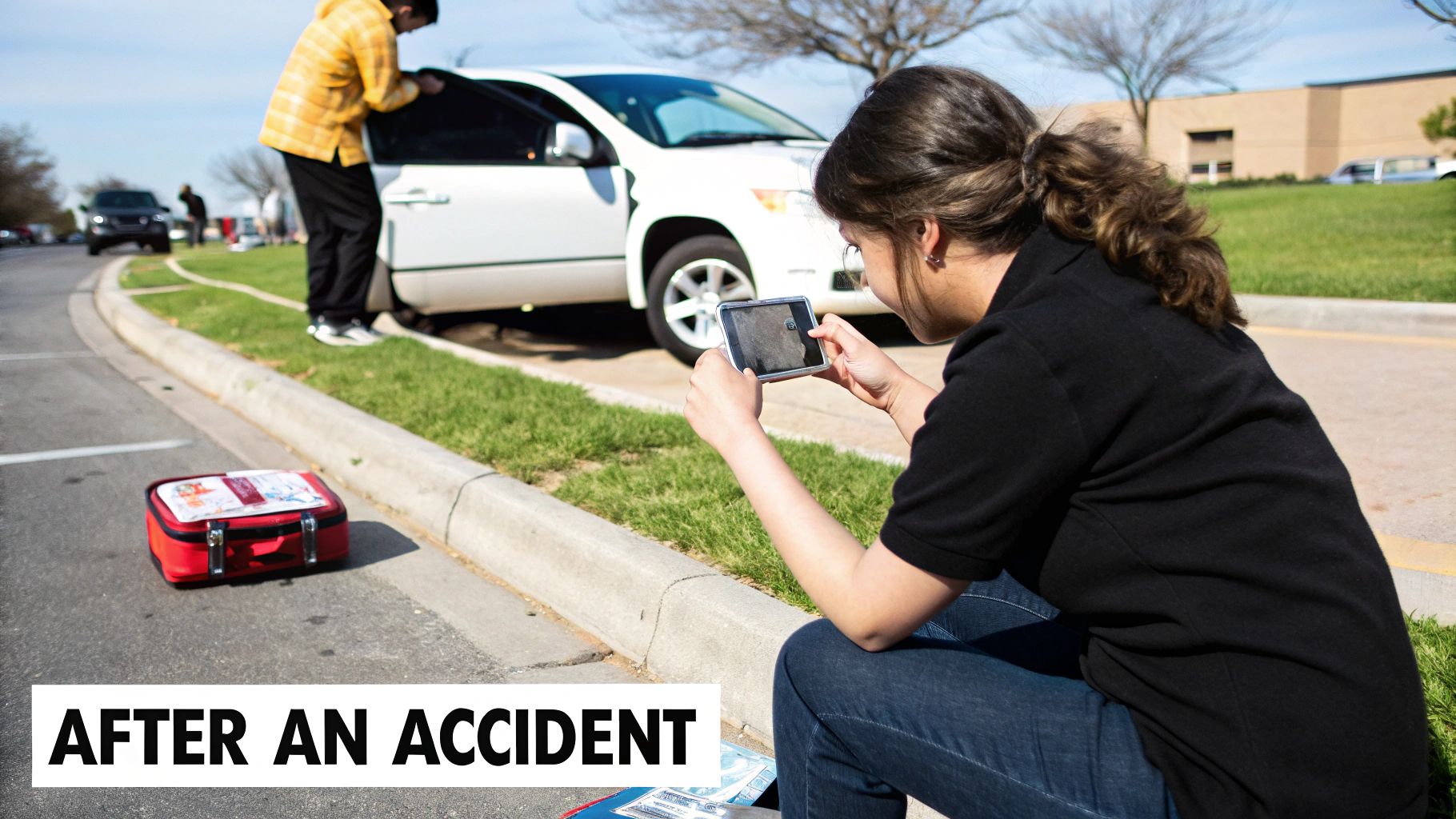
Gather Evidence at the Scene: If you’re physically able, use your phone to document everything. Take pictures of the scene, the car involved, your injuries, and any nearby traffic signals or road conditions. Be sure to get the driver’s name and contact information, along with that of any witnesses.
The Role of Comparative Negligence
The new jaywalking law can definitely work in your favor, but it isn’t a free pass. With comparative negligence, a court assigns a percentage of blame to everyone involved. For instance, if a driver was speeding but you stepped into the road without looking carefully, you could both be found partially at fault.
Under California’s comparative negligence rule, your final compensation is reduced by your percentage of fault. If you’re awarded $100,000 but found to be 20% responsible, you’ll actually receive $80,000. This is exactly why proving the driver’s carelessness is so critical.
The court will weigh your actions, like whether you created an “immediate hazard”, against the driver’s, like if they were speeding, distracted, or failed to yield. An attorney can build a case to minimize your share of the fault and get you fair compensation. Our guide on what to expect for pedestrian hit-by-car compensation dives deeper into this topic.
Common Mistakes to Avoid
In the stressful aftermath of an accident, it’s easy to make mistakes that could hurt your case. Try your best to avoid these common slip-ups:
- Do Not Admit Fault: Stay away from saying things like “I’m sorry” or “I should have looked.” Such statements can easily be twisted into an admission of guilt, even if you just meant to be polite.
- Avoid Speaking to the Driver’s Insurance Company: The other driver’s insurance adjuster is not your friend. Their job is to settle the claim for as little money as possible. Politely refuse to give a recorded statement and tell them to speak with your lawyer.
- Do Not Post on Social Media: Insurance companies absolutely search social media accounts for any photos or posts that might contradict your injury claims. It’s safest to just stay off social media while your case is active.
Why Consulting an Attorney is Crucial
Trying to navigate the legal system after an accident is incredibly complicated, especially when you’re dealing with new laws like the “Freedom to Walk” Act. A personal injury attorney is your strongest advocate. They will take over communications with insurance companies, gather all the necessary evidence, and build a solid strategy to protect your rights.
Even as laws change, the dangers for pedestrians are still very real. An analysis showed that while old jaywalking enforcement was a strain on resources, by September 2022, Los Angeles had already seen 106 pedestrian deaths and 317 serious injuries. Getting the right legal help is key to finding justice.
Beyond the legal battle, your physical recovery is what matters most. It’s common to need help with things like addressing neck pain after a car accident. A good attorney helps make sure that every aspect of your recovery, physical, financial, and emotional, is taken care of.
Your Questions About the Law, Answered
Disclaimer: This article is for informational purposes and not to be construed as legal advice. No attorney client relationship exists based on the review of this this article and none of the information in this article is legal advice.
When a new law like the “Freedom to Walk” Act (AB 2147) comes along, it naturally stirs up a lot of practical questions. Let’s break down how this change works in the real world.
The new rules give pedestrians more freedom, but it’s not a free-for-all. The core idea is simple: safety comes first, for you and everyone else on the road.
Can I Still Get a Jaywalking Ticket in California?
Yes, you absolutely can, but the game has changed. An officer can only write you a ticket if your crossing creates an “immediate danger” of a collision.
Gone are the days of getting ticketed just for crossing a street mid-block when it’s completely safe. Now, a ticket is only supposed to be issued if what you did forced a driver to slam on their brakes, swerve wildly, or take some other sudden action to avoid hitting you. The focus has shifted from where you cross to how safely you do it.
Does This Law Mean Pedestrians Always Have the Right of Way?
Not at all. This law doesn’t touch the fundamental right-of-way rules in California. If you’re crossing outside of a marked or unmarked crosswalk, you still have to be cautious and yield to vehicles.
The new law just means you won’t get a ticket for the act of crossing itself if you’re not causing a hazard. But if you step out into traffic and cause a crash, you could definitely be found partially or even entirely at fault.
What Should I Do if an Officer Tries to Cite Me?
You can politely explain that you believe your crossing was safe and didn’t create an immediate hazard as defined by the new law, AB 2147.
If the officer decides to issue a ticket anyway, just accept it. Don’t argue or admit you did anything wrong. As soon as you can, jot down detailed notes: the time, location, what the traffic was like, and everything that was said. You have every right to fight the ticket in court, where you can make your case that your crossing was perfectly legal.
Can I Still Sue if I Was Hit by a Car While Crossing Mid-Block?
Yes, in most situations, you can. California operates under a “comparative negligence” system. In plain English, this means that the fault for an accident can be shared between the driver and the pedestrian.
Even if a court decides you were partly responsible for what happened, you can still recover money from a driver who was also being negligent, maybe they were speeding, texting, or just not paying attention. The new jaywalking law can actually make your case stronger by showing that your mid-block crossing wasn’t automatically illegal. The best move is always to talk to a personal injury attorney to figure out your options and protect your rights.
Disclaimer: This article is for informational purposes and not to be construed as legal advice. No attorney client relationship exists based on the review of this this article and none of the information in this article is legal advice.
Navigating the aftermath of a pedestrian accident can be overwhelming. The team at LA Law Group, APLC is here to provide the legal guidance you need to protect your rights and secure fair compensation. For a free, no-obligation consultation to discuss your case, visit us at https://www.bizlawpro.com.
Attorney Advertising. This article is general information, not legal advice, and does not create an attorney-client relationship. Prior results do not guarantee a similar outcome.