
Car Seats After Accidents: A CA Replacement Guide

The crash is over. Your child looks okay. The car seat looks okay. That is when parents make the wrong call.
I often see this problem in post-collision cases. A parent focuses on the visible damage to the car, gets through the tow, the police exchange, the call to insurance, and then keeps using the same seat because no crack jumps out at them. That is a mistake. With car seats after accidents, the most dangerous damage is often the damage you cannot see.
If you are sore after the collision, this is also the stage where delayed symptoms can show up. Parents dealing with neck pain, back pain, or stiffness often benefit from learning what physical therapy after auto accident care can involve while they sort out the insurance side.
Your Child’s Safety After a Crash Starts Now
The first decision is simple. Stop using the car seat until you confirm it is safe to reuse or you replace it. Do not let convenience make the decision for you.
A lot of parents assume the question is whether the crash felt serious. That is not the right question. The right questions are legal, mechanical, and manufacturer-specific. Was the crash minor under the official federal checklist? What does the seat manual require? What proof do you have for the insurer?
A key problem after a crash
A car seat can do its job in the first collision and still be unsafe for the next one. Plastic shells, harness assemblies, tether points, and base components can absorb force without leaving obvious external evidence.
That is why car seats after accidents create both a safety issue and an insurance issue. If the carrier later says the seat did not need replacement, you need documentation. If your child was hurt, or later develops symptoms tied to the crash, you also need evidence preserved from day one.
If you remember only one rule, remember this. Treat the car seat like evidence, not like ordinary property.
What parents in California should do
Parents need a practical approach, not vague advice. Start with these priorities:
- Protect your child first. Follow emergency guidance if your child appears injured or uncomfortable.
- Preserve the seat. Do not throw it away, donate it, or keep using it until you know the rules that apply.
- Check the manual. Federal guidance is not always the final answer.
- Build the paper trail immediately. Photos, crash details, the seat model, and the manual matter.
This article is for informational purposes and not to be construed as legal advice. No attorney-client relationship exists based on the review of this article and none of the information in this article is legal advice.
Immediate Steps to Take with Your Car Seat at the Scene
Your first job at the scene is safety. Your second job is preserving facts before they disappear.
Do not keep using the seat
If the car seat was in the vehicle during the crash, take it out of service until you sort it out. That includes the drive home. Borrowing another safe seat, arranging another ride, or buying a replacement the same day is better than guessing.
This is not overreaction. It is damage control.
Build your first record at the scene
You do not need a perfect inspection in the street. You do need a usable record.
Take these photos before the vehicle is repaired or cleaned:
- Wide shots of the vehicle that show the point of impact.
- The side of the car nearest the child seat if the seat was installed behind a particular door.
- Inside the cabin showing the installed car seat.
- Close-ups of the seat including shell, base, harness, chest clip, buckle, tether, and LATCH connectors.
- Airbag areas if any bag deployed.
- Model labels and serial labels on the seat.
If law enforcement responds, tell the officer that a child restraint system was in the vehicle and may need replacement. That detail can matter later when you are proving property damage and crash circumstances.
What to say to insurance right away
When you make the initial report, keep it direct.
Use plain language like this:
“A child car seat was in the vehicle during the crash. I am preserving it and seeking replacement based on crash involvement and manufacturer instructions.”
Do not argue with the adjuster on the first call. Do not accept a casual statement that the seat is “probably fine.” Adjusters are not the final authority on your car seat’s safety.
The first 24 hours matter
Common mistakes happen:
- Throwing the seat away before photos and claim review
- Cleaning or disassembling it in a way that changes evidence
- Using it again because the child seems fine
- Relying on memory instead of gathering labels, receipts, and photos
For a broader post-collision checklist, parents can review the first 72 hours after an automobile accident while they organize medical care, reports, and insurance communications.
A fast visual check is not enough
At the scene, you can look for obvious issues:
- Cracks or dents
- Twisted straps
- Broken foam
- Bent connectors
- Loose components
But do not confuse “no visible damage” with “safe to reuse.” That is only one part of the analysis.
The scene is for preservation, not final judgment. Collect the evidence first. Decide reuse later.
When Must You Replace a Car Seat The Official Checklist
Federal guidance gives parents a narrow exception for reuse. It does not create a broad permission slip.
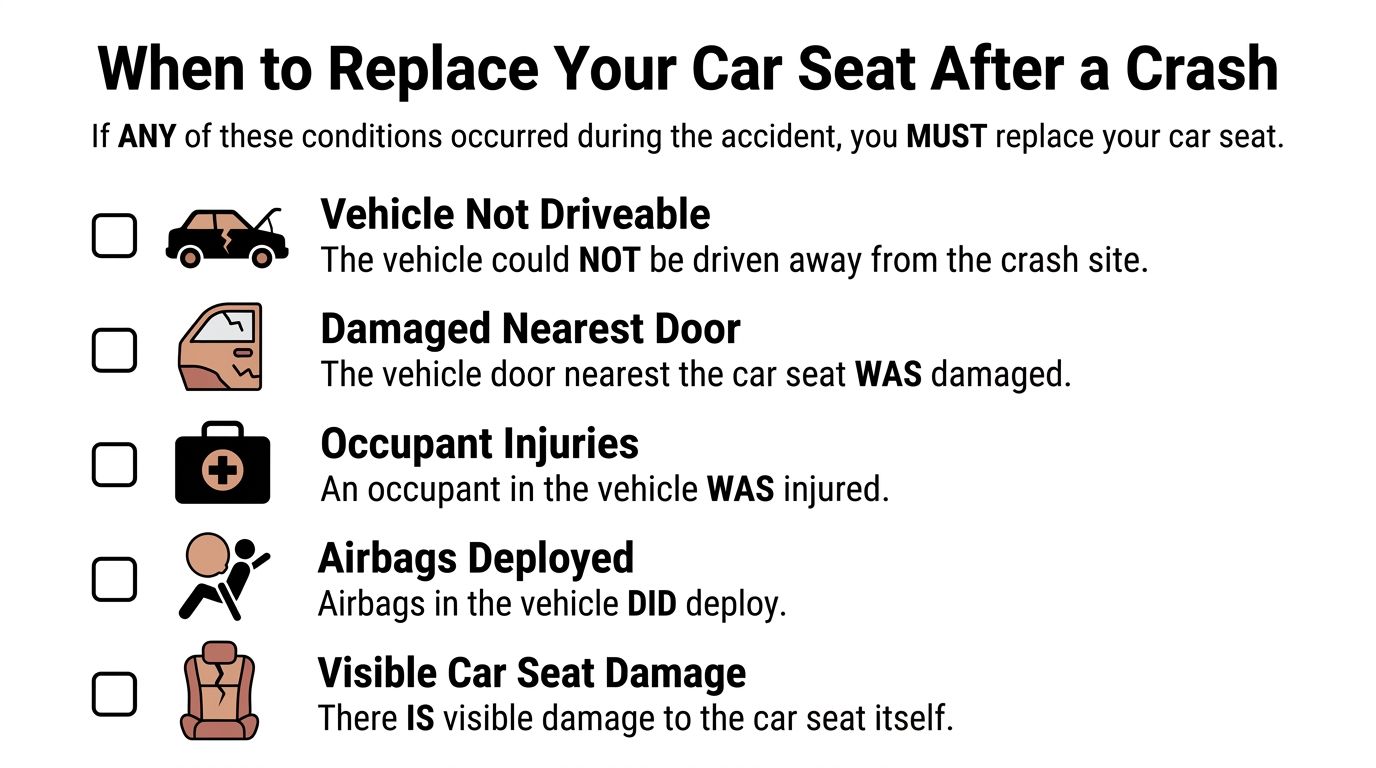
According to the NHTSA methodology summarized here by Consumer Reports, a crash is only “minor” if all five of these conditions are met: NHTSA minor crash criteria for car seat reuse.
- The vehicle could be driven away.
- The vehicle door nearest the car seat was undamaged.
- No passengers sustained any injuries.
- The airbags did not deploy.
- There is no visible damage to the car seat.
If even one condition fails, replace the seat.
What “driven away” means in practice
This point sounds simple, but parents tend to stretch it. If the vehicle needed towing, could not be safely operated, or had damage that made normal driving questionable, do not call that a minor crash.
A drivable vehicle means more than “it could technically move.”
The nearest door rule is narrower than people think
Parents frequently focus on the side with the external body damage. The federal test focuses on the door nearest the car seat. If that door took damage, the minor-crash exception is gone.
This matters in side impacts, angled collisions, and parking-lot crashes where the damage pattern looks small but sits right next to the restraint.
Any injury changes the analysis
If any passenger sustained an injury, the crash does not qualify as minor under this checklist. Do not overthink the severity. The rule is not limited to ambulance transport or hospital admission.
If there was an injury, replacement is the safer and cleaner position.
Airbag deployment is a bright line
Airbag deployment typically ends the discussion. Once airbags deploy, the crash does not fit the minor-crash standard.
Parents occasionally get tripped up when the airbag deployed away from the child seat location. Under the checklist, deployment still matters.
Visible damage to the seat means replacement
Visible damage includes obvious cracking, dents, broken pieces, damaged harness hardware, or compromised attachment components. If you see something wrong, replace the seat.
That said, visible damage is the easiest part of the test. It is not the only part.
Quick self-audit table
| Question | If Yes | If No |
|---|---|---|
| Could the car be safely driven away? | Continue checklist | Replace the seat |
| Was the nearest door undamaged? | Continue checklist | Replace the seat |
| Were all occupants uninjured? | Continue checklist | Replace the seat |
| Did airbags stay undeployed? | Continue checklist | Replace the seat |
| Is the seat free of visible damage? | Federal guideline may allow reuse | Replace the seat |
A final point matters here. This checklist only tells you whether federal guidance may allow reuse. It does not settle the manufacturer question, and the manufacturer question is often the one that controls the actual claim.
If your child was injured by a restraint issue, or if a seat defect may be part of the problem, this overview of defective child safety seats and restraint system injury attorney issues is worth reviewing before you discard anything.
Why Your Car Seat Manual Overrules NHTSA Guidelines
Here is the point parents and insurers miss. NHTSA is the floor. Your manual may be stricter.
That distinction is not technical trivia. It can decide whether your child is protected in the next crash and whether your insurance company pays for a replacement now.
Many car seat manufacturers have replacement policies stricter than NHTSA’s, and many manuals require replacement after any crash.
The important hierarchy
If the seat manual says replace after any crash, follow the manual. Do not let an adjuster talk you into using a federal baseline to override the product instructions.
Manufacturers write those rules because they know the seat’s materials, attachment points, and tested tolerances. They also know what they are willing to stand behind.
In a dispute over car seats after accidents, the manual is often your strongest document.
NHTSA vs manufacturer rules
| Crash Condition | NHTSA Minor Crash Guideline | Common Manufacturer Policy (Example) |
|---|---|---|
| Very low-severity collision | Reuse may be allowed if all five minor-crash conditions are met | Manual may still require replacement |
| No visible seat damage | Reuse may be allowed if all other criteria are met | Manual may still require replacement after any crash |
| Insurer says “minor crash” | Carrier may deny replacement based on federal guidance | Manual can support a stronger reimbursement demand |
| Future injury claim | Federal checklist may be cited | Manual may become key evidence on proper post-crash conduct |
Where to find the rule
Check these places first:
- The printed manual in the original packaging or glove box
- Labels on the seat
- The manufacturer’s website for the exact model
- Customer support for written confirmation tied to the model number
Do not rely on a generic internet comment or a different model’s instructions. Car seat policies can vary by manufacturer and model.
Why this creates insurance fights
Insurance carriers frequently treat a child seat like replaceable personal property with a simple damage question. That is the wrong lens. A crash-involved car seat is a safety device with model-specific instructions.
If the carrier denies replacement because the crash was “minor,” send the manual page. If the denial continues, escalate in writing. If there are injuries, a disputed liability issue, or a rideshare setting, legal counsel may need to step in.
Ignoring the manual can also create ugly arguments later. If a second collision happens and the seat should have been replaced after the first one, the manual may become central evidence in a personal injury case.
How to Get Your Insurance to Pay for a New Car Seat
Insurance reimbursement is easiest when you act like you are building a file for trial, not just asking for a favor.

A key concern is invisible structural damage.
Build a claim package, not a casual request
A strong submission usually includes these items:
-
Crash report information
Get the report number, officer details, date, and location. If you do not have the final report yet, do not wait to start the file.
-
Photos of the vehicle and seat
Include wide shots, impact-area photos, cabin photos, and close-ups of the restraint system.
-
Seat identification
Photograph the model name, serial number, manufacture label, and any warning labels.
-
Manual excerpt
Include the page that states the crash replacement rule for your exact model.
-
Purchase record for the replacement seat
Buy a comparable safe seat that fits your child properly, then keep the receipt.
-
Written reimbursement request
Keep it short. State that the seat was crash-involved, the model-specific manual requires replacement if that applies, and you are requesting reimbursement.
Preserve the old seat
Do not throw the old seat in the trash. Store it in a dry place. Put the straps and loose parts in a bag if needed, but do not alter the condition more than necessary.
If liability is disputed, if your child has symptoms, or if there is a later injury question, the old seat may become evidence.
The old car seat can matter more after the crash than it ever did before the crash.
How to respond to a denial
If the adjuster says no, respond in writing. Ask them to identify the policy basis for denial. Then send the manual page, your photos, and a concise explanation that the seat was involved in a crash and must be replaced under the applicable safety guidance or manufacturer instruction.
If you need a basic refresher on policy language before that conversation, this guide on understanding your auto insurance coverage can help you frame the property-damage side of the claim.
What not to do
Avoid these self-inflicted problems:
- Do not donate the old seat
- Do not sell it online
- Do not let the insurer take it without documentation
- Do not accept a verbal denial and move on
- Do not replace it with the wrong size or stage for your child
When legal help belongs in the process
In these situations, legal support can become practical, not dramatic. If the insurer refuses to reimburse the seat, if the crash involved injuries, or if the seat history may affect liability, lawyers handling injury and property-damage issues can help organize the claim and preserve evidence. LA Law Group, APLC handles California accident matters that can include property-damage disputes tied to child safety equipment.
California Car Seat Rules and When to Call an Attorney
California families have another layer to follow. The crash rules are not the whole story. You also need the replacement seat to comply with state law.
California Vehicle Code section 27360 requires that children under two ride in a rear-facing car seat unless they weigh 40 or more pounds or are 40 or more inches tall, and children under age eight must be secured in a car seat or booster in the back seat: California Vehicle Code section 27360.
Replacement has to be legally correct
Parents sometimes rush to buy “something for now.” That shortcut can create a second problem.
The replacement seat must fit:
- Your child’s age and stage
- Your child’s size
- California placement rules
- Your vehicle setup
If you need a practical overview of the state rules while shopping for a replacement, review understanding car seat laws safety tips for parents in California.
When you should stop handling it alone
Some claims stay straightforward. Others do not. Call an attorney if any of these apply:
-
Your child was injured
Even “mild” symptoms can develop into treatment, follow-up visits, or longer-term issues.
-
You were in an Uber or Lyft
Rideshare claims can involve multiple insurance layers and messy responsibility questions about who provided the seat, who installed it, and what crash history exists.
-
The insurer denies the car seat claim
If the seat manual supports replacement and the carrier still refuses, the issue has moved beyond a simple customer-service problem.
-
The other driver is uninsured or underinsured
Coverage questions quickly become more complicated.
-
You suspect a defective seat or restraint failure
Keep the seat, preserve all parts, and get legal advice before anyone disposes of it.
Spanish-speaking families should ask for clear communication
If Spanish is your primary language, insist on direct explanations in Spanish when discussing injuries, releases, claim forms, and seat replacement disputes. Many preventable mistakes happen because a parent signs something they do not fully understand.
California families dealing with car seats after accidents need clean advice, not mixed messages from adjusters, tow yards, and internet forums. If your child was hurt, if the car seat claim is being denied, or if a rideshare or uninsured driver is involved, get legal help before evidence disappears.
If you need help sorting out injuries, insurance pushback, or a disputed replacement claim involving a child car seat, contact LA Law Group, APLC. We offer case evaluations for California accident matters. This article is for informational purposes only, does not constitute legal advice, and does not create any attorney-client relationship.
Attorney Advertising. This article is general information, not legal advice, and does not create an attorney-client relationship. Prior results do not guarantee a similar outcome.