
LA Car Accident Guide: What to Do in 2026

A crash in Los Angeles usually starts with an ordinary errand, a freeway merge, a left turn under pressure, or a stoplight that changes too fast for the traffic around you. Then everything narrows. You hear tires, feel the impact, and your first clear thought is often not about a claim. It’s whether everyone is okay, whether your car can move, and what you’re supposed to do next.
That confusion is normal. LA roads put people in difficult situations every day. Congestion, density, and constant lane changes make a routine drive feel unpredictable.
This guide is written for people dealing with the immediate aftermath of a la car accident. It’s practical, local, and focused on what helps protect your health, your evidence, and your legal position. It also speaks to a reality many families face in Southern California. Access to care, language barriers, rideshare involvement, and confusing insurance calls can all complicate recovery, especially for Spanish-speaking households trying to move quickly after a collision.
This article is for informational purposes only and is not to be construed as legal advice. No attorney-client relationship exists based on the review of this article, and none of the information in this article is legal advice.
Your Guide Through the Aftermath of an LA Car Accident
On LA streets, a collision rarely happens in a calm setting. It happens in fast-moving traffic, near a packed intersection, on an arterial road with limited visibility, or during a stressful commute when people are already reacting late. That matters because the moments right after impact often shape the entire claim.
What most people feel first
Most injured drivers and passengers I speak with remember the same sequence. Shock first. Then pain. Then the pressure to answer questions before they’ve had time to think.
A lot of clients later realize they had symptoms they dismissed at the scene. Neck strain, dizziness, and headaches after a car accident are common examples of symptoms people minimize because adrenaline is still high.
Practical rule: If something feels off, even if it seems minor, treat it seriously and document it early.
Why LA cases need a local approach
An LA crash isn’t just a generic insurance event. It may involve freeway cameras, nearby businesses with surveillance footage, rideshare activity, heavy traffic patterns, or a police response delayed by call volume. It may also involve multiple drivers giving inconsistent accounts because they only saw part of what happened.
That’s one reason local context matters. Reports can be brief. Witnesses leave quickly. Vehicles get repaired before key evidence is preserved.
What helps most in the first days
The strongest cases usually begin with calm, basic steps taken early:
- Protect your body first. Medical care comes before legal strategy.
- Preserve the scene if possible. Photos, contacts, and notes disappear fast if you wait.
- Be careful with statements. Polite is good. Guessing is not.
- Track every development. Symptoms, appointments, repair issues, and insurance calls all matter.
An la car accident claim is easier to manage when you stop treating the crash as a one-time event and start treating it as a process. The road from impact to recovery is rarely quick, but it becomes more manageable when you know what to do next.
Immediate Actions at the Scene of the Crash
The first few minutes matter because they affect both safety and evidence. In Los Angeles, that often means making decisions while traffic is still moving around you.
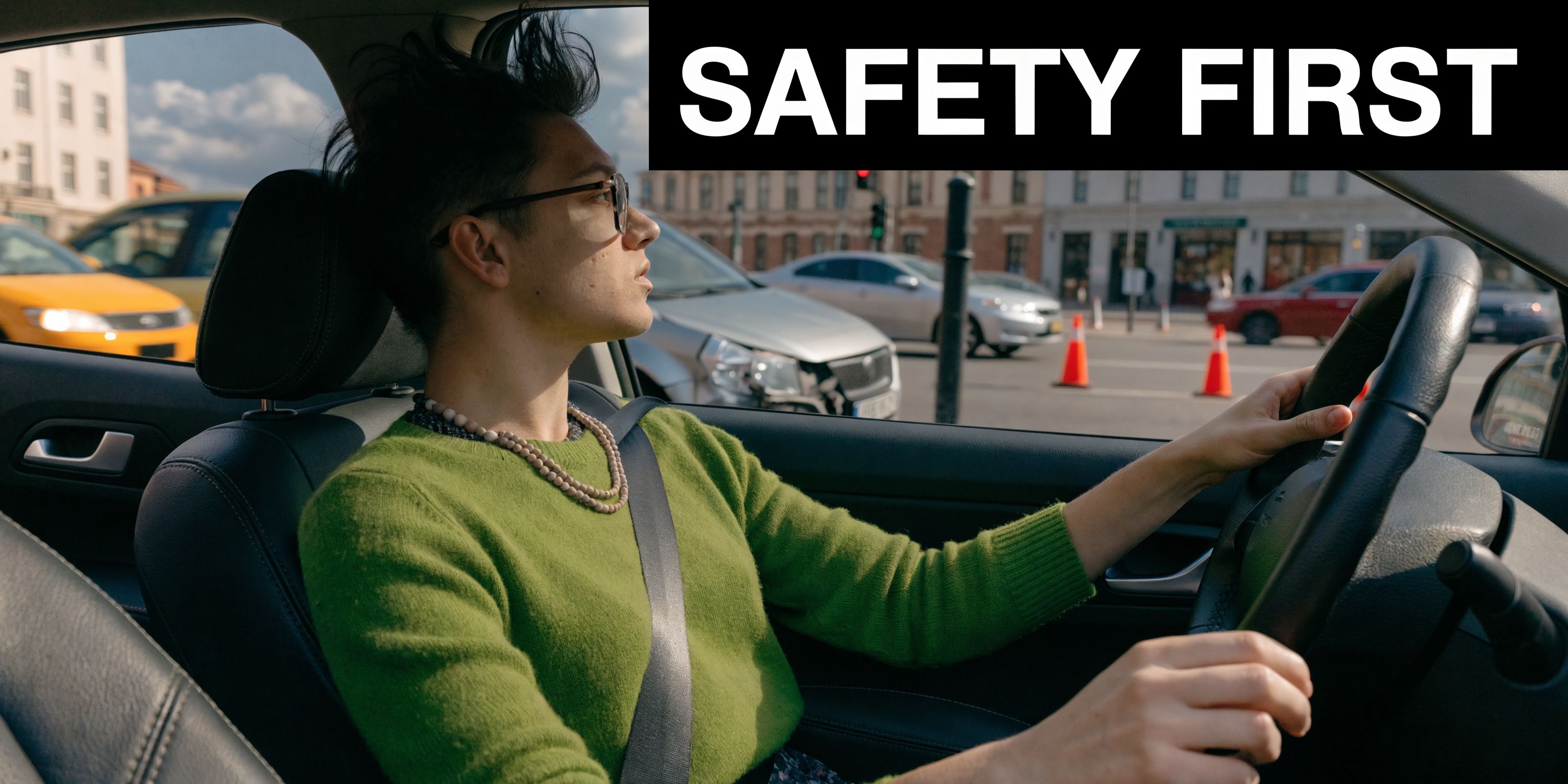
Start with danger, not blame
Check yourself and everyone in the vehicle for injuries. If anyone is hurt, call 911. If the cars are creating an immediate hazard and can be moved safely, get to the shoulder or another safer location and turn on hazard lights.
On a freeway or major corridor, staying in an active lane can create a second collision. That risk is real in LA, especially on crowded routes where drivers have little room to react.
Exchange information without arguing
Once you’re safe, get the other driver’s basic identifying information. Keep the conversation short and factual.
- Driver details: Name, phone number, driver’s license number.
- Vehicle details: License plate, make and model if needed.
- Insurance details: Carrier name and policy information.
- Witness details: Names and contact information for anyone independent who saw the crash.
Don’t argue about fault. Don’t apologize just to be polite. Don’t speculate about speed, distance, or what you “must have” done.
A calm sentence works better than a long explanation: “Let’s wait for the police and exchange information.”
Watch what gets lost in the confusion
People often focus on vehicle damage and forget the surrounding facts. In LA, those surrounding facts can become critical. Construction zones, lane markings, signal timing, bus stops, crosswalk locations, and traffic backups can all affect liability.
If you want a simple general checklist to compare against your own situation, this guide on what to do after a car accident is a useful reference.
Be careful with early statements
Police officers, tow operators, and insurance representatives all serve different roles. At the scene, your job is to report facts clearly. If you don’t know something, say so.
That includes common pressure points like:
- Speed estimates: Don’t guess.
- Injury severity: Don’t say you’re “fine” if you haven’t been evaluated.
- Cause of impact: Describe what you observed, not your theory.
- Timeline: Stick to what you remember directly.
A clean first response protects you better than a rushed one. In many la car accident cases, the earliest statements get repeated for months.
Preserving Evidence and Documenting Your Case
Once immediate danger has passed, your phone becomes one of the most useful tools you have. The quality of your evidence often depends less on fancy technology and more on whether you captured the right details before the scene changed.
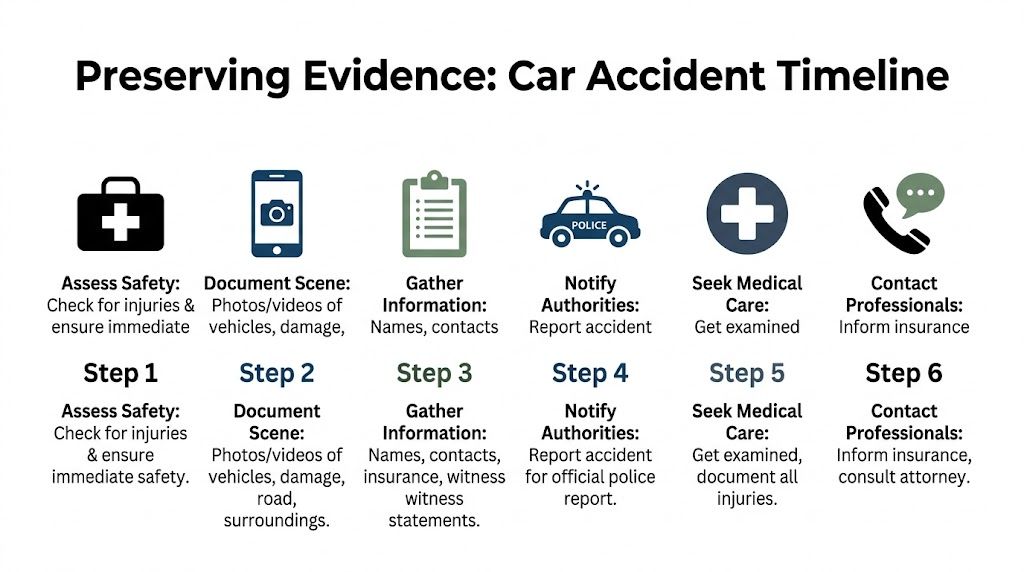
Photograph the whole scene, then the details
Start wide. Show where the vehicles ended up, the lanes, the signals, the road surface, and any visual obstruction. Then move closer and capture the damage to each vehicle from several angles.
Good scene documentation usually includes:
- Wide shots: Entire intersection, roadway, traffic control devices, nearby businesses, and approach lanes.
- Vehicle damage: Front, rear, sides, wheels, airbags, glass, and interior intrusion if visible.
- Road evidence: Skid marks, debris, gouge marks, fluid stains, and broken parts.
- Injuries: Bruising, cuts, swelling, seatbelt marks, and anything else visible over time.
Take more photos than you think you need. Memory fills in gaps badly. Photos don’t.
Make notes while your memory is fresh
A short written note on your phone can become surprisingly important later. Record the time, date, weather, direction of travel, lane position, signal phase if you know it, and what happened immediately before impact.
Include sensory details if they stand out. For example, whether you heard braking, whether the other car came from a turn lane, or whether traffic was stopped ahead. Those details can help frame the sequence of events before formal reports are available.
The best witness to your own crash is often the version of you who writes it down the same day.
Why ordinary evidence matters to experts
In serious disputes, attorneys may bring in reconstruction specialists. Their work often depends on the raw evidence preserved at the start. When that digital evidence is matched with physical scene evidence and software simulation, it can strongly shape the fault analysis.
Build a file, not a pile
A claim gets easier to manage when everything is stored in one place. That file can be digital, paper, or both. What matters is consistency.
| Item | Why it matters | Best practice |
|---|---|---|
| Photos and videos | Preserves scene conditions | Back them up the same day |
| Witness contacts | Helps confirm disputed facts | Save full names and numbers |
| Medical records | Connects injuries to the crash | Keep visit summaries and bills |
| Repair records | Shows damage and timing | Save estimates and invoices |
| Insurance letters | Tracks the claim history | Screenshot emails and voicemails |
If your vehicle may contain relevant electronic crash data, don’t rush repairs without speaking to counsel if fault is disputed. In a harder la car accident case, early preservation can make the difference between proving what happened and arguing over assumptions.
Navigating California’s Reporting and Insurance Maze
After the scene clears, many involved individuals expect things to settle down. Instead, the administrative side begins. California adds deadlines, forms, and insurance contact that can create problems if you wait too long or say too much too soon.
The reporting side
In California, some crashes trigger a separate DMV reporting obligation through an SR-1 form. That requirement is different from a police report and doesn’t disappear just because an officer responded.
The key point is simple. Don’t assume someone else handled everything.
Here is a practical reference chart for the post-crash tasks people most often miss.
| Action | Deadline | Who to Notify/File With | Notes |
|---|---|---|---|
| File SR-1 if the crash qualifies | Within 10 days | California DMV | Separate from any police report |
| Notify your own insurer | Promptly | Your insurance company | Give basic facts and open the claim |
| Preserve records and correspondence | Ongoing | Yourself and your attorney if retained | Keep all letters, emails, and claim numbers |
| Evaluate legal deadlines | As early as possible | Attorney if needed | Delay makes evidence harder to secure |
If you’re reviewing coverage questions at the same time, California’s minimum car insurance requirements are worth understanding because they often shape how much insurance is available at the outset.
The insurance side
Insurance adjusters are trained to gather information early, before the full medical picture is clear. That doesn’t mean every adjuster is acting in bad faith. It does mean their job is not the same as yours.
Your job is to protect your claim. Their job is to evaluate exposure for the carrier.
Many people weaken a strong case by:
- Giving recorded statements too early: Symptoms often evolve after the first day.
- Using minimizing language: “I’m okay” can follow you even if treatment starts later.
- Accepting fault framing: Adjusters may ask questions that build shared blame.
- Overlooking behavior evidence: Speeding, impairment, and aggressive driving matter.
That last point is important in California. Insurers and legal teams pay close attention to speeding, impaired driving, and reckless behavior, which is why witness statements and police observations can become important pieces of a liability dispute.
Keep a communication log
A plain notebook or note app works. Record the date, the company, the adjuster’s name, the phone number, and what was discussed. Save voicemails. Confirm important points by email when possible.
Important: If you don’t keep your own timeline, the insurer’s file becomes the timeline that shapes the claim.
An la car accident case often turns not only on what happened in traffic, but also on what happened in the weeks after. Organized paperwork isn’t glamorous, but it prevents avoidable damage.
When and How to Hire a Los Angeles Car Accident Attorney
People usually call an attorney at one of three moments. When the injuries are worse than expected. When the insurer starts disputing fault. Or when the calls and paperwork become too much to manage while trying to recover.
That instinct is usually sound. The more serious the collision, the less wise it is to handle everything alone.
Cases that usually need legal help
Some claims stay relatively straightforward. Many don’t.
You should seriously consider counsel if the crash involves:
- Meaningful injuries: ER care, imaging, specialist treatment, or ongoing symptoms.
- Disputed liability: Left-turn crashes, intersection conflicts, lane-change collisions, or multi-car impacts.
- Commercial involvement: Delivery vans, company cars, trucks, or rideshare vehicles.
- Pedestrians or passengers: These claims often involve multiple insurance layers.
- Language barriers: Miscommunication can damage a claim early.
California also follows comparative fault principles, which means blame can be divided. In practice, that gives insurers room to argue you were partly responsible even when the other driver clearly caused most of the harm. A lawyer’s role is often to stop that drift and force the case back toward actual evidence.
What an attorney does that clients can’t easily do alone
A good lawyer doesn’t just send letters. They structure the case.
That can include obtaining records, preserving vehicle data, reviewing scene evidence, identifying all potential defendants, and deciding whether expert involvement will help. In a tougher la car accident claim, those decisions matter early, not late.
One area people often underestimate is injury causation. Defense lawyers and insurers often argue that the crash didn’t generate enough force to cause the injuries claimed. In those cases, attorneys may use biomechanical analysis. As discussed in this article on expert witnesses in motor vehicle litigation, biomechanic experts can analyze g-forces and delta-V to determine whether the physics of the crash were sufficient to cause the specific injuries alleged, linking crash mechanics to medical records in a way that can be highly persuasive.
How to choose counsel
Not every injured person needs the same kind of representation. Ask practical questions.
| Question | Why it matters |
|---|---|
| Will I have direct attorney access? | Claims move better when communication is clear |
| Who handles insurer communication? | You want one strategy, not mixed messages |
| Do you handle disputed liability cases? | Not all firms build fault cases well |
| Can you work with Spanish-speaking clients? | Clear language protects the record |
| What happens if experts are needed? | Serious cases often require technical proof |
If you’re weighing timing, this overview of when to hire an attorney after a car accident can help frame the decision.
LA Law Group, APLC is one option for California injury matters, including car accident claims, and the firm states that it offers free initial consultations and direct attorney access. Those are practical features many injured people value because they reduce delay and cut down on confusion after a crash.
Hire counsel before the claim gets defined by the other side. It’s easier to preserve leverage than to rebuild it.
The right time to call is often earlier than people think. Not because every case must go to court, but because early legal guidance can keep a manageable claim from becoming a damaged one.
Your Next Steps Toward Recovery and Compensation
Recovery after an la car accident usually happens on two tracks at once. Your body heals on one track. Your claim moves on the other. Problems start when people focus on one and neglect the other.
Put treatment first and keep it consistent
Medical follow-through does more than help you feel better. It creates a record that ties your symptoms, limitations, and care to the crash. Gaps in treatment can create avoidable arguments, even when the injuries are real.
If you need a general patient-centered explanation of why prompt evaluation matters, Why See A Doctor After A Car Accident is a useful resource.
Some LA cases involve more than one wrongdoer
Not every crash is only about the driver who hit you. Some pedestrian and passenger injury cases involve road design, visibility issues, unsafe crossings, or dangerous arterial conditions. Emerging data discussed here shows that many pedestrian and passenger injuries occur on LA’s multi-lane arterial roads, which can raise questions about negligent infrastructure as well as driver negligence.
That matters for:
- Pedestrians hit near wide arterials
- Rideshare passengers injured on major corridors
- Crashes near poorly designed crossings or access points
- Cases where sight lines or road layout contributed to impact
The practical path forward
Claimants typically don’t need a dramatic strategy. They need a disciplined one.
Keep doing the simple things well:
- Attend treatment: Follow recommendations and report changes in symptoms.
- Save every record: Bills, referrals, imaging, prescriptions, and work notes.
- Limit case discussion: Don’t argue online or post about the crash casually.
- Get advice early: Especially if fault is disputed or the injuries are serious.
A fair result can come through settlement, and some cases need litigation. Either way, the strongest position usually comes from early documentation, careful communication, and a willingness to take the claim seriously from day one.
You don’t have to know everything right away. You do need to avoid the common mistakes that make recovery harder. If you protect your health, preserve evidence, and get informed guidance when needed, the path becomes much clearer.
If you need help after a car crash in California, LA Law Group, APLC handles personal injury matters and offers initial consultations so you can understand your options, your deadlines, and the next practical steps.
Attorney Advertising. This article is general information, not legal advice, and does not create an attorney-client relationship. Prior results do not guarantee a similar outcome.