
How Long Does Insurance Company Have to Settle Claim in California in 2026?

After a serious accident or property damage, the first question on everyone’s mind is always the same: how long does an insurance company have to settle a claim? While California has specific laws on the books, the real-world answer is almost always “it depends.” The timeline can range from a few weeks to many frustrating months, depending on how complex your claim is.
Disclaimer: This article is for informational purposes only and is not to be construed as legal advice. No attorney-client relationship exists based on the review of this this article, and none of the information provided constitutes legal advice.
Decoding California Insurance Claim Timelines

When you file an insurance claim, you’re not just sending a request and waiting for a check. You’re kicking off a legal process that’s governed by California’s Fair Claims Settlement Practices Regulations. These rules exist to make sure insurers act “promptly,” but what the law considers prompt and what you need to get your life back on track can be two very different things.
Think of the claims process less like a sprint and more like a relay race. The baton gets passed from one stage to the next—from initial report to investigation to final payment—and each leg of the race has its own timeline.
The Difference Between Law and Reality
Here’s where a lot of confusion comes in. The law gives an insurance company a 40-day window to accept or deny your claim after you’ve provided all the necessary proof of your loss. But that doesn’t mean your check will be in the mail on day 41. This is just the deadline for the insurer to make a decision, and many factors can stretch the process out much longer.
The type of claim you have is the biggest factor affecting the timeline:
- Simple Auto Property Damage: A clear-cut fender-bender where fault isn’t in dispute might wrap up in just a few weeks.
- Complex Personal Injury: If you have a claim with serious injuries, ongoing medical care, and questions about who was at fault, it can easily take many months or even over a year to resolve.
- Major Property Damage: A house fire or significant flood damage requires a ton of investigation, multiple expert opinions, and extensive paperwork. These claims naturally take longer.
To get a feel for the standard steps, you can look at a general insurance claim timeline to see how the pieces fit together. This guide will help you understand your rights and know what to expect. For a closer look at injury cases specifically, you might want to learn more about how long a personal injury case can take to settle.
Understanding Your Rights Under California Law
When you file an insurance claim in California, you’re not just at the mercy of the insurance company’s internal schedule. State law lays out a specific timeline they must follow, almost like a “shot clock” that starts the second you report your loss.
These rules, officially known as the Fair Claims Settlement Practices Regulations, were put in place to protect you. They prevent insurers from dragging their feet and leaving you in limbo indefinitely. Knowing these deadlines is the first step in taking control of your claim. It gives you a roadmap so you know what to expect and, more importantly, when a delay is just a delay versus when it’s becoming a serious problem.
Disclaimer: This article is for informational purposes only and is not to be construed as legal advice. No attorney client relationship exists based on the review of this this article and none of the information in this article is legal advice.
The Three Core Timelines You Must Know
The law breaks the whole process down into three main stages, each with its own deadline. While claims can feel messy and complicated in the real world, it really boils down to these key steps. Understanding them helps you keep tabs on your claim’s progress and know exactly how long an insurance company has to settle a claim.
These timelines cover most types of insurance claims in California, whether it’s a simple fender-bender or a more involved personal injury case.
-
Acknowledge and Get Started (15 Days): The clock starts ticking as soon as you file. The insurance company has 15 calendar days to acknowledge they received your claim, send you the required forms, explain what they need, and start their investigation.
-
Make a Decision (40 Days): After you’ve sent in all the necessary paperwork (like a “proof of loss” form), the insurer generally gets 40 calendar days to make a decision. They must either approve your claim, deny it in writing with a clear reason, or let you know they need more time.
-
Cut the Check (30 Days): Once you and the insurer agree on a settlement amount, they have 30 calendar days to mail your payment.
This simple three-part framework—acknowledge, decide, and pay—is the foundation of your rights as a policyholder in California.
What Happens When Insurers Need More Time?
Life is complicated, and so are some insurance claims. The law recognizes this and allows for some wiggle room, but it’s not a free-for-all. If an insurer needs more than the standard 40 days to make a decision, they can’t just go silent.
They are legally required to do a few things if they need an extension:
- Send you a written update every 30 days.
- Explain exactly why there’s a delay.
- List what additional information they still need from you to move forward.
This process ensures you’re never left wondering what’s going on. An insurance company has to keep communicating and justify any extra time they take, which is a critical protection for you.
For example, property damage claims after a storm or a premises injury claim often require more legwork. In fact, a global claims analysis from Aon found that the average settlement time for these is now 23.9 days—a full six days longer than in previous years. Catastrophic events, like the devastating California wildfires in 2025-2026 that displaced thousands, can swamp adjusters and push claim times even higher, with an average of 34.2 days for those complex cases. Even with the 40-day state rule, these averages show how things like fraud investigations and disputes over the extent of damage can cause chronic delays.
Why Your Insurance Claim Is Taking So Long
Even when an insurance company sticks to all the legal deadlines, you can still feel like you’re stuck waiting forever. This is where the law clashes with the frustrating reality of the claims process. Let’s walk through the common—and often perfectly legitimate—reasons your settlement might be dragging on.
Plenty of things can hit the brakes on your claim, turning what seems like a straightforward process into a lengthy ordeal. These issues can pop up at any point, from the first investigation to the final payment, and they don’t necessarily mean the insurer is acting in bad faith.
Disclaimer: This article is for informational purposes only and is not to be construed as legal advice. No attorney client relationship exists based on the review of this this article and none of the information in this article is legal advice.
Complex Investigations and Disputed Fault
One of the single biggest reasons for a slowdown is figuring out who was at fault. If you were caught in a multi-car pileup or had a slip-and-fall where the property owner is denying any responsibility, the insurance company has to launch a full-scale investigation.
This isn’t a quick look-over. Adjusters often need to:
- Interview every person involved, plus any witnesses who saw what happened.
- Dig through police reports, photos, and any available video footage.
- Bring in accident reconstruction specialists to piece together the event.
Any time liability is unclear or someone is fighting it, the timeline is going to stretch out. Insurers simply won’t cut a check until they are certain who is responsible for the damages, and establishing that can take time.
The Paperwork Mountain
An insurance claim is built on a foundation of documents. The more complicated your claim is—especially if it involves a personal injury—the more paperwork the adjuster has to sift through before they can put a fair settlement offer on the table.
Think about it from the adjuster’s perspective. For a single car accident victim, they need the police report, photos of the scene, vehicle repair estimates, and every single medical bill and treatment record. If you are still getting physical therapy, the insurer will probably wait until you’ve reached Maximum Medical Improvement (MMI)—the point where your doctor says your condition is as good as it’s going to get.
Settling a claim before MMI is a huge risk. Once you accept a settlement and close the claim, you can’t go back and ask for more money if you suddenly need another surgery down the road.
This flowchart breaks down the basic steps an insurer follows, from acknowledging your claim to deciding on it and issuing payment.
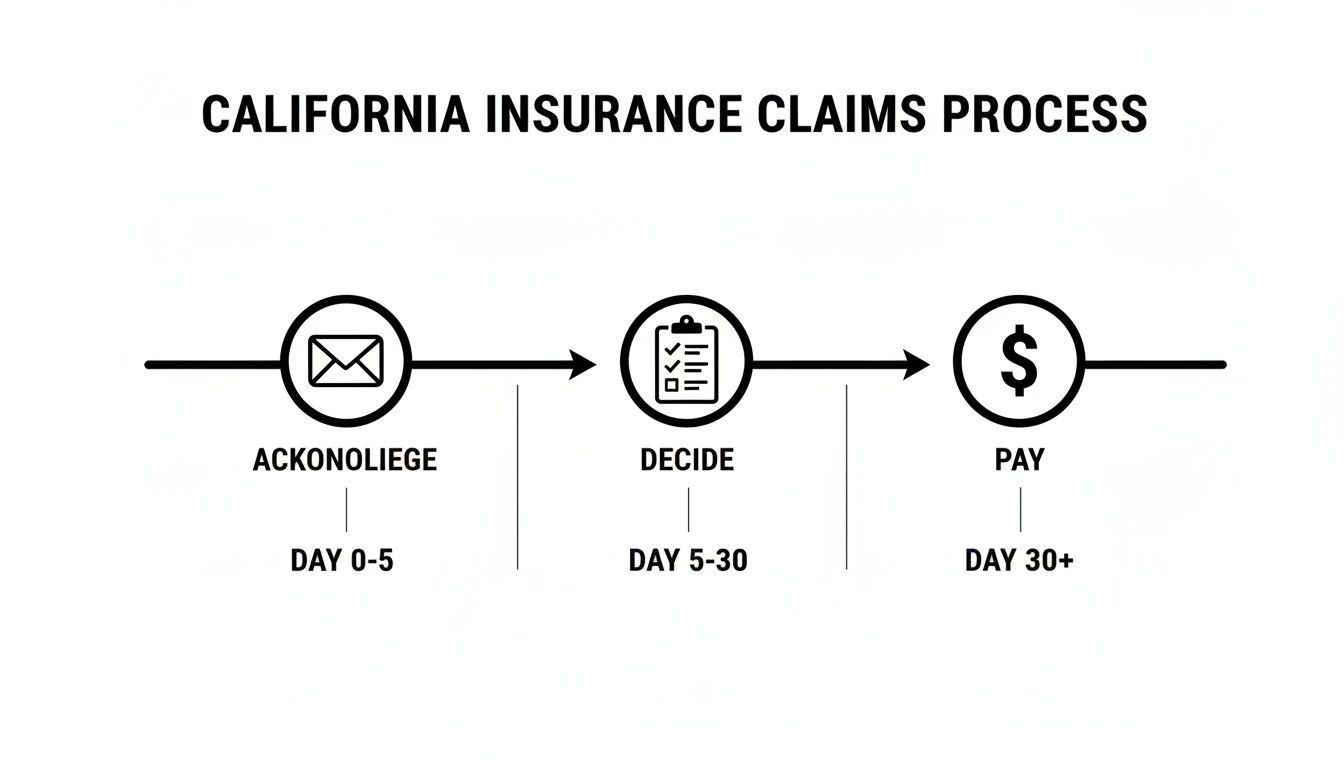
Each of these stages has its own internal processes, all adding to the total time it takes to get from filing your claim to having a check in your hand.
Factors Outside the Insurer’s Control
Sometimes, the delay has nothing to do with your insurance company and everything to do with forces they can’t control. For auto claims, these external factors have become a major headache for people all across the country.
Statistically, the average time it takes to get a car repaired after a claim is now 22.3 days, and that number is climbing. Widespread supply chain problems for auto parts, labor shortages at body shops, and the difficulty of coordinating between insurers, repair shops, and rental car agencies all contribute to the slowdown. If you’ve been injured, these delays mean medical bills and lost wages just keep piling up. You can discover more insights about claims payout statistics to see how these trends are affecting payouts.
High claim volume after a catastrophe, like a major wildfire or hurricane, also plays a massive role. When thousands of people are filing claims all at once, even the biggest insurers get swamped, and every case gets stuck in a long line. Understanding these real-world bottlenecks can help set your expectations and explain the “why” behind the agonizing wait.
When a Delay Becomes Insurance Bad Faith
There’s a world of difference between a frustratingly slow insurance claim and one that has crossed the line into insurance bad faith. An insurance company has every right to investigate your claim properly. What they don’t have the right to do is drag their feet on purpose or use sneaky tactics just to avoid paying what you’re owed. This is the critical line separating normal business from a serious legal breach.
Understanding this difference is key. A bad faith violation isn’t just bad customer service—it’s a breach of the company’s “covenant of good faith and fair dealing.” That’s a fancy term for the implied promise they make to treat you fairly. When they break that promise, you may have the right to sue for damages that go far beyond what your original policy was worth.
Disclaimer: This article is for informational purposes only and is not to be construed as legal advice. No attorney client relationship exists based on the review of this this article and none of the information in this article is legal advice.
Red Flags for Insurance Bad Faith
Insurers almost never come out and say they’re stalling on purpose, so you have to learn to spot the warning signs. Think of these as red flags—a pattern of behavior that points to your claim not being handled in good faith.
Keep a close eye out for these common tactics:
- Refusing to Communicate: The adjuster goes completely dark, ignoring your calls and emails for weeks. They are legally required to give you an update every 30 days on a delayed claim, so radio silence is a huge red flag.
- Failing to Investigate Promptly: The insurer isn’t making any real effort to look into your claim. They aren’t talking to witnesses, reviewing the evidence you sent, or taking the basic steps needed to evaluate your loss.
- Denying a Claim Without a Reason: You get a denial letter that’s vague, offers no clear explanation, or points to a policy exclusion that just doesn’t seem to fit your situation.
- Misrepresenting Your Policy: The adjuster tries to twist the language in your policy to get out of paying, hoping you won’t bother to read the fine print yourself.
When you start seeing these things happen, it’s a good bet the delays aren’t just accidental. It looks more like a deliberate plan to wear you out until you just give up or agree to a tiny fraction of your claim’s true value.
Lowball Offers and Unreasonable Demands
Two of the most common bad faith moves involve playing games with money and paperwork. An insurer might hit you with a settlement offer that’s so low it’s insulting. This is called “lowballing,” and it’s a classic tactic. They might offer $5,000 on a claim where you have $25,000 in clear medical bills, banking on your financial desperation to force you to accept.
Another frustrating tactic is drowning you in pointless paperwork. The adjuster might keep asking for the same documents you’ve already sent or suddenly demand piles of irrelevant information. This isn’t about due diligence; it’s a stalling tactic designed to create endless “reasons” for not making a decision on your claim.
If you believe your insurer is intentionally delaying or denying your claim without a valid reason, you may be able to take legal action. Learning more about suing an insurance company for bad faith can help you understand your options and the potential remedies available.
At the end of the day, insurance bad faith is what happens when a company puts its own profits ahead of its legal duty to you. Recognizing the signs is the first step in fighting back and knowing when it’s time to get a legal professional involved to protect your rights.
How to Proactively Manage Your Insurance Claim

Waiting on an insurance company can feel like a helpless, frustrating ordeal. But you have more power than you think. You can, and absolutely should, take an active role in managing your own claim.
Being organized, persistent, and strategic helps prevent those frustrating delays. More importantly, it helps you build a rock-solid case and pushes your claim toward a fair resolution. This approach shifts you from being a passive victim to your own best advocate, creating an invaluable record if you ever need to prove the insurer dragged their feet in bad faith.
Disclaimer: This article is for informational purposes only and is not to be construed as legal advice. No attorney client relationship exists based on the review of this this article and none of the information in this article is legal advice.
Create a Meticulous Claim Journal
Your first step, starting with the very first phone call, is to log every single interaction you have about your claim. This journal is the central nervous system of your case. It will become your single source of truth and your best tool for holding the insurance company accountable.
Make sure your claim journal includes:
- Date and Time of Communication: Log every single call, email, and letter.
- Name and Title: Always get the full name and title of who you spoke with (e.g., John Smith, Senior Adjuster).
- Summary of Discussion: What was said? What information did they ask for? What did they promise to do next?
- Follow-Up Actions: Note any documents you need to send or tasks you need to complete.
This simple habit keeps you organized and gives you powerful evidence if the insurer starts giving you the runaround or contradicts what they said earlier.
Respond Promptly and Always in Writing
One of the oldest excuses in the book for a delay is that the insurer is “waiting for more information” from you. Don’t give them that opening. Whenever they request a document or a piece of information, get it to them as quickly as you can.
A phone call alone isn’t good enough, though. After any conversation with an adjuster, send a brief follow-up email to confirm what was discussed. This creates a paper trail that is impossible for them to argue with later.
For example: “Dear [Adjuster’s Name], this email confirms our phone call today, [Date], at [Time]. Per our discussion, you requested my last three pay stubs to verify my lost wages claim. I have attached them to this email. Please confirm you’ve received them.” This small step shuts down any “we never got it” claims and keeps the pressure on their end. Managing your claim also means understanding the specifics of your situation, which might involve learning what you need to know about water damage and insurance claims.
Send a Formal Demand Letter
Once you have a full and complete picture of your damages—every medical bill, lost paycheck, and repair estimate—it’s time to send a formal demand letter. This isn’t just a note; it’s a professional letter that officially details your claim, presents your evidence, and states the exact settlement amount you’re demanding.
A powerful demand letter will clearly lay out:
- A Factual Summary: A brief, clear explanation of what happened.
- Liability: State exactly why their insured is responsible for your losses.
- Your Damages: Itemize all economic losses (bills, lost wages) and describe your non-economic damages (pain and suffering).
- The Demand: State the total dollar amount you require to settle the claim in full.
This letter officially puts the ball in the insurer’s court and kick-starts the real negotiation process. To help with these crucial communications, you might want to review our guide on how to deal with insurance adjusters.
Implement a System for Regular Follow-Ups
Never just sit and wait for the adjuster to call you. If a deadline they gave you comes and goes, be proactive. A polite but firm follow-up call or email demonstrates that you are taking your claim seriously and will not let it get buried on someone’s desk.
Ultimately, being organized and persistent is the best way to fight back against delays. It ensures you have a detailed record of every action taken and keeps your claim moving forward.
Knowing When You Need a Personal Injury Attorney
While you might be able to handle a minor, clear-cut claim on your own, some situations absolutely require professional legal help. Going up against a major insurance company by yourself is a bit like trying to fix a complex modern engine with only a basic wrench; you might get a few things done, but you don’t have the specialized tools or knowledge to tackle the real problem.
Hiring an experienced personal injury attorney is how you level the playing field. Their involvement signals to the insurer that stall tactics and insulting lowball offers just won’t fly.
Disclaimer: This article is for informational purposes only and is not to be construed as legal advice. No attorney client relationship exists based on the review of this this article and none of the information in this article is legal advice.
Clear Signs You Need Legal Counsel
If you run into any of the following scenarios, it’s a strong signal that you should talk to a lawyer. These are the situations where insurers tend to dig in their heels, making it almost impossible for someone without legal representation to get a fair result. This is also where the question of how long an insurance company has to settle a claim can become much more contentious.
Here are the key red flags:
- The Insurer Is Disputing Liability: The insurance company is blaming you for the accident or flat-out denying their policyholder was at fault. This is an immediate sign you’re in for a fight. A good attorney will start gathering the evidence needed to prove exactly what happened.
- You’ve Suffered Serious Injuries: Any injury that involves surgery, requires long-term therapy, or leads to a permanent impairment makes a claim significantly more complex. An attorney will work with medical and financial experts to calculate the true, long-term cost of your injuries.
- You Suspect Insurance Bad Faith: Are your calls being ignored? Is the adjuster making unreasonable demands for documents? Did you get a denial without a single valid reason? These are classic signs of bad faith, and you need an attorney to hold the insurer accountable to their legal duties.
But often, the most common trigger is getting a settlement offer that feels like a slap in the face.
When You Get a Lowball Settlement Offer
That first low offer from the adjuster isn’t a mistake; it’s a calculated business strategy. They dangle a small, quick payout in front of you, banking on the idea that your financial stress will push you to accept it and go away.
This is incredibly dangerous because that first offer almost never accounts for future medical bills, lost earning capacity, or the full extent of your pain and suffering. One of an attorney’s most critical jobs is to build a case that shows the full value of your claim—not just adding up your current bills, but projecting all your future damages.
With this proper valuation in hand, your lawyer takes over all negotiations, shielding you from the adjuster’s high-pressure tactics. If the insurance company still refuses to be fair, your attorney has the ultimate leverage: filing a lawsuit and taking them to court.
The settlement timeline also changes drastically depending on the type of claim, and delays can point to bigger problems. While a simple health insurance claim might resolve in under a week, many personal injury claims face long delays because of the complex documentation involved. In fact, a recent Accenture study found that 60% of claimants were unhappy with how long their settlements took. You can learn more about how technology is changing claim settlement times to get a better sense of these industry-wide challenges.
Frequently Asked Questions About Claim Timelines
When you’re waiting on an insurance claim, the silence can be maddening. It’s easy to get confused about the process, so here are some quick answers to the questions we hear most often from clients about claim timelines in California.
Disclaimer: This article is for informational purposes only and is not to be construed as legal advice. No attorney client relationship exists based on the review of this this article and none of the information in this article is legal advice.
Can an Insurance Company Take Longer Than 40 Days?
Yes, they can. While 40 days is the benchmark for an insurer to make a decision after you’ve handed over all the proof they need, life isn’t always that neat. They are allowed to take more time if the situation calls for it.
The key is that they can’t just leave you hanging. If an insurer needs an extension, they must tell you in writing and explain exactly why. Maybe the investigation is unusually complex, or they’re waiting on a key piece of evidence. Whatever the reason, they are required to send you written updates every 30 days until they have a decision.
What Is the Statute of Limitations for Filing a Lawsuit?
The statute of limitations is a legal stopwatch, and it’s one of the most important deadlines you’ll face. In California, you typically have:
- Two years from the date of your injury to file a personal injury lawsuit.
- Three years from the date the damage occurred to file a lawsuit for property damage.
It’s impossible to overstate how critical these deadlines are. If you miss the statute of limitations, a judge will almost certainly throw out your case. You lose your right to sue for good, no matter how strong your claim might have been.
What If the Insurer Ignores My Calls and Letters?
An insurance company going silent on you is a massive red flag. This kind of unresponsiveness can be a sign of bad faith. Your best defense is to create a paper trail. Document every single time you try to contact them—log your calls with dates and times, and send any important letters via certified mail.
If the adjuster still won’t respond, it’s time to stop waiting and start acting. You should seriously consider speaking with an attorney to make sure your rights are protected.
At LA Law Group, APLC, our team gets how frustrating it is to deal with slow-moving or unresponsive insurance companies. If you’re fighting to get a fair settlement for your personal injury claim, we’re ready to step in. Contact us for a free consultation at https://www.bizlawpro.com and let us put our experience to work for you.
Attorney Advertising. This article is general information, not legal advice, and does not create an attorney-client relationship. Prior results do not guarantee a similar outcome.