
How Much Is My Injury Case Worth?

You may be reading this with an ice pack on your shoulder, a brace on your wrist, or a stack of medical paperwork on the kitchen table. You may also be wondering how you’re supposed to pay bills while your body heals and an insurance adjuster keeps asking for “just a quick statement.”
The question almost everyone asks is simple: how much is my injury case worth?
The hard part is that the answer usually isn’t a single number you can pull from an online calculator. A personal injury case is valued through a process. Your injuries matter. Your treatment matters. Your lost income matters. The insurance available matters. The evidence matters. And the person negotiating the claim matters.
This article is for informational purposes only. It is not legal advice, and no attorney-client relationship exists based on your review of this article. None of the information here should be construed as legal advice for your specific situation.
A good valuation isn’t guesswork. It’s built piece by piece, the same way a lawyer or insurance company would evaluate a claim in California. When people feel confused, it’s often because they only see the final settlement number and not the reasoning underneath it. Once you understand that reasoning, the process gets much less mysterious.
The First Question After an Accident
Most injured people ask about value before they ask about legal procedure. That’s normal. You’re trying to make practical decisions while you’re in pain.
You may be asking questions like these:
- Medical pressure: Who pays the emergency room bill, follow-up visits, imaging, and therapy?
- Work concerns: What happens if you miss paychecks or can’t return to the same job right away?
- Insurance stress: Why did the adjuster sound friendly but still avoid talking about a real number?
- Future uncertainty: What if the injury gets worse, or the doctor says you need more treatment later?
A case value usually isn’t something that appears on day one. It develops as the facts become clearer. Early on, some of the most important parts of the claim are still unknown, including the full diagnosis, the recovery timeline, and whether the insurance company will dispute fault.
Practical rule: The value of a case becomes more reliable when the medical picture becomes more complete.
That doesn’t mean you must wait forever to get answers. It means the best estimate comes from looking at the right categories of loss and applying them to the facts of your case. If someone gives you a number too quickly, especially without reviewing records, they’re probably guessing.
A careful evaluation looks at what the injury cost you financially, how it affected your daily life, how strong the evidence is, and how much insurance is available. That’s why two people in what sounds like a similar accident can end up with very different outcomes.
The Three Pillars of Your Case Value

Every injury claim rests on three basic categories of damages. If you don’t understand these categories, settlement numbers can seem random. They aren’t.
Economic damages
Economic damages are the measurable financial losses caused by the accident. These are usually the easiest damages to document because they appear in bills, payroll records, receipts, and treatment estimates.
They often include:
- Medical bills: Emergency care, urgent care, surgery, follow-up appointments, prescriptions, physical therapy, injections, or future treatment.
- Lost wages: Income you missed while recovering.
- Reduced earning ability: If your injury limits the kind of work you can do later.
- Out-of-pocket costs: Travel to treatment, medical equipment, and other accident-related expenses.
If you want a plain-English breakdown of this category, economic damages and how they’re calculated gives a useful starting point.
California benchmarks show that injury value tends to rise with severity. Moderate car accidents average $20,000 to $30,000, while commercial truck and motorcycle crashes reach $50,000 to $150,000, with more intensive treatment often pushing value higher, according to California personal injury settlement benchmarks.
Non-economic damages
These damages cover losses that don’t come with a clean invoice. They are still real, and they often make up a large part of a claim.
Think about the part of the injury that doesn’t show up on a billing statement:
- Physical pain
- Emotional distress
- Sleep disruption
- Anxiety about driving
- Loss of enjoyment of daily life
- Limits on hobbies, parenting, exercise, or intimacy
A broken wrist isn’t just an x-ray and a cast. It might mean you can’t lift your child, type comfortably, drive without pain, or sleep through the night. Non-economic damages attempt to account for that human impact.
Insurance companies often try to treat pain and disruption as vague. Your job is to document them specifically.
That can mean keeping a recovery journal, following treatment instructions, and making sure your medical records reflect what you are experiencing.
Punitive damages
Punitive damages are different. They aren’t meant to compensate you for losses in the same way as medical bills or pain and suffering. They’re tied to especially serious misconduct.
They don’t appear in most routine injury claims. In many cases, your valuation discussion will focus mainly on economic and non-economic damages. Still, people hear the term often, so it’s important to know that punitive damages are a separate concept and aren’t part of every settlement analysis.
Why these pillars matter together
A claim isn’t valued by looking only at your bills or only at your pain. Lawyers and insurers look at the full picture.
One person may have modest medical expenses but strong evidence of prolonged disruption to daily life. Another may have substantial treatment bills but a policy limit that restricts recovery. A third may have a severe injury with long-term consequences that drives the value much higher.
That is why the worth of a case can’t be reduced to one universal chart. The pillars matter individually, but the interaction between them matters just as much.
How Insurers and Lawyers Calculate Your Settlement
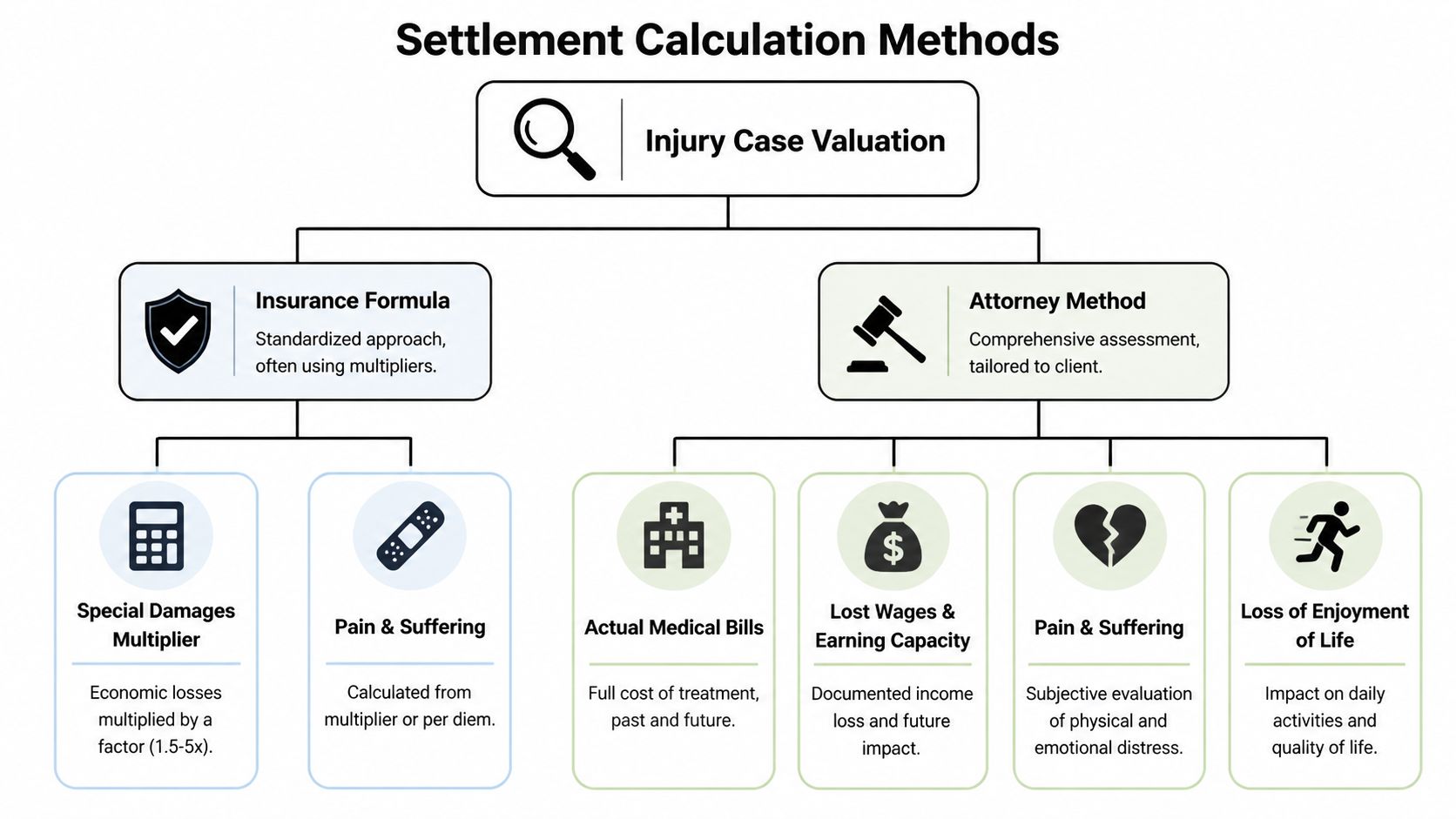
When people ask how much is my injury case worth, they’re often really asking how insurance companies and lawyers turn a stack of records into a dollar figure. In practice, two common approaches are the multiplier method and the per diem method.
The multiplier method
This is the method many people hear about first. It starts with your economic damages, then applies a factor to estimate pain and suffering.
In California, the multiplier method for pain and suffering commonly uses a factor of 1.5 to 5 applied to economic damages. A case with $50,000 in medical bills and lost wages and a 3x multiplier for moderate severity would produce $150,000 in non-economic damages, according to this discussion of California pain and suffering compensation. The same source notes that over 95% of cases settle pre-trial, which is why the quality of your medical records and negotiation strategy matters so much.
Here is the basic idea:
- Add up economic losses.
- Choose a multiplier based on severity.
- Calculate non-economic damages.
- Combine the two for a working valuation.
A lawyer may use a more detailed approach than an adjuster does, but the framework is familiar on both sides. If you want a practical overview, how to calculate a personal injury settlement can help you see how the pieces fit together.
What affects the multiplier
Not every injury gets the same multiplier. The number usually changes based on facts such as:
- Injury severity: A temporary strain is valued differently than a herniated disc or broken bone.
- Length of recovery: A short treatment period usually supports a lower multiplier than a long, difficult recovery.
- Permanent impact: Ongoing limitations, scarring, chronic pain, or future care can push valuation upward.
- Strength of documentation: Detailed records usually support a stronger demand than vague complaints with gaps in treatment.
- Consistency: If your symptoms, treatment history, and daily limitations line up, the claim is easier to defend.
Insurers don’t just ask, “Were you hurt?” They ask, “Can this be proven in records, bills, and credible testimony?”
A multiplier isn’t a reward. It’s an argument about how serious and lasting the harm is.
A simple multiplier example
Assume a person has these economic damages:
- Medical care and therapy: $50,000
- Lost wages: included in the same economic total for this example
If the facts support a 3x multiplier, the non-economic portion would be $150,000 based on the California example cited above. That would place the overall working value at the economic damages plus the non-economic calculation.
That doesn’t mean the insurer will offer that amount immediately. It means this is one way lawyers frame the case during settlement negotiations.
The per diem method
The per diem approach values pain and suffering by assigning a daily amount to the period you experienced meaningful limitations. Some lawyers use it selectively, especially when the recovery timeline is clear and the day-to-day disruption is easy to describe.
The logic is simple. If a person lived with pain, anxiety, mobility problems, or treatment demands every day for a defined period, those days have value.
This method can be useful when explaining suffering in human terms. It can be less useful when an insurer resists the chosen daily rate or disputes how long symptoms lasted. For that reason, many negotiations rely more heavily on the multiplier framework, supported by records and testimony.
Why lawyer valuation is usually broader
An adjuster often begins with formulas and internal limits. A lawyer should begin with the lived reality of the injury, then support it with evidence.
A full valuation often considers:
- Past treatment
- Future treatment
- Lost income
- Any effect on future work
- Pain and suffering
- Loss of normal daily activities
- How a jury might react if the case had to be tried
That last point matters even when a case settles. Settlement value often changes when the other side believes your lawyer is prepared to prove the case fully.
Sample Case Valuations in California
A client calls after a crash and asks a fair question: “Can you give me a ballpark number?”
You usually can, but only the way a contractor can give a preliminary estimate before opening the wall. The injury may sound straightforward at first. Then the records, time away from work, future treatment needs, and insurance limits show what the case is ultimately worth in California.
Examples are useful because they turn an abstract formula into something you can test against real facts. These are illustrations, not guarantees. They show how the same type of injury can land in very different ranges depending on proof, recovery time, and who is paying.
Example one with a moderate rear-end crash
A driver is stopped at a red light and gets hit from behind. In the first week, the symptoms look familiar: neck pain, back pain, headaches, stiffness, trouble sleeping. The person goes to urgent care, follows up with a doctor, completes physical therapy, and misses several days of work.
A California adjuster and a California injury lawyer will both ask whether the story is supported from start to finish. Was fault clear? Did the person get care promptly? Do the records describe limits that make sense, such as difficulty driving, lifting, working, or concentrating?
If the treatment is short, the medical bills are modest, and the person improves steadily, this is often a lower-to-mid five-figure discussion. If the symptoms last longer, imaging shows a more significant injury, or the person needs injections or specialist care, the same rear-end crash can move much higher. The label “rear-end case” does not set the value. The documented effect on the person does.
Example two with a rideshare passenger injury
Now use a different scenario. A passenger in an Uber or Lyft is hurt in a crash and is later diagnosed with a concussion or a herniated disc. The passenger did nothing to cause the collision, but the recovery is longer and more disruptive than expected. Work becomes harder. Follow-up care grows. The file gets more expensive and more serious.
Rideshare claims often have a different ceiling because of the insurance structure. While a passenger is in the vehicle, Uber and Lyft generally provide up to $1 million in third-party liability coverage, as described on the Uber insurance coverage page. That does not guarantee a large settlement. It does mean there may be enough coverage to pay a stronger claim if the injuries and evidence support it.
In practice, a California rideshare passenger claim involving a concussion or herniated disc may settle in the mid-five figures or into the six figures when treatment is substantial and the records are consistent. A severe rideshare injury with surgery, lasting impairment, or major wage loss can rise well beyond that.
Coverage changes the conversation. A serious case with a low policy can be capped early. A serious rideshare case may have room to be valued more fully because the available insurance is often higher.
Case value is not just about harm. It is also about collectability. Insurance limits can raise or lower the amount a claim can realistically produce.
Example three with a premises injury
A shopper slips on a wet floor in a California store, falls hard, and suffers a concussion with ongoing headaches, dizziness, and trouble focusing. Medical treatment may be real and substantial, but the key fight is often different from an auto case. The property owner may argue the hazard appeared only moments earlier or that the injured person should have seen it.
That is why two slip-and-fall cases with similar medical records can end very differently. If video, incident reports, employee statements, or maintenance logs show the store had notice of the hazard, settlement value usually improves. If liability is murky, the defense has more room to discount the claim even when the symptoms are genuine.
Sample California Injury Case Value Ranges
| Accident Type | Typical Valuation Drivers | Estimated Total Value Range |
|---|---|---|
| Moderate rear-end collision | Clear fault, short-to-moderate treatment, documented wage loss, steady recovery | Often in the lower-to-mid five figures, with higher ranges possible if treatment intensifies or symptoms persist |
| Rideshare passenger crash with concussion or herniated disc | Strong coverage, specialist care, imaging, work disruption, consistent symptom reporting | Often in the mid-five figures to six figures, depending on treatment and impact |
| Severe rideshare passenger injury | Surgery, future care, permanent impairment, major lost earnings, high available coverage | Can reach very high six figures or more in the right case |
| Slip and fall with concussion | Proof of notice, incident reporting, video or witness support, duration of cognitive symptoms | Varies widely. Liability proof often changes the range as much as the injury itself |
The black box part of valuation becomes easier to understand once you see what lawyers are really comparing. They are not comparing diagnosis labels alone. They are comparing the full story: how the injury changed daily life, how well that change is documented, what insurance is available, and how much pressure the defense will feel if the case is prepared for trial.
That is why two people can both say, “I had a concussion,” and still have very different outcomes in California. One has a short recovery and thin records. The other has months of treatment, missed income, clear medical support, and an insurance policy that can fund a fair result.
Critical Factors That Increase or Decrease Your Case Value

Once the math starts to make sense, the next surprise for many clients is this: the math doesn’t control everything. Several outside factors can push a case up or drag it down.
Evidence quality changes the outcome
Strong evidence gives your claim structure. Weak evidence gives the insurer room to minimize it.
The most persuasive files usually include:
- Medical records that track the injury clearly
- Bills and wage proof that are organized
- Photos of injuries or the accident scene
- Witness information
- Reports that help establish fault
- Consistent statements from the injured person
Gaps in treatment are especially damaging. Insurers often argue that if you missed appointments or delayed care, your injury must not have been serious. Sometimes there are valid reasons for those gaps, but they still need to be explained.
Insurance limits can cap a claim
A serious injury doesn’t automatically produce a high recovery if the available insurance is limited. This is one of the most frustrating parts of injury law because the harm may be severe, but the collectible amount may still be restricted.
Rideshare cases show this clearly. In California, an accident while a passenger is in the car falls under a $1 million liability policy, but if the driver is logged into the app and waiting for a ride request, coverage drops to $50,000 per person, $100,000 per accident, and $30,000 property damage, according to this discussion of rideshare insurance value tiers.
That app status issue confuses many people. They assume “Uber was involved” or “Lyft was involved” means the same policy applies in every crash. It doesn’t.
Fault disputes reduce leverage
Even a legitimate injury claim becomes harder to resolve well when the defense argues you caused part of the incident or exaggerated the consequences. In California, disputes about fault can directly reduce negotiating power because they change how risk is evaluated.
That is why details matter. A witness who saw the crash. A photo taken right after a fall. A timeline showing prompt treatment. These are often the pieces that separate a strong demand from a discounted one.
The same injury is worth more in a case with clear liability than in a case where fault is murky.
The lawyer’s role affects value
People sometimes assume the case value exists independently of the lawyer. In reality, advocacy can affect outcome in very practical ways.
A lawyer can strengthen the case by:
- Framing the medical evidence clearly
- Connecting symptoms to treatment
- Presenting future damages in a credible way
- Responding to low offers with proof, not outrage
- Preparing the file as if it may need to be litigated
That doesn’t mean every case becomes a courtroom battle. It means settlement negotiations improve when the insurer believes the claim has been built carefully and can be proved.
A lawyer’s job isn’t to inflate numbers. It’s to prevent the case from being undervalued through missing evidence, rushed timing, or poor presentation.
Understanding Your Net Recovery and Attorney Fees

A gross settlement number and the amount you ultimately receive are not always the same. Clients deserve a clear explanation of that difference.
Gross value versus net recovery
Gross settlement means the total amount paid to resolve the claim.
Net recovery means what you receive after deductions that may apply, such as attorney fees, case costs, and medical or other valid liens if they exist. The exact breakdown depends on the fee agreement and the facts of the case.
Most personal injury lawyers work on a contingency fee. That means the attorney fee is tied to the outcome of the case rather than billed by the hour. If you want a simple explanation of the structure, contingency fees and how personal injury lawyers get paid walks through the model.
Attorney fees and case costs are different
Clients often combine these two categories, but they aren’t the same.
- Attorney fees are the lawyer’s compensation under the fee agreement.
- Case costs are expenses that may be incurred to move the claim forward, such as records, filing-related expenses, investigation work, or expert support if needed.
Ask for the fee agreement in writing. Ask how costs are handled. Ask whether costs are advanced and how they are repaid. Those questions are not awkward. They’re smart.
Why representation can still change the outcome
People naturally focus on what gets deducted. They should also focus on whether the case was undervalued without representation.
High-value California rideshare outcomes show how much case development can matter. Recent examples include a $9.5 million award for a bicyclist hit by a Lyft driver and a $7 million payout to a family after a fatal rideshare crash, with those results tied to proof of catastrophic damages and expert testimony, according to California rideshare settlement examples.
Those are severe cases, not ordinary ones. But they illustrate an important point. Case value is affected by how damages are proved and how the evidence is presented.
If you’re comparing options, some firms and attorneys offer free case reviews to estimate potential value and explain fee structure before representation begins. LA Law Group, APLC is one example of a California firm that offers that kind of initial evaluation.
Questions to ask before signing
A short list can save a lot of confusion later:
- How will fees be calculated under the agreement?
- What case costs might come up?
- How often will I get updates?
- Who will handle my file?
- How will medical records and billing be gathered?
A good fee conversation should leave you calmer, not more confused.
Your Next Steps Toward a Fair Settlement
If you’ve made it this far, you already know more than many initially understand when they first ask how much is my injury case worth. A claim isn’t just a bill total with a random bonus attached. It’s built from your financial losses, your pain and daily disruption, the available insurance, the strength of your evidence, and the quality of the negotiation.
That also means you don’t have to guess your way through it.
Start by preserving the basics. Keep your records. Follow through with treatment. Save proof of missed work. Write down how the injury affects your daily routine while it’s still fresh. If the crash involved a rideshare vehicle, make sure the app status and trip details are identified early because that can affect coverage in a major way.
Then get a case-specific review from a lawyer who handles California injury claims. A real evaluation should consider your diagnosis, treatment path, wage loss, liability proof, and insurance coverage before anyone talks seriously about value.
The right next step is usually a consultation, not a calculator.
Frequently Asked Questions About Injury Case Worth
A client often asks these questions after the first shock wears off. One day they are arranging car repairs and medical visits. The next day an adjuster is asking for a statement and hinting at a quick payment. That is usually when the primary concern surfaces: how long will this take, what could reduce the case value, and how much of any settlement do I keep?
How long will it take to get my settlement
The timeline depends on how clear the medical and insurance picture is. A straightforward claim can move faster when fault is obvious, treatment is mostly complete, and the insurer has enough records to value the case. A harder claim takes longer when doctors are still deciding whether you will need future care, when there are gaps in treatment, or when the insurer is disputing fault or arguing that your symptoms are unrelated.
Timing affects value in a very direct way. Settling before your doctors understand the full injury is a little like pricing a house before the inspection is finished. You may be agreeing to a number before anyone knows the true cost of repairs.
Will I have to go to court
Usually not. Many California injury claims settle without a trial.
Still, the possibility of filing a lawsuit matters because it changes the negotiation. Insurance companies do not just look at your bills. They also assess how persuasive you would be in litigation, how credible your witnesses are, and whether your lawyer is prepared to prove damages if negotiations fail.
A person who wants dependable injury claim assistance should look for guidance that explains both tracks clearly, settlement and litigation, and when each one makes financial sense.
What if the person who hit me has no insurance
Your case may still have value, but the answer depends on where coverage can be found. In California, that can include your own uninsured or underinsured motorist coverage, a household policy in some situations, an employer policy if the driver was working, or a commercial policy tied to a rideshare or delivery company.
Rideshare cases need special attention because coverage changes based on what the driver was doing in the app at the time of the crash. California lawmakers have also changed some rideshare insurance rules. For example, the California Legislative Information page for SB 371 is a useful starting point if your case involves a passenger injury and uninsured motorist issues. A lawyer should trace every possible policy before deciding the case is limited.
Does a previous injury affect my case value
It can affect value, but it does not erase your claim. The legal question is usually whether the accident caused a new injury or made an old condition worse.
A simple example helps. If you had occasional back pain before the crash but needed regular treatment only after the crash, that change matters. Good records can show the difference between your baseline condition and the symptoms the accident triggered. Insurers often try to blur that line because it lowers what they want to pay.
Should I accept the first insurance offer
Early offers are often based on incomplete information. The insurer may not have all of your records yet, may be testing whether you know the value of pain and suffering, or may be trying to close the file before future treatment becomes clear.
Once you sign a release, the case is usually over. If complications show up later, you generally cannot reopen the claim just because the first number was too low.
How much of the settlement do I actually keep
The settlement amount and your take-home amount are not the same. Your net recovery is what remains after attorney fees, case costs, medical liens, and unpaid bills are resolved.
That is why two cases with the same gross settlement can produce very different results for the client. A good evaluation looks at the whole picture, not just the headline number.
If you were injured in California and want a clearer answer about what your claim may be worth, LA Law Group, APLC offers a free consultation so you can discuss the facts of your case, your treatment, and your options. This article is for informational purposes only, is not legal advice, and does not create an attorney-client relationship.
Attorney Advertising. This article is general information, not legal advice, and does not create an attorney-client relationship. Prior results do not guarantee a similar outcome.