
Reporting an Accident to the Police: A CA Guide

You’re standing next to a damaged car on a California street. Your hands are shaking a little. The other driver is talking fast. Someone nearby is telling you to “just exchange insurance and move on.” You may be worried about pain in your neck, your job, your deductible, or whether calling the police will make everything harder.
This is the moment when small decisions start affecting a claim in a very real way.
Reporting an accident to the police isn’t just paperwork. It helps create a record of what happened, when it happened, who was involved, and whether anyone appeared injured at the scene. In California, that record can matter for insurance, for the DMV, and for any later personal injury claim. Just as important, there are times when police won’t come out to a minor crash, and many drivers don’t know what to do next.
This article is for informational purposes only. It is not legal advice, and reviewing it does not create an attorney-client relationship.
Navigating the First Moments After a California Car Accident
A lot of people think the biggest problem after a crash is damage to the car. Usually, that’s not the hard part. The hard part is that the first few minutes are chaotic, and people make decisions while they’re in shock.
One driver says, “Nobody looks hurt, let’s not involve the police.” Another says, “I’ll pay for it privately.” A third starts apologizing before anyone really knows what happened. Those reactions are common. They also create problems.
The better approach is simple. Slow the situation down and get organized.
Why order matters
The first phase after a collision affects three things at once:
- Your safety
- Your legal reporting obligations
- The quality of the evidence available later
If you handle those in the right order, you protect yourself. If you skip them, you may spend months trying to prove facts that could have been documented in minutes.
A police report is not the same thing as a DMV filing. An insurance claim is not the same thing as either of those. California drivers often learn that too late. They assume that if an officer came to the scene, everything has been “reported.” That’s not always true.
Practical rule: Treat every crash as if you may need to explain it later to an insurance adjuster, a doctor, and a lawyer. That mindset usually leads to better decisions at the scene.
The goal is a clean record, not a dramatic scene
Most strong claims don’t begin with an argument. They begin with a calm, thorough record.
That means getting medical help when needed, notifying law enforcement when required, collecting names and insurance information, preserving photos, and making sure the DMV reporting requirement doesn’t slip through the cracks. It also means understanding a hard truth. Even a “minor” collision can become a serious dispute once injuries appear later or the other driver changes their story.
When clients call after a difficult claim, the same pattern shows up again and again. The facts weren’t necessarily bad. The documentation was.
Your Immediate Actions at the Accident Scene
The first half hour matters more than people realize. If you focus on the right tasks, you reduce confusion and preserve evidence while it’s still fresh.
Start with safety
Check yourself first. Then check passengers, pedestrians, and anyone in the other vehicle. If anyone appears seriously hurt, call 911.
If the vehicles can be moved safely and they’re blocking traffic, move them out of an active lane if possible. Turn on hazard lights. If the cars can’t be moved, stay alert to traffic and avoid standing where you could be struck by another vehicle.
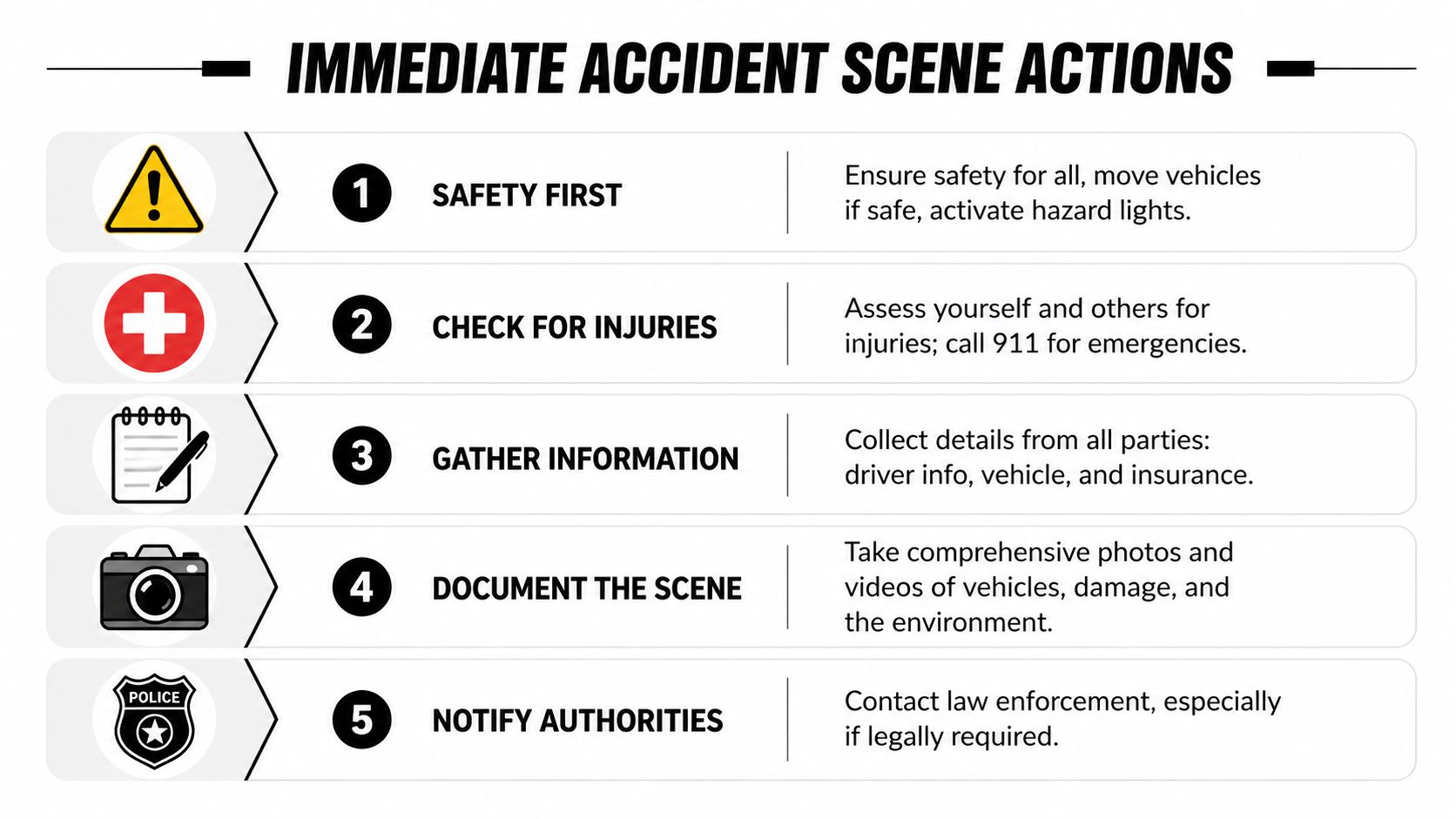
Some people hesitate to call because they don’t want to “make it a big deal.” That’s a mistake when there’s an injury, a fatality, a hit-and-run, an intoxicated driver, or confusion about what happened. Reporting rates for accidents average 57.5% to 59.9%, but that drops to 33.0% for cyclists. Common reasons for not reporting include hit-and-run situations (32.4%), believing a report isn’t needed (31.8%), or trying to settle privately (20.4%). Critically, 10.8% of unreported accident cases result in hospitalization, according to analysis on police reporting after car accidents.
Know when to call 911 and when to use a non-emergency line
Use 911 if:
- Someone may be injured: Even if symptoms seem mild, let dispatch decide the response level.
- There’s a fatality or immediate danger: Fire, leaking fuel, blocked traffic, or an impaired driver all justify emergency contact.
- The other driver leaves or becomes aggressive: A hit-and-run or unsafe confrontation should be documented immediately.
Use a non-emergency law enforcement line if there’s no urgent medical need and the scene is stable, but you still need guidance about reporting.
If you’re unsure whether it’s an emergency, call. Dispatch can downgrade a call. You can’t recreate missed evidence after everyone leaves.
A simple script helps
People freeze on calls because they think they need to sound polished. You don’t.
Use something like this:
“I’ve been in a car accident at [location]. There are [possible/no obvious] injuries. [Number] vehicles are involved. Traffic is [blocked/not blocked]. I need police and, if necessary, medical assistance.”
That gives dispatch the essentials fast.
What to collect before anyone leaves
Do not rely on memory. Do not assume the insurance companies will sort it out. Gather basic facts yourself.
- Driver identity: Full name, phone number, address, and driver’s license details.
- Insurance details: Carrier name, policy number, and the name of the insured if different from the driver.
- Vehicle information: License plate, make, model, color, and VIN if you can access it safely.
- Passengers and witnesses: Names and contact information. Independent witnesses can become very important later.
- Scene details: Exact location, direction of travel, traffic controls, weather, lighting, and road conditions.
Build your own evidence file
Use your phone methodically. Don’t just take two photos of the bumper.
Take:
- Wide shots showing the whole scene and vehicle positions
- Close-ups of all visible damage
- Roadway images showing lanes, signals, skid marks, debris, and signage
- Interior details if airbags deployed or there’s visible cabin impact
- Visible injuries if appropriate and safe to document
Video can help too. Slowly walk the scene and narrate location, vehicle positions, and anything notable such as obstructed views or damaged traffic controls.
What works and what doesn’t
A few habits consistently help. A few consistently hurt.
| Approach | What usually happens |
|---|---|
| Calmly document the scene | You preserve facts before stories change |
| Exchange full information | Insurance claims move with fewer identity disputes |
| Photograph everything | Later damage disputes become easier to address |
| Rely on a verbal promise to pay | The promise often disappears once repair or medical costs rise |
| Say you’re “fine” too early | That statement may be used against you if symptoms appear later |
One more rule at the scene
Don’t argue about fault.
You can be polite without debating who caused the collision. The roadside is not where liability gets sorted out. It’s where records get created.
Interacting With Law Enforcement at the Scene
When an officer arrives, many drivers start talking too much. They fill silence, guess about speed, estimate distances they didn’t observe, or apologize reflexively. That instinct is understandable. It’s also risky.
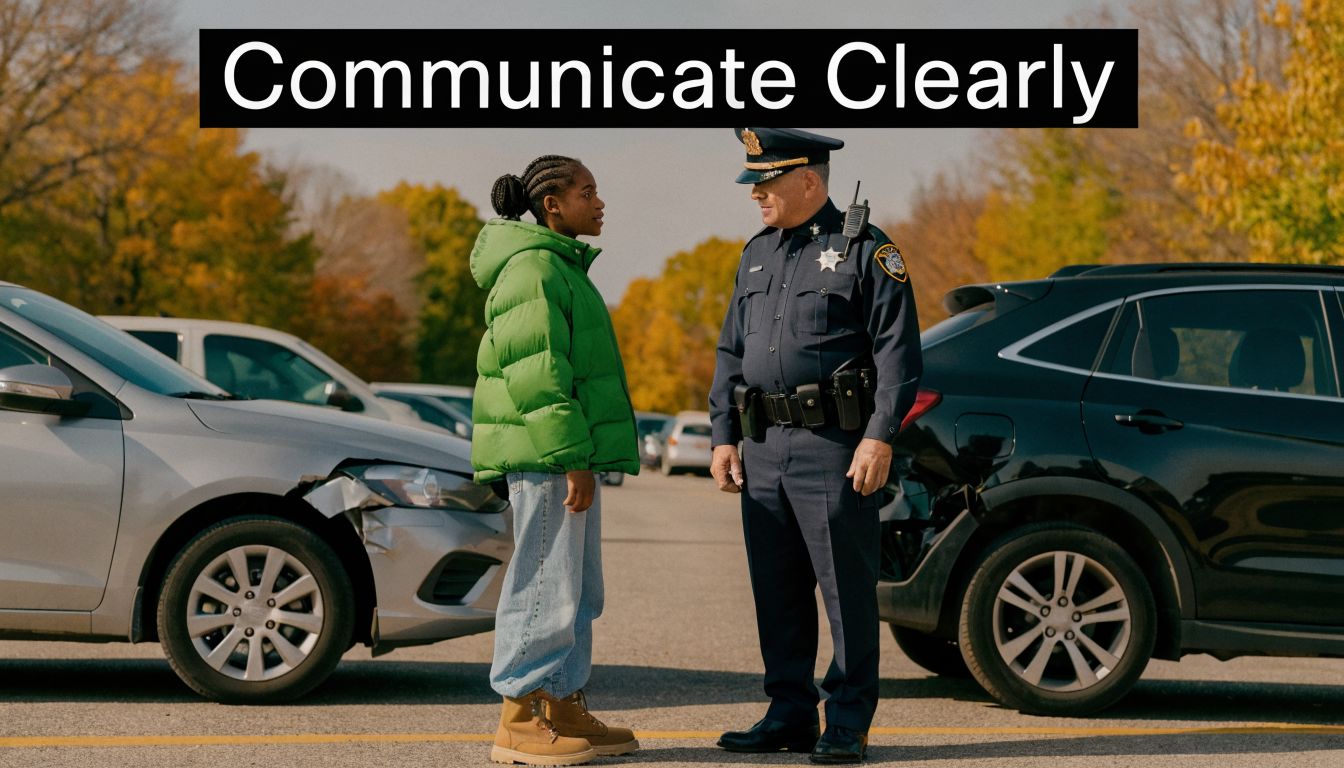
Stick to facts, not conclusions
The best communication strategy is usually the simplest one. Tell the officer what you observed, in order, without trying to label fault.
Good examples:
- I was traveling eastbound in the right lane.
- The light was green when I entered the intersection.
- I felt an impact on the driver’s side.
- My shoulder and neck started hurting afterward.
Risky examples:
- I must have been in their blind spot.
- I think I was going around the speed limit.
- I’m sorry, I probably could have reacted faster.
That last category causes trouble because it mixes courtesy with speculation. Officers are taking notes. Insurers will review those records. A casual comment can be interpreted as an admission even when you didn’t intend it that way.
Give a clear timeline. Leave out guesses.
Ask for the details you’ll need later
Before the interaction ends, try to get:
- The officer’s name
- Badge number
- Agency name
- Incident or report number
- Instructions for obtaining the completed report
If you’re physically uncomfortable, put this in your phone or ask a passenger to handle it. Small details get lost quickly once tow trucks arrive and everyone separates.
If police don’t come out
This is more common than people expect, especially in lower-impact crashes. A lot of online advice assumes police will always respond. However, this may not occur.
One study found 30% of minor crashes go unreported, correlating with 15% lower insurance payouts for those claims. When police are unavailable, self-documentation becomes critical, including extensive photos, witness information, and efforts to locate surveillance footage, according to guidance on documenting a crash when police don’t show up.
Build the record yourself
If dispatch tells you no officer is coming, act like you’re creating the file an adjuster will read later.
Look for:
- Nearby businesses: Gas stations, markets, parking structures, and storefronts often have cameras.
- Homes or apartment buildings: Doorbell cameras and exterior systems can capture street activity.
- Transit or commercial vehicles: Buses, delivery vans, and rideshare vehicles may have recording systems.
- Witnesses leaving the area: Ask for names and numbers before they disappear.
A short, respectful request can work: “We were just in a collision. Did your camera face the street?” If the answer is yes, note the business name and speak with a manager as soon as possible.
This short walkthrough is useful if you want a visual explanation of what to do next:
Don’t let the absence of an officer end the reporting process
A non-response does not mean the incident disappears. It means you have to be more disciplined. Save photos in a dedicated folder. Screenshot call logs. Write down the time you contacted law enforcement. Keep notes about what dispatch told you.
That kind of organized record often makes the difference between a disputed claim and a coherent one.
How to File Official Accident Reports in California
California has a dual-reporting system, which often trips up many drivers. They think one report covers everything. It doesn’t.
A police report and the DMV’s SR-1 form serve different purposes. You may need one, or both.
The police report requirement
Under CVC § 20008, drivers must report an accident to the California Highway Patrol or local police within 24 hours if the crash results in injury or death. Separately, CVC § 16000 requires a report to the DMV using the SR-1 form within 10 days if the accident caused injury, death, or property damage exceeding $1,000. Failure to file the SR-1 can result in license suspension, as summarized in this California accident reporting overview.
That means an officer coming to the scene does not automatically satisfy the DMV requirement.
The SR-1 is separate
The SR-1 is the DMV’s accident reporting form. It’s not the same as the police officer’s traffic collision report, and insurance companies don’t file it for you as a substitute.
You can review the firm’s more detailed guide on filing an SR-1 form with the DMV after a California accident if you want a closer look at the filing process and common mistakes.
When you should think “SR-1”
Ask yourself these questions:
- Was anyone injured?
- Did anyone die?
- Does the property damage appear to exceed $1,000?
If the answer to any of those is yes, treat the SR-1 as part of your immediate post-accident checklist.
What the SR-1 asks for
The DMV form generally captures identifying and insurance information along with core crash details. Before you sit down to complete it, gather:
- Date, time, and location of the crash
- Driver information for everyone involved
- Vehicle ownership information
- Insurance details
- Whether anyone was injured or killed
- A basic description of the accident
If you’re missing some details, don’t guess. Use the best verified information you have, then correct errors promptly if needed.
Important distinction: The police report creates one official record. The SR-1 creates another. Don’t assume one replaces the other.
Practical filing sequence
Many people do better with a simple order of operations:
- Get medical attention if needed
- Notify police or CHP if the crash involved injury or death
- Open your insurance claim
- Complete and submit the SR-1 within the 10-day deadline
- Request and preserve copies of everything
Create a folder, physical or digital, with your claim number, photos, tow receipt, repair estimate, and all reporting paperwork. Claims often become harder because documents are scattered across texts, emails, glove compartments, and camera rolls.
Why vehicle records can matter too
If damage severity or prior condition becomes an issue, it sometimes helps to compare what the vehicle looked like before and after the collision. In those cases, a VekTracer accident history report can be a useful background resource when you’re trying to understand prior accident history tied to a vehicle identification number.
That kind of information won’t replace your reporting duties, but it can help clarify later disputes about whether damage was pre-existing.
Avoid these filing errors
The most common problems are usually procedural, not dramatic:
- Missing the deadline: People wait because they’re focused on repairs or medical appointments.
- Assuming a body shop or insurer handled it: They usually didn’t.
- Leaving out insurance information: Incomplete forms create follow-up problems.
- Using vague descriptions: Keep it factual and direct.
- Failing to save a copy: You should always keep proof of what you submitted.
A short comparison helps
| Record | Who receives it | When it matters most |
|---|---|---|
| Police or CHP report | Law enforcement | Initial official documentation and insurance review |
| DMV SR-1 | California DMV | License compliance and accident reporting obligations |
| Insurance claim file | Your insurer or the other driver’s insurer | Property damage and injury compensation process |
If you remember only one thing here, remember this. Reporting an accident to the police is not the end of your California reporting duties.
Common Reporting Mistakes and Their Legal Consequences
The most expensive reporting mistakes usually don’t look serious at first. They sound reasonable in the moment. They only become costly later.

Mistake one: making a private deal
Drivers often say they’ll “handle it without insurance.” Sometimes they mean it. Sometimes they disappear once the repair estimate arrives or once you start medical treatment.
Private side deals also tend to leave no reliable paper trail. If the other driver later denies fault, you may be stuck rebuilding the event from fragments.
Mistake two: minimizing injuries
A lot of injured people are trying to be agreeable at the scene. They tell the officer or the other driver they’re okay because they want to go home. Then pain sets in later.
That doesn’t mean they’re dishonest. It means adrenaline can mask symptoms. But insurers often point to early statements to argue the injury wasn’t serious or wasn’t caused by the crash.
Mistake three: believing the police report alone wins the case
This is one of the biggest misunderstandings in California personal injury work.
Under California Vehicle Code 20013, accident reports are generally treated as hearsay and are not admissible as evidence in a civil trial. Judges consistently uphold that rule. So while the report is important for insurance purposes and creates an official record, a personal injury case can’t rely on the report alone to prove fault. Admissible evidence usually has to come from witnesses, photographs, and expert analysis, as explained in these California crash data and reporting materials.
The report matters. It just isn’t the whole case.
Mistake four: missing required reporting deadlines
Missing a reporting deadline can create avoidable legal and insurance trouble. If you want a plain-language discussion of that risk, this guide on failure to report an accident is a useful starting point.
The practical consequence is simple. A missed filing gives the other side one more argument to use against you, even when liability should have been straightforward.
What actually strengthens a claim
The strongest claims usually have multiple layers of admissible proof.
- Medical records: They connect symptoms to timing and treatment.
- Photographs and video: They show damage, vehicle position, and scene conditions.
- Witness testimony: Neutral witnesses often carry weight.
- Repair and towing records: These help anchor the force and aftermath of the crash.
- Consistent reporting: Police, DMV, insurer, and medical histories should not contradict each other.
If there’s one theme running through these mistakes, it’s this. Reporting starts the record. It doesn’t finish the proof.
Your Next Steps After Reporting the Accident
Once the reporting is done, your focus should shift from the scene to the claim. That starts with your health.
Get a medical evaluation if you have pain, dizziness, headaches, numbness, stiffness, or any symptom that feels new after the collision. Many injuries don’t announce themselves immediately. Early medical records also help document timing, which matters later when insurers review causation.
Build a recovery file
Keep everything together:
- Medical visit summaries
- Prescriptions and treatment recommendations
- Work notes and missed-time records
- Repair estimates and rental receipts
- All claim correspondence
If your vehicle damage involves a truck, photos and repair records become even more important because part quality can become a later issue. For owners comparing replacement options, information about durable truck body components can help you understand what may affect repair decisions and value discussions.
Legal strategy starts early
A detailed report is only the first move. The more effective approach is to identify all contributing factors, preserve evidence, and evaluate what additional proof will be needed if liability is disputed. That is consistent with the broader point made in this accident reporting and corrective action framework, which emphasizes that reporting should be followed by deeper analysis and evidence preservation.
If you want a practical explanation of why the report itself matters so much to the insurance side of a case, this guide on why filing a police report after an auto accident is crucial for your claim is worth reviewing.
This is also the point where legal counsel can reduce your workload. A lawyer can help obtain the completed report, preserve evidence before it disappears, manage insurer communications, and evaluate the claim’s value based on medical treatment, lost income, and liability issues. LA Law Group, APLC handles those steps as part of its California personal injury practice.
Act promptly. Evidence rarely gets better with time.
Frequently Asked Questions about Accident Reporting
What if I think the other driver gave me false information
Report what you know and preserve what you can verify. Photograph the driver, vehicle, license plate, insurance card, and driver’s license if possible. Tell your insurer exactly why you believe the information may be false, and include that concern in any law enforcement follow-up.
What if the crash happened on private property
A parking lot collision can still trigger reporting obligations. The location doesn’t automatically eliminate the need for documentation. If the crash involves injury, death, or enough property damage to trigger the DMV requirement discussed above, treat it seriously and document it thoroughly.
I was a passenger in an Uber or Lyft. What should I do
Make sure a report is created if possible, collect the rideshare trip details, screenshot the app information, and get the identities of all involved drivers. Passengers often have strong injury claims because they usually aren’t the at-fault party, but they still need proof of how the incident occurred and who was involved.
Do I need the final police report before I get medical care
No. Don’t wait on paperwork if you’re hurt. Medical evaluation comes first. Reporting and claim documentation can continue afterward.
If you were injured in a collision and you’re unsure whether the accident was reported properly, contact LA Law Group, APLC for a free, no-obligation consultation. The firm can help you understand your reporting obligations, evaluate the available evidence, and discuss what steps may protect your rights. This article is for informational purposes only, is not legal advice, and does not create an attorney-client relationship.
Attorney Advertising. This article is general information, not legal advice, and does not create an attorney-client relationship. Prior results do not guarantee a similar outcome.