
California Contingent Fee Agreement Explained

After an accident, many individuals ask the same practical question before they ask any legal question: How could I possibly afford a lawyer right now? If you’re dealing with medical treatment, time away from work, car repairs, and calls from insurance adjusters, paying hourly legal fees can feel out of reach.
That’s where a contingent fee agreement often changes the picture. In plain English, it means your lawyer’s fee depends on whether there’s a financial recovery in your case. It is worth asking how fees and case costs work and getting the terms in writing.
I want to be clear about one thing from the start. This article is for informational purposes only. It is not legal advice, and reading it does not create an attorney-client relationship. Every injury case is different, every fee agreement is different, and the details matter.
People also tend to assume these agreements are simple. They aren’t complicated once someone explains them, but they do include important moving parts. You should understand how the fee is calculated, how costs are handled, what rights you keep as the client, and what happens if you want to change lawyers later.
A good fee agreement should feel clear, not mysterious. You shouldn’t have to guess what you’re signing.
Your Guide to Affordable Legal Help After an Accident
When someone is hurt in a car crash, a rideshare collision, or a premises liability incident, money pressure starts fast. Bills arrive before the claim is resolved. Work may be interrupted. Insurance carriers may sound polite while still trying to limit what they pay.
Many people respond the same way. They delay getting legal help because they assume a lawyer is only for people who can afford a large retainer.
That assumption keeps injured people from getting answers when they need them most.
A contingent fee agreement is designed to remove that barrier. Instead of billing you by the hour as the case moves forward, the lawyer agrees to be paid from a recovery if the case succeeds. That structure lets a client pursue a claim without paying attorney fees up front.
Why this matters in real life
Think about the timing of an injury case. Evidence needs to be preserved early. Medical records need to be gathered. Witnesses may need to be contacted. Insurance issues often need attention long before a settlement check exists.
If a person had to pay hourly fees during that period, many valid claims would never be pursued.
A contingent fee agreement gives people access to representation at the point when they’re least able to absorb another expense.
That doesn’t mean you should sign the first contract someone puts in front of you. It means you should understand the model well enough to ask smart questions before you sign.
What clients usually want to know first
Most new clients want answers to a few basic concerns:
- Will I owe money right away: In a true contingency arrangement for a personal injury case, the agreement should explain when attorney fees are paid. It is worth asking how fees and case costs work and getting the terms in writing.
- How does the lawyer get paid: The agreement usually sets a percentage of the recovery.
- What about expenses in the case: Costs and fees are not the same thing, and the contract should explain the difference clearly.
- Can I leave if I’m unhappy: Yes, but the legal and financial consequences should be spelled out in writing.
You don’t need to memorize legal jargon. You just need to know what each part of the agreement means for your money, your control, and your choices.
What Is a Contingent Fee Agreement
You are hurt, bills are arriving, and a lawyer slides a contract across the desk. The first question is usually not legal. It is practical: “What am I signing, and what does it let this lawyer take from my case?”
A contingent fee agreement is the written contract that answers that question. It says your lawyer’s fee depends on whether money is recovered for you through a settlement or verdict.

The easiest way to understand it is to separate roles. You provide the facts, medical history, records, and decisions about your case. Your lawyer provides time, strategy, investigation, negotiation, and courtroom work if needed.
What the agreement really does
A clearer version is this: the contract should tell you when a fee is earned, how case costs are treated, and what happens if the attorney-client relationship ends before the case is over. If you want a broader overview of how accident lawyer fees are typically structured, read that before comparing contracts.
This is more than a payment method. It is a risk-sharing agreement. The lawyer takes on the risk of spending time and labor without guaranteed payment. You take on the responsibility to read the contract carefully, ask questions, and keep control over big decisions such as whether to accept a settlement.
Why clients misunderstand these agreements
Confusion usually starts because three different buckets of money get discussed as if they were one.
| Term | What it means |
|---|---|
| Fee | The lawyer’s pay for legal services |
| Costs | Case expenses such as filing fees, records, expert charges, or deposition expenses |
| Recovery | The money obtained through settlement or verdict |
If those buckets are not kept separate, clients can miss what they are agreeing to. A settlement offer does not tell you what you will receive in hand.
The part clients should pay close attention to
A contingent fee agreement also defines your rights inside the relationship.
For example, you still decide whether to settle. Your lawyer can advise, push, warn, and recommend, but the case belongs to you. That matters because one of the least discussed problems in injury practice is settlement pressure. A lawyer working on contingency may have an incentive to resolve a case quickly rather than spend more time and money building it further. That does not mean every lawyer does this. It means you should know the pressure can exist and make sure your agreement, and your conversations with counsel, leave no doubt that settlement decisions are yours.
The same is true if the relationship breaks down. Clients are often surprised to learn they can change lawyers, but the first lawyer may still claim a fee interest for work already performed. The agreement should explain that possibility in plain language.
A simple way to read the contract
Read the agreement like instructions for dividing a future check that does not exist yet.
Ask yourself:
- What event triggers the lawyer’s fee
- Is the percentage the same at every stage, or does it increase after filing suit or going to trial
- Are costs deducted before or after the fee is calculated
- If there is no recovery, who is responsible for costs
- If I discharge the lawyer, how is that handled
If the answers are hard to find, the contract is not doing its job.
A good contingent fee agreement should feel clear, not slippery. You do not need legal jargon. You need a document that explains, in plain English, how money, authority, and risk are handled from the day you sign to the day the case ends.
How Fees and Costs Are Calculated in Your Case
Most confusion about a contingent fee agreement comes down to one issue: How do you calculate the final payout? The answer is easier to understand when you separate the process into steps.
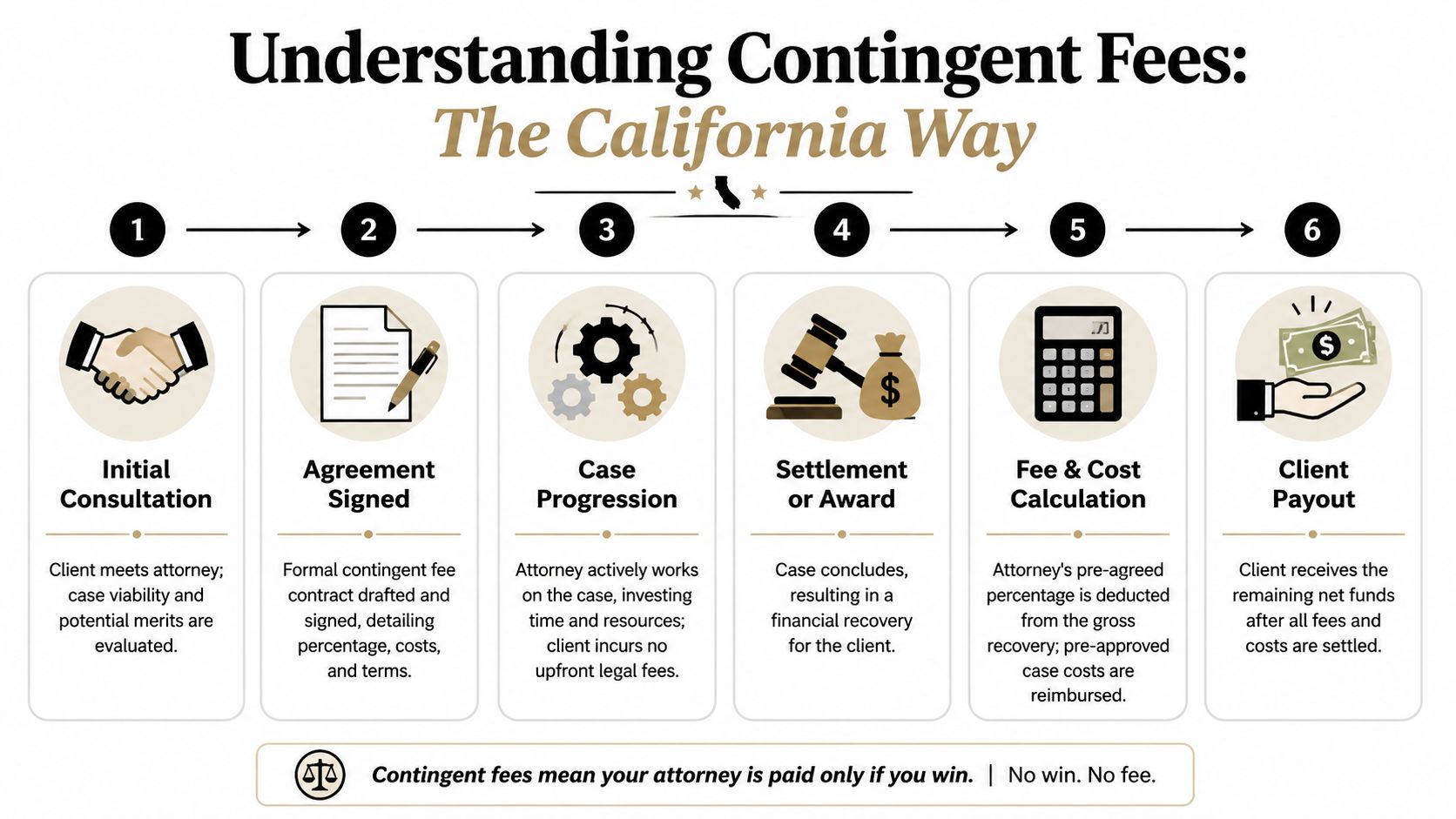
In California personal injury matters, the typical fee structure often changes based on how far the case goes.
Step one means gross recovery
Start with the total amount recovered in the case. Lawyers call that the gross recovery.
If the case settles for $100,000, the gross recovery is $100,000. That is the starting point, not the amount you necessarily take home.
The same California source explains that contingency percentages are generally calculated on the total recovery, while case costs such as filing fees, medical records, expert witnesses, and depositions are treated separately and must be disclosed in writing.
Step two means attorney fee
The agreement should tell you the percentage that applies at the point where your case resolves.
Step three means case costs
Clients often get surprised if no one has explained the agreement carefully.
Fees pay the lawyer for legal work. Costs are the out-of-pocket expenses involved in building and moving the case forward. Common examples include:
- Court filing charges: fees required to open or process litigation
- Medical record expenses: charges for obtaining records and billing files
- Expert witness work: specialists who review facts or testify
- Deposition expenses: reporter fees, transcripts, and related services
Some firms advance these costs and seek reimbursement from the recovery. Some may ask the client to front certain expenses. The contract should state which approach applies.
A simple example
Here’s the basic flow using the same $100,000 recovery figure discussed above.
- Gross recovery: $100,000
- Attorney fee: depends on the percentage in the agreement and the stage of the case
- Case costs: deducted or reimbursed according to the written contract
- Client net recovery: the amount remaining after fees and costs
If you want a broader consumer explanation of billing models and injury fees, this guide on how much accident lawyers charge is a useful companion read.
Questions to ask before you sign
Use these questions during the intake meeting or before signing the contract:
- Is the fee based on the gross recovery: It is worth asking that exact question.
- How are costs handled: Are they advanced by the firm, billed along the way, or reimbursed only after recovery?
- Does the fee percentage change after filing or trial: The contract should say so plainly.
- Will I receive a closing statement: You should be able to see the math in writing at the end.
If a fee agreement can’t be explained with real numbers and a simple worksheet, it’s too vague.
California’s Rules Protecting Your Rights

You are hurt, bills are showing up, and a lawyer slides a fee contract across the desk. At that moment, California law steps in to slow things down and make the deal clear enough for a real decision, not a rushed guess.
That matters because a contingent fee agreement is not supposed to work like fine print on the back of a receipt. It is supposed to tell you, in writing, how the lawyer gets paid, how case costs are treated, and what you are agreeing to. If the writing is missing or unclear, that can create real problems with enforceability. California’s rules are designed to protect the client first.
What California requires the agreement to say
Under California law, a contingent fee agreement generally must be in writing and must spell out the main financial terms in plain enough form that a client can follow them. At a minimum, you should be able to locate these points without hunting through legal jargon:
- The fee percentage or formula. You should see the actual percentage, not a fuzzy description.
- How costs and disbursements are handled. This tells you whether the firm advances costs, whether you must reimburse them from a recovery, and whether you may owe any costs if there is no recovery.
- A statement that the fee is negotiable. California does not set one fixed contingency percentage for every injury case.
- What services the lawyer is agreeing to provide. You should know the scope of the representation.
A good way to picture this is a receipt before the purchase, not after. You should know the pricing rules before the work begins.
Your rights go beyond the percentage
Clients often focus on the fee percentage and miss the other rights built into the agreement. Those other terms can affect your bottom line just as much.
For example, the contract should make clear who pays for records, filing fees, depositions, experts, and similar expenses. It should also be clear whether those costs come off the top of a recovery, whether they are deducted after the attorney fee is calculated, and whether you remain responsible for any unpaid costs if you decide to change lawyers.
That last point causes confusion. If you switch attorneys, the first lawyer may still claim a fee for the value of work already performed, depending on the facts and timing. The agreement should not hide that issue. It should help you see it coming.
The settlement-pressure problem clients should watch for
Here is the dirty secret many clients are never told plainly. A quick settlement can be good for the client, but it can also be good for the lawyer in a very different way. Less time invested can mean a better return on the lawyer’s time, even if holding out longer might increase the case value.
That does not mean your lawyer is doing anything improper. It does mean you should protect yourself by asking direct questions: Why is this offer reasonable today? What evidence is still missing? What are the risks of waiting? What costs will increase if we keep going?
You are not being difficult by asking those questions. You are doing exactly what an informed client should do.
A short client checklist
Before you sign, confirm these points in writing:
| Check | Why it matters |
|---|---|
| Fee percentage is stated clearly | Prevents later disputes about the math |
| Costs are explained separately from fees | Helps you estimate your net recovery |
| The agreement says the fee is negotiable | Confirms your right to ask for changes |
| You receive a copy signed by both sides | Lets you review the deal calmly later |
| Termination or lawyer-change terms are understandable | Reduces surprises if the relationship ends |
If your case involves disputed treatment, delayed diagnosis, or another medically complex issue, outside reading on comprehensive medical malpractice evaluations can help you understand how lawyers and experts assess the medicine behind the claim.
Fee terms are only part of the picture. Filing deadlines can end a case before fee questions ever matter, so it helps to review California injury deadlines alongside the contract. This guide to the California statute of limitations for injury claims explains why timing and written agreements often need attention at the same time.
Understanding Sample Clauses in Your Agreement
Clients often tell me the same thing after reading a fee contract: “I understood the first sentence, then it started sounding like another language.” That reaction is normal. Legal documents compress a lot of meaning into a few lines.
Below are sample-style clauses that show what you’re looking for. These are educational examples, not forms to copy blindly.
Fee percentage clause
Sample clause
Attorney’s fee shall be a percentage of the recovery obtained on Client’s behalf. The applicable percentage shall depend on the stage at which the matter is resolved, as stated in this agreement.
You should not have to infer the percentages from context. They should appear clearly elsewhere in the agreement.
Case costs clause
Sample clause
Client is responsible for case costs and disbursements incurred in the handling of the matter, including but not limited to filing fees, medical record charges, deposition expenses, and expert witness fees, as described in this agreement. Such costs may be advanced by Attorney and reimbursed from any recovery.
This language separates costs from fees. That distinction matters. A lawyer’s fee pays for legal work. Costs reimburse out-of-pocket spending on the case itself.
Clients should read this clause slowly. The important question isn’t just what costs exist. The important question is when they are paid and from where they are reimbursed.
Discharge of attorney clause
Sample clause
Client may terminate Attorney’s services at any time, subject to applicable law and the terms of this agreement. In the event of discharge before recovery, Attorney may assert a claim for the reasonable value of services rendered, to the extent permitted by law.
Annotation: This clause addresses your right to change lawyers. It should not say that firing the lawyer automatically means you owe the full contingency percentage. In California, that is not generally how it works when the lawyer is discharged before recovery.
What to circle before signing
When you review a real agreement, mark any sentence that leaves you unable to answer one of these questions:
- What exactly is the fee formula
- Who pays costs if the case becomes expensive
- What happens if I want to switch counsel
- Do I control settlement approval
If the office representative says, “Don’t worry, that part never matters,” that’s a reason to slow down. If it’s in the contract, it matters.
Negotiation Tips and Red Flags to Watch For
You are sitting in a consultation room after a crash. The intake packet slides across the table. Someone says, “This is our standard contingency agreement.” That moment can feel a lot like signing a repair estimate after your car is towed. You know you need help, but you still have the right to understand the charges, ask questions, and slow the process down.

A contingent fee agreement should create access to representation. It should not make you feel cornered.
Some terms are common across personal injury cases. Even so, common does not mean beyond discussion. You may not be able to rewrite every line, but you can ask for clearer language, written confirmation of key rights, and direct answers about how the relationship will work if the case becomes difficult.
The red flag clients rarely hear about
Clients usually understand the obvious alignment. If the case recovers money, the lawyer gets paid. The less obvious issue is pressure around timing.
A quick settlement can sometimes produce a good return for the lawyer’s time, even if waiting, building evidence, or filing suit might improve the client’s result. That does not mean every lawyer pushes low offers. It means the fee structure can create competing incentives, and a careful client should address that risk before signing.
The practical protection is simple. Ask, in plain words, “Will any settlement require my approval?” Then look for that answer in writing. If the office speaks as though settlement is mainly the lawyer’s call, slow down.
You hire counsel to advise you. You keep the right to decide whether to settle.
What you can discuss before signing
Start with the terms that affect your money, your control, and your exit rights. Those are the pressure points.
- Cost handling: It is worth asking who advances costs, which costs are common, and whether reimbursement comes off the top of the recovery.
- Communication rules: Ask who your point of contact is, how often you will get updates, and how calls are returned.
- Settlement approval: Ask for clear contract language stating that you decide whether to accept an offer.
- Changing lawyers: Ask what the firm says happens if you end the relationship before the case resolves.
For readers who want a practical mindset on negotiating under pressure in another context, Superior Credit Repair’s guide offers useful general lessons about reading terms carefully, asking direct questions, and avoiding rushed decisions.
Watch how the firm reacts to ordinary questions
This part tells you a lot.
A healthy response sounds calm and specific. The lawyer or staff member explains the fee, explains costs separately, and does not act irritated when you ask for examples. A concerning response sounds rushed, vague, or dismissive. Phrases like “every contract says that” or “that part never comes up” should make you pause.
Aggressive intake behavior is another warning sign. If a firm seems more focused on signing you than understanding your injuries, timeline, and concerns, learn the basics of what an ambulance chaser is so you can separate pressure tactics from professional representation.
What happens if you fire your lawyer
Many clients stay in unhappy attorney-client relationships because they assume switching lawyers means owing the full contingency fee right away. That fear often keeps people stuck when communication has broken down.
In California, the usual issue is the lawyer’s claim for the reasonable value of the work already performed, often called quantum meruit, rather than an automatic right to the full contingency percentage before any recovery occurs. The exact result depends on the facts and the contract language, but the big picture matters. Signing a contingency agreement does not erase your right to change counsel.
That is one of the client rights people miss. The agreement sets terms for the relationship. It is not a trap door.
Questions to ask before the relationship starts
Watch this short video, then compare it against the contract in front of you and the answers you’re getting from the office.
Then ask these questions out loud:
- Who decides whether to settle
- What costs might be charged to me
- If I switch firms, how is that handled
- Will I receive the final disbursement statement in writing
If the answers do not match the document, trust the document. If the document is unclear, ask for a revision or a written explanation before you sign.
One practical way to compare firms
Compare firms the way you would compare surgeons, contractors, or financial professionals. Pay attention to how they explain risk, money, and client control.
| What to look for | Healthy sign | Red flag |
|---|---|---|
| Explanation of terms | Clear answers in plain English | “Just sign, it’s standard” |
| Discussion of costs | Specific and written | Hand-waving |
| Settlement control | Client approval emphasized | Pressure to trust blindly |
| Discharge rights | Explained calmly | Avoided or minimized |
If you’re evaluating options, some firms, including LA Law Group, APLC, use written engagement agreements during consultation so clients can review contingency terms before deciding whether to move forward.
Frequently Asked Questions About Contingency Fees
Even after clients understand the basics, a few specific questions keep resurfacing. These are the ones I hear most often.
What happens if we lose the case
It is worth asking how fees and case costs work and getting the terms in writing.
Costs are the part still worth asking about. Agreements describe costs differently, so it is worth reading that section carefully and asking for examples in plain language.
Can the fee percentage change during the case
The fee shouldn’t change randomly in the middle of representation. What can happen is that the contract itself may use different percentages depending on the stage where the matter resolves.
That’s not a surprise increase if it is clearly written into the agreement from the start. The key is that you understand the structure before signing.
Do I have to accept a settlement because my lawyer recommends it
No. Settlement is your decision.
A lawyer should advise you about risk, value, timing, and evidence. A lawyer should not decide for you. If an office speaks as if the client’s approval is a formality, that’s a problem.
You hire the lawyer to guide the case. You do not surrender your right to decide whether to settle it.
Can a contingent fee agreement be used outside personal injury
Yes, but the context matters. Other legal areas may use different billing models, including hourly rates, flat fees, or hybrid structures.
That’s one reason you shouldn’t assume that a fee arrangement from a business matter works the same way as one from an auto accident case.
If I change lawyers, do I owe the first lawyer the full percentage
Not generally. As discussed earlier, that’s usually not how discharge works in California when the lawyer is terminated before recovery. The issue often becomes the reasonable value of the work already performed, rather than the full contingency percentage.
Still, the contract language matters. It is worth asking how the firm handles file transfer, lien claims, and final accounting if representation ends early.
Are these agreements always non-negotiable
No. Some terms may be standard. Some may not move much in an ordinary case. But you can always ask for clarification, and in some circumstances you can negotiate parts of the agreement.
The most important point isn’t winning every negotiation point. It’s making sure you know what you’re agreeing to before your signature goes on the page.
Should I sign the agreement the same day I receive it
Not unless you’re comfortable doing so.
If you need time to read it, take the time. If English isn’t your first language, ask for a clear explanation in the language you understand best. If a clause feels unclear, that is exactly when questions should be asked, not after the case settles.
Take the Next Step with Confidence
A contingent fee agreement can be one of the most practical tools in personal injury law.
The agreement still deserves careful review. You should understand the fee formula, the treatment of case costs, the requirement that the contract be in writing, and your right to control settlement decisions and change lawyers if necessary. Those details are not side issues. They shape what your case feels like from start to finish.
If you’re hurt and trying to decide what to do next, slow the process down enough to read the contract carefully. Ask hard questions. Request examples. Make sure the office explains the numbers and the language in terms that make sense to you.
If you want help evaluating a contingent fee agreement for an accident, rideshare injury, or premises liability claim in California, a consultation can help you understand your options before you commit to representation. This article is for informational purposes only, does not constitute legal advice, and does not create an attorney-client relationship.
If you’d like to discuss a potential personal injury matter and review how a contingent fee agreement would apply to your situation, contact LA Law Group, APLC. The firm offers initial consultations so you can ask questions about fees, costs, timelines, and representation before deciding whether to move forward. It is worth asking how fees and case costs work and getting the terms in writing.
Attorney Advertising. This article is general information, not legal advice, and does not create an attorney-client relationship. Prior results do not guarantee a similar outcome.