
how much do accident lawyers charge: quick fee breakdown

If you’ve been in an accident, one of the first questions on your mind is probably, “How much is this going to cost me?” When it comes to hiring an accident lawyer, the answer is simpler than you think: you pay nothing upfront.
Almost every personal injury attorney in California works on a contingency fee basis. In plain English, this means their fee is just a percentage of the money they recover for you. You only pay them if they win your case.
Disclaimer: This article is for informational purposes only and is not to be construed as legal advice. No attorney-client relationship exists based on the review of this article, and none of the information in this article is legal advice.
The Contingency Fee Model Explained

When you’re juggling injuries, mounting medical bills, and lost time from work, the last thing you need is another bill. The contingency fee model was designed for exactly this situation. It completely removes the financial barrier to getting expert legal help when you need it most.
Think of it as a partnership. Your lawyer invests their time, expertise, and resources into building your case without asking for a dime. In return, they receive an agreed-upon percentage of the final settlement or court award. This “no win, no fee” arrangement ensures their goals are perfectly aligned with yours: to get you the highest possible compensation.
How Contingency Fees Work
The concept is pretty straightforward: the lawyer’s fee is contingent upon them winning money for you. If your case doesn’t end in a financial recovery—whether through a settlement or a court verdict—you owe them nothing in attorney fees.
This structure gives you peace of mind and, more importantly, access to justice, no matter what your bank account looks like. It lets you focus on healing while your legal team handles the heavy lifting.
Across the U.S., this is the standard for personal injury lawyers. The contingency fee typically averages around 33%, or one-third, of the total recovery. It can range from 25% to 40%, depending on how complex the case is and other factors we’ll get into later. This system is what allows everyday people to take on massive insurance companies and win.
Key Benefits of This Payment Structure
The contingency model is built from the ground up to protect your interests. Here are the biggest advantages for accident victims:
- No Upfront Costs: You don’t need to pay a retainer or any hourly fees to get started. Your lawyer fronts the costs of building the case.
- Risk-Free Representation: You only pay attorney fees if your lawyer successfully gets you compensation. If you don’t win, you don’t pay. Simple as that.
- Shared Motivation: Since your lawyer’s payment is a slice of your settlement, they are highly motivated to make that settlement as large as possible.
- Access to Expertise: This model levels the playing field, allowing anyone to hire a top-tier attorney, not just those who can afford steep hourly rates.
The most powerful thing about the contingency fee is that it makes your lawyer a true partner in your recovery. Their success is tied directly to your success, creating the strongest possible incentive to fight for every dollar you deserve.
Here’s a quick summary of how this system works for you.
Contingency Fee Model At a Glance
| Feature | What It Means for You |
|---|---|
| Payment Structure | Fee is a percentage of the total settlement or award. |
| Upfront Cost | $0. You pay nothing to hire the lawyer and start your case. |
| When You Pay | Only after your lawyer wins your case and you receive money. |
| If You Lose | You owe zero attorney fees. |
| Attorney Motivation | Aligned with yours—to get the maximum compensation possible. |
Understanding this payment model is the first step toward getting the help you need without the financial stress. For a deeper dive, feel free to check out our other guide on how contingency fees work for personal injury lawyers. This foundation allows you to move forward confidently, knowing your legal team is fully invested in your success.
How Fee Percentages Are Calculated
Disclaimer: This article is for informational purposes only and is not to be construed as legal advice. No attorney-client relationship exists based on the review of this article, and none of the information in this article is legal advice.

While the contingency fee is always a percentage, that number isn’t set in stone. The specific percentage an accident lawyer charges really boils down to one key factor: the amount of work and risk it’s going to take to resolve your case.
Think of it like this: a straightforward case that settles quickly will almost always have a lower fee than a complex case that ends up in a courtroom battle. It’s a lot like building a house. A simple, pre-designed floor plan costs less than a custom-built mansion that needs architects, specialized crews, and months of construction. The legal effort required to win your case works the same way.
The Two Tiers of Contingency Fees
Most personal injury firms in California use a tiered fee structure. This simply means the percentage changes depending on how far your case has to go. It’s the most common way law firms answer the question, “how much do accident lawyers charge?”
The two main stages that determine the fee are:
- Pre-Litigation Settlement: This is when your case is resolved through negotiations with the insurance company before a formal lawsuit is ever filed in court.
- Litigation and Trial: This phase kicks off the moment a lawsuit is filed. It involves a much more intense legal process, including depositions, court filings, and potentially a full-blown trial.
Let’s dig into why the fee jumps up once a case enters litigation.
Why Fees Increase After a Lawsuit Is Filed
When your attorney can lock in a fair settlement just by negotiating, the process is pretty efficient. They gather evidence, write a powerful demand letter, and work out a resolution with the insurance adjuster. The standard fee for this stage is typically 33.3%, or one-third, of the total settlement.
But insurance companies don’t always play fair. If they dig in their heels and refuse to offer what your case is worth, your lawyer’s only move is to file a lawsuit and take the fight to court. This is a complete game-changer.
The moment a lawsuit is filed, the law firm’s investment of time, money, and resources skyrockets. The higher contingency fee reflects the increased risk and the immense amount of work required to force an insurance company to pay what you are owed through the court system.
Once a case is in litigation, the legal work becomes far more complicated and expensive for the law firm. The fee often increases to 40% to cover all the extra effort, which includes things like:
- Formal Discovery: This is a legal process where both sides have to exchange information, including answering written questions (interrogatories) and providing documents.
- Depositions: Your lawyer will need to question the at-fault driver, witnesses, and experts under oath. This is a time-consuming—and critical—part of building a strong case for trial.
- Expert Witnesses: Many cases need experts like accident reconstructionists or specialized doctors to testify. These professionals charge significant fees that the law firm usually pays for upfront.
- Court Appearances and Trial Prep: Litigation is filled with court hearings, motions, and endless preparation for a potential trial, which can easily eat up hundreds of hours of an attorney’s time.
This higher percentage ensures the law firm has the resources to go toe-to-toe with the insurance company’s lawyers in a much tougher legal arena.
Seeing the Financial Impact
To make this crystal clear, let’s look at how these different percentages affect a hypothetical settlement. Seeing the breakdown is the key to understanding what an accident lawyer might charge in your situation.
The table below shows the difference, laying out the lawyer’s fee and your gross recovery before any case expenses are deducted.
Sample Fee Calculation on a $100,000 Settlement
| Scenario | Contingency Fee % | Lawyer’s Fee | Your Gross Recovery |
|---|---|---|---|
| Case Settles Before Lawsuit | 33.3% (1/3) | $33,300 | $66,700 |
| Case Settles After Lawsuit is Filed | 40% | $40,000 | $60,000 |
As you can see, when your case is resolved has a direct impact on the final numbers. An experienced attorney will always push to get you the best possible outcome at the earliest stage. But they also have to be ready to escalate the fight to litigation if that’s what it takes to get you the full compensation you deserve.
Separating Attorney Fees from Case Costs
Disclaimer: This article is for informational purposes only and is not to be construed as legal advice. No attorney-client relationship exists based on the review of this article, and none of the information in this article is legal advice.
When you’re looking into what an accident lawyer charges, one of the first things to get straight is the difference between “attorney fees” and “case costs.” It’s a point of confusion for a lot of people, but getting a handle on it is key to understanding where your settlement money actually goes. They’re related, but they are two completely separate things.
Here’s a simple way to think about it: the attorney’s fee is what you pay the lawyer for their work. It’s their “salary” for putting their legal expertise, negotiation skills, and time into winning your case.
Case costs, on the other hand, are the “expenses” needed to build and prove your case. Think of these as the out-of-pocket costs required to gather all the evidence and present your claim in the strongest possible way.
What Are Common Case Costs?
Every injury case is different, but most involve a fairly standard set of expenses to get the ball rolling. Your law firm will typically front the money for these costs, so you still don’t pay anything upfront. Once the case settles, the firm is reimbursed for these expenses out of the final settlement.
Some of the most common case costs include:
- Court Filing Fees: Every court system charges a fee just to file a lawsuit and other essential documents.
- Expert Witness Fees: Many cases, especially complex ones, need experts to explain things. This could be an accident reconstruction specialist or a medical expert who can testify about your injuries. Their fees can run from hundreds to thousands of dollars.
- Deposition Costs: This is the cost to pay a court reporter to create an official transcript of sworn testimony from witnesses, the person you’re suing, and other experts.
- Costs for Records: There are always small administrative fees for getting critical documents like the official police report or your complete medical history.
- Investigation Expenses: This bucket can cover a lot, from hiring a private investigator to track down a witness to the cost of taking professional photographs of the accident scene.
These expenses are the tools your lawyer uses to build a winning argument. Without them, it’s almost impossible to prove who was at fault and show an insurance company or a jury the true extent of your damages.
How Case Costs Affect Your Final Payout
Now, here’s where you need to pay close attention. How and when these costs are taken out of your settlement has a direct impact on the final check you receive. Law firms generally use one of two methods, and you absolutely need to ask which one your potential attorney uses.
The most client-friendly way to do it is to deduct the case costs from the total settlement before calculating the attorney’s percentage fee. This approach lowers the amount the fee is based on, which means more money ends up in your pocket.
Let’s look at the two methods side-by-side:
- Costs Deducted Before the Fee: The law firm takes the total case costs out of the gross settlement first. Then, they calculate their contingency fee based on that smaller, net amount.
- Costs Deducted After the Fee: The attorney calculates their fee based on the gross (total) settlement amount. After their fee is taken out, the case costs are then subtracted from what’s left for you.
Understanding this calculation is non-negotiable. A good, reputable lawyer will be completely upfront about how they do this and will have it spelled out clearly in their fee agreement. Just asking this one simple question during your free consultation can give you the power to make a truly informed choice about who represents you, ensuring there are no nasty surprises when your case finally settles.
Calculating Your Final Payout with Real Examples
Disclaimer: This article is for informational purposes only and is not to be construed as legal advice. No attorney-client relationship exists based on the review of this article, and none of the information in this article is legal advice.
Theory is one thing, but seeing how the numbers actually play out is what really makes it all click. Let’s walk through two different, but common, scenarios to show you exactly how the money flows from the total settlement amount into your pocket.
This infographic gives you a quick visual breakdown of the process.
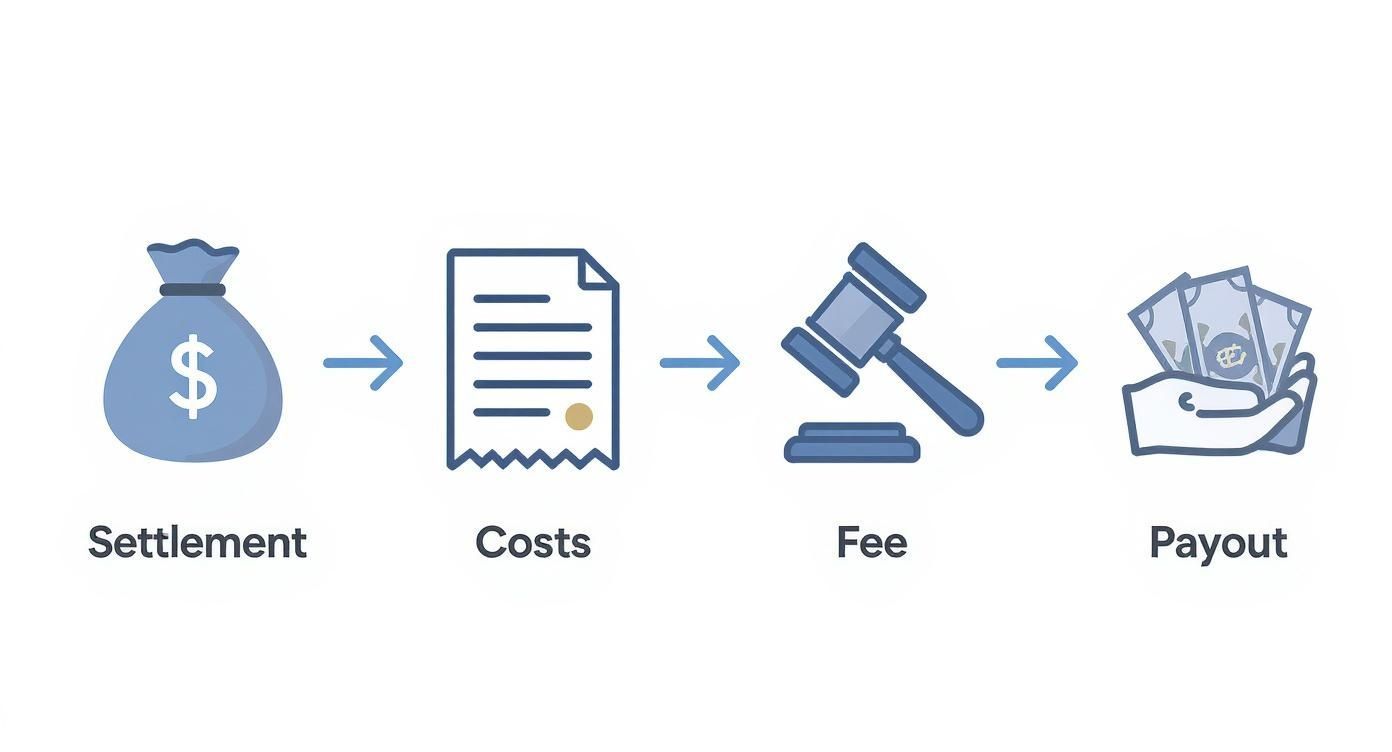
As you can see, the path is pretty clear: we pay off the case costs first, then the attorney’s fee is calculated, and the rest is the net amount for you.
Example 1: The Straightforward Car Accident
Let’s start with a classic case. Imagine you were rear-ended at a red light. The other driver is clearly at fault, and your injuries require some physical therapy but no surgery. It’s a strong case, and we convince the insurance company to offer a fair settlement before we ever have to file a lawsuit.
Here’s what the breakdown would look like:
- Total Settlement Amount: $75,000
- Case Costs: $2,500 (This covers things like getting medical records, police reports, and other administrative fees.)
- Attorney’s Fee: 33.3% (This is a standard rate for cases that settle before litigation.)
Now, let’s do the math. We always use the most client-friendly method, which means we deduct the costs before calculating our fee.
- Subtract Case Costs: $75,000 (Gross Settlement) - $2,500 (Costs) = $72,500
- Calculate Attorney’s Fee: $72,500 x 33.3% = $24,142.50
- Determine Your Net Payout: $72,500 - $24,142.50 = $48,357.50
In this situation, you walk away with $48,357.50. That money is yours to pay off any remaining medical bills or liens, and the rest is your final compensation. If you’re curious about how we arrive at that initial settlement number, you can get a better sense of things by reading our detailed guide on how to calculate personal injury settlements.
Example 2: The Complex Slip and Fall Case
Okay, now let’s look at something more complicated. Picture a client who slips on an unmarked wet floor in a big-box store and suffers a serious injury needing surgery. The store, of course, denies any responsibility. This forces us to file a lawsuit and get ready for a potential trial.
The process is much more involved—we have to hire experts, take depositions, and put in hundreds of hours of legal work.
Here’s how the numbers for this kind of case might break down:
- Total Settlement Amount: $250,000
- Case Costs: $15,000 (This now includes things like expert witness fees, court filing fees, and deposition transcripts.)
- Attorney’s Fee: 40% (This is the standard rate once a case enters litigation.)
Let’s run those numbers.
- Subtract Case Costs: $250,000 (Gross Settlement) - $15,000 (Costs) = $235,000
- Calculate Attorney’s Fee: $235,000 x 40% = $94,000
- Determine Your Net Payout: $235,000 - $94,000 = $141,000
In this scenario, the client’s final recovery is $141,000. Yes, the fee percentage and costs were higher, but that’s because the intensive work of litigation was necessary to secure a much, much larger settlement. The end result was a significantly bigger payout for the client.
These examples show that while fees are a key part of the equation, the lawyer’s ability to maximize the total settlement is what truly drives your final outcome. The higher fee in complex cases often reflects the work needed to secure a much larger award.
These figures line up with what we see across the industry. For instance, in motor vehicle accidents with average settlements around $37,248, a 30% to 40% fee would come out to between $11,174 and $14,913. These real-world examples should help take the guesswork out of the process and give you a clear, transparent picture of how it all works.
Is Hiring an Accident Lawyer a Smart Investment?
Disclaimer: This article is for informational purposes only and is not to be construed as legal advice. No attorney-client relationship exists based on the review of this article, and none of the information in this article is legal advice.
After looking at the numbers and fee structures, you might still be asking yourself the big question: is it really worth it? It’s natural to see a contingency fee as just another cost, but that perspective misses the forest for the trees.
Hiring an experienced accident lawyer isn’t an expense. Think of it as a strategic investment toward getting the maximum possible financial recovery for your injuries.
The proof is in the results. Over and over again, the data shows that accident victims who team up with an attorney walk away with significantly more compensation than people who go it alone. And we’re not talking about a small difference—it’s often a life-changing amount of money.
The Statistical Edge of Having a Lawyer
Industry studies and federal court data paint a very clear picture. There’s a stark contrast between what represented and unrepresented claimants receive. Research consistently shows that over 91% of people with legal representation get some form of compensation.
Compare that to the roughly 51% of people who manage to get a payout by navigating the claims process solo.
What’s even more telling is that this advantage remains even after you account for the lawyer’s fee. Claimants with attorneys, on average, recovered nearly three times more money than those without. That single statistic flips the question from “How much do lawyers charge?” to “How much money am I leaving on the table by not hiring one?”
Hiring a lawyer isn’t about giving away a piece of your settlement. It’s about unlocking a much larger settlement you likely couldn’t have gotten on your own. The attorney’s fee is paid from the extra money they secure for you.
Why Lawyers Get Bigger Settlements
So, what’s the secret? How does having an attorney on your side make such a massive financial difference? It really boils down to three key areas where a skilled lawyer adds undeniable value.
-
Leveling the Playing Field: Insurance companies are not your friends. They are multi-billion dollar businesses with armies of adjusters and lawyers trained to do one thing: minimize what they pay out. When you’re unrepresented, you’re at a huge disadvantage. A lawyer signals to the insurer that you’re serious and ready to fight for what you deserve.
-
Valuing Your Claim Correctly: Most people have no idea how to calculate the true value of their claim. You might add up medical bills and lost paychecks, but what about the non-economic damages? Things like pain and suffering, emotional distress, and the loss of enjoyment of life have real value. An attorney knows how to put a number on these losses and build a case to justify it.
-
Expert Negotiation and Litigation: Experienced accident lawyers are expert negotiators. They know every trick in the insurance company’s playbook and how to counter them. They build your case with solid evidence, ready to file a lawsuit and take it to trial if the insurer refuses to make a fair offer.
Modern law firms also use sophisticated tools like a Lawyer Contract Storage Cloud for Swiss Firms to keep cases organized and build strong, evidence-backed arguments.
When you look at it this way, paying a 33% to 40% fee seems like a small price for potentially tripling your total recovery. It’s about ensuring you have the resources you need to truly heal and put your life back together.
Key Questions to Ask About Fees and Costs
Disclaimer: This article is for informational purposes only and is not to be construed as legal advice. No attorney-client relationship exists based on the review of this article, and none of the information in this article is legal advice.
Knowledge is power. This is especially true when you’re choosing the right legal partner after an accident. Your first meeting with a potential lawyer is the perfect chance to get crystal clear on their fees and any costs involved, so you aren’t blindsided later.
Walking into that consultation with the right questions helps you confidently pick an attorney who is upfront and transparent. Think of it as an interview—you’re hiring someone for a critically important job. Don’t be shy about digging into how they handle billing and case expenses.
Clarifying the Contingency Fee Percentage
Your first order of business should be nailing down the exact contingency fee percentage. Any reputable lawyer will give you a straight answer without hesitation. But the conversation shouldn’t stop there.
Here are the key questions you need to ask about the fee itself:
- What is your standard contingency fee percentage? You want a specific number, like 33.3% or 40%.
- Under what circumstances would that percentage change? Many firms increase their fee if a lawsuit has to be filed. Ask them to walk you through their tiered structure so you understand it completely.
- Is this percentage negotiable? While the fee is often standard, it never hurts to ask. This is particularly true if your case has clear-cut liability and the potential for significant damages.
Getting these numbers on the table from day one is essential. It establishes clear expectations and wipes out any confusion about how much your accident lawyer will charge for their work. For more on preparing for this crucial first meeting, you can learn more about what happens during your first appointment with a personal injury lawyer in our complete guide.
Understanding How Costs Are Handled
Next up is figuring out how the firm manages case costs. This is where things can get confusing if it’s not addressed right at the start.
The single most important financial question you can ask is: “Are case costs deducted from the settlement before or after you calculate your fee?” This one detail can change your final payout by thousands of dollars.
Before you sign anything, always ask for a written, itemized fee agreement. This document is your safety net, clearly spelling out the fee structure, how costs are handled, and every other financial detail of your relationship with the attorney. It’s just like hiring any professional service; understanding different service pricing models helps you know which questions to ask about all the costs involved.
Common Questions About Accident Lawyer Charges
Disclaimer: This article is for informational purposes only and is not to be construed as legal advice. No attorney-client relationship exists based on the review of this article, and none of the information in this article is legal advice.
Even after breaking it all down, some common questions always pop up. It’s completely normal to have a few lingering concerns, so let’s tackle them head-on to clear up any confusion.
What Happens If I Lose My Case?
This is probably the biggest worry for most people. Thankfully, the answer is simple. If your lawyer doesn’t win you a settlement or a court verdict, you owe them absolutely nothing in attorney fees. That’s the entire point of a contingency fee, or a “no win, no fee” promise. It’s a risk we take on, not you.
Is the Contingency Fee Percentage Negotiable?
It never hurts to ask. While most firms have a standard fee structure they’ve developed based on their experience and risk, some flexibility can exist. A straightforward case where fault is crystal clear and the damages are significant might give an attorney a reason to adjust their rate. Ultimately, it’s handled on a case-by-case basis.
How Do My Medical Bills Get Paid After a Settlement?
Once your case is settled, your attorney takes the lead on sorting out the finances. Any outstanding medical bills or liens from hospitals and doctors who treated you are paid directly from the settlement funds. Your lawyer manages this entire process, making sure all accident-related debts are cleared before you get your check.
A huge part of your lawyer’s job—and a real measure of their value—is negotiating with those medical providers. They often work to reduce the total amount you owe, which can dramatically increase the money that actually ends up in your pocket.
How Long Until I Get My Money?
Everyone wants to know when they can expect to receive their funds. After you’ve officially agreed to a settlement, it typically takes a few weeks to a couple of months to get your final payout. This time allows the insurance company to process the payment and gives your attorney the window they need to settle any case costs and medical liens.
Trying to make sense of everything after an accident is tough, but understanding your legal options shouldn’t add to the stress. The team at LA Law Group, APLC is here to give you clear answers and expert guidance.
We offer free consultations, and our team is ready to assist Spanish-speaking clients. Contact us today to get the help you deserve at https://www.bizlawpro.com.
Attorney Advertising. This article is general information, not legal advice, and does not create an attorney-client relationship. Prior results do not guarantee a similar outcome.