
Injured? What to Do After a Slip and Fall

A slip and fall usually happens faster than your mind can process it. One second you’re walking through a store aisle, apartment walkway, parking lot, office lobby, or job site. The next, you’re on the ground, people are staring, your body is pumping adrenaline, and you’re trying to decide whether to stand up, apologize, or pretend you’re okay.
That moment matters more than it might seem. In California, slip and fall accidents lead to over 200,000 emergency room visits annually, and average hospital costs exceed $30,000 per injury, according to Hillstone Law’s California slip and fall statistics. A fall that seems minor at first can turn into days of pain, missed work, medical testing, and an insurance dispute over what transpired.
This article is for informational purposes and not to be construed as legal advice. No attorney-client relationship exists based on the review of this article and none of the information in this article is legal advice.
What helps most after a fall is a calm sequence. Protect your body first. Preserve the scene before it changes. Get medical documentation early. Then keep building proof over time, especially if symptoms show up later. That last part is where many people lose ground without realizing it.
The Shock of a Sudden Fall
The first problem after a fall is confusion. Many injured people feel embarrassed before they feel pain. They want to get up quickly, reassure everyone, and move on. That instinct is understandable, but it’s often the wrong move.
Adrenaline can mask pain. A person with a head injury, back injury, or wrist injury may not know the full extent of the damage in the first few minutes. If you stand up too fast, brush off the incident, or laugh it away, you can make both your physical recovery and any future claim harder.
Why the moment feels deceptive
A slip and fall doesn’t always look dramatic. There may be no broken bone sticking out, no obvious bleeding, no ambulance in the background. But that doesn’t mean the injury is minor. Soft tissue damage, concussion symptoms, spinal irritation, and knee injuries often declare themselves later.
What works is slowing the moment down. Get oriented. Notice what hurts. Notice what caused the fall. Notice who’s around you. The legal side of a slip and fall claim starts there, not weeks later when the insurance company asks for proof.
Practical rule: If you’re deciding whether to act like nothing happened, assume that instinct is being driven by shock, not good judgment.
What this article focuses on
Most discussions of what to do after a slip and fall stop at the obvious first steps. Seek care. Take photos. Report the fall. Those steps matter, and they should happen quickly.
But the stronger cases usually come from people who do one more thing well. They create a record that continues after the scene is gone. That means preserving medical records, keeping damaged clothing and shoes, and maintaining a daily log of symptoms so delayed injuries don’t get dismissed as unrelated.
A simple way to think about the process is this:
| Timeframe | Main priority | Common mistake |
|---|---|---|
| Immediately after the fall | Safety and scene preservation | Getting up too quickly and saying you’re fine |
| First day or two | Medical evaluation and evidence storage | Waiting to see if pain goes away |
| Following days and weeks | Symptom tracking and claim protection | Leaving gaps that insurers can attack |
People don’t need to become investigators overnight. They do need to be deliberate. The next half hour often controls whether useful evidence survives.
Your First 30 Minutes at the Scene
The first half hour is usually the only window you get to capture the hazard as it existed. Floors get mopped. Cones get placed. Lighting gets changed. Employees start cleaning. Witnesses leave.
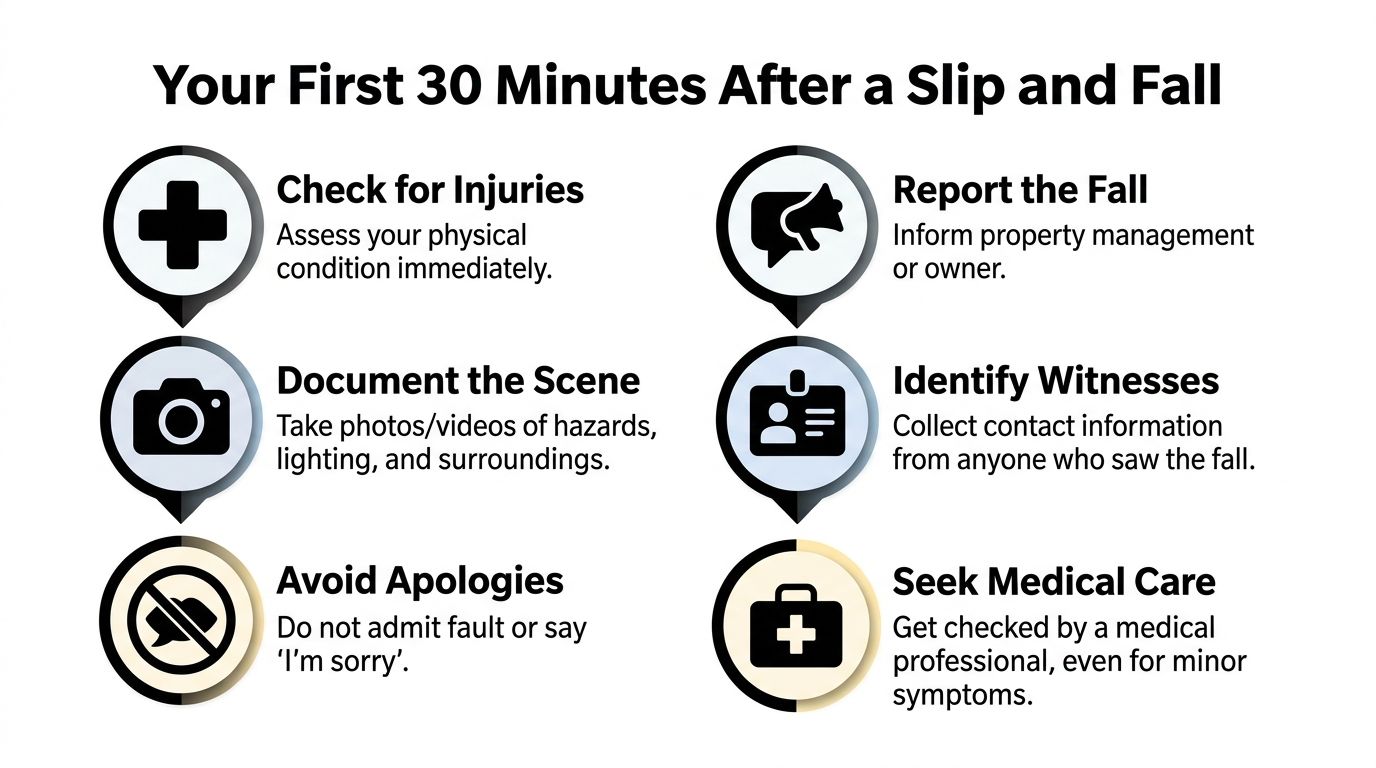
According to Goidel & Siegel’s step-by-step post-fall guide, it’s vital to document the scene within the first 30 minutes. Hazards like spills are often cleaned within an hour, visual evidence can boost settlement success rates by 60 to 70%, and failure to document the scene contributes to 80% of initial claim rejections by insurers.
Stay still long enough to assess yourself
If you may have hit your head, neck, or back, don’t rush to stand. Check for dizziness, blurred vision, tingling, nausea, sharp back pain, or pain shooting into an arm or leg. If something feels wrong, call 911 or ask someone nearby to do it.
The worst choice in this moment is trying to “walk it off” because other people are watching. Public embarrassment fades. A worsened injury doesn’t.
Record the hazard before anyone fixes it
Use your phone immediately if you can do so safely. Take wide shots that show the whole area and close shots that show the specific hazard. If the issue is a spill, capture the spill and the surrounding floor. If it’s poor lighting, include the dim area and the approach to it. If it’s a broken step, uneven pavement, torn carpet, loose mat, or missing warning sign, make that visible from more than one angle.
Short video can help too. Slowly pan the scene. Narrate only if necessary, and stick to facts.
Focus on details people forget:
- The exact location: Show aisle markers, doorway numbers, nearby displays, or building features.
- The condition itself: Wet floor, debris, cracked concrete, broken tile, loose handrail, or obstructed path.
- What was missing: No cone, no warning sign, no barrier, no visible cleanup effort.
- Your condition: Torn clothing, visible swelling, redness, bruising, or blood.
If the fall happens in a context where police might respond, this guide on reporting an accident to the police can help you understand how formal reporting fits into evidence preservation.
Get names before people disappear
Witnesses matter most when the property owner later claims nothing dangerous was present. If someone saw the fall or saw the hazard beforehand, ask for their full name and contact information. Don’t assume management will collect it for you.
You don’t need a written statement at the scene. You do need a way to reach them later.
Say less than you think. A simple “I slipped there” is enough. Don’t guess why it happened, and don’t volunteer blame.
Report the incident without minimizing it
Tell the manager, owner, supervisor, or person in charge that you fell and need an incident report. Ask for a copy if one is created. If they won’t give you one, write down who you reported it to, their title, and the time.
Avoid these common mistakes:
- Saying “I’m fine”: You may not know that yet.
- Apologizing: People do this reflexively, but it can be framed as fault.
- Speculating: Don’t say your shoes caused it or that you weren’t looking.
- Arguing on scene: Preserve facts, not emotions.
The scene is not the place to debate liability. It’s the place to preserve evidence before it disappears.
Securing Medical and Physical Evidence
The next risk after a fall is not always the injury itself. It is the gap between what you feel today and what you can prove two weeks from now.
That gap gets exploited. If you wait too long to get checked, or if your records are thin, the insurer has room to argue that your pain started later, came from a prior condition, or is less serious than you claim.
Get medical care while the facts are still fresh
Prompt treatment protects your health, but it also fixes the timeline in place. That matters because many fall injuries do not show their full pattern right away. Back spasms can build overnight. A concussion may look like a headache and fatigue before it is recognized for what it is. Knee and shoulder injuries often worsen after the adrenaline wears off.
Tell the provider exactly how the fall happened. State what surface you landed on, what body parts took the impact, whether you twisted, and whether your head hit anything. Then describe every symptom you have, even if it seems minor. Headache, dizziness, nausea, neck stiffness, tingling, low back pain, sleep disruption, and a sense that a joint feels unstable all belong in the record if they are present.
Accuracy matters more than toughness. Clients sometimes minimize symptoms because they do not want to sound dramatic. That choice can follow them for months.
A first visit does important work:
- It ties the onset of symptoms to the date of the fall.
- It gives you a treatment plan, referrals, and imaging if needed.
- It creates records that are harder to challenge later.
- It gives a baseline that supports the symptom diary you start afterward.
If you want a clearer picture of what insurers and defense lawyers look for, review this guide on how to prove your injuries are sufficient for a personal injury claim.
Preserve the items that tell the story
Physical evidence gets lost in ordinary cleanup. Shoes get wiped down. Clothes go through the wash. A broken phone gets replaced. Those small decisions can erase the condition of the items at the time of the fall.
Keep the shoes and clothing exactly as they were. If they are wet, dirty, torn, or marked by residue, store them in a dry place and leave them alone. Save discharge papers, prescription information, imaging orders, visit summaries, rideshare receipts to medical appointments, and screenshots of messages where you reported the fall or described your symptoms soon after it happened.
If surveillance footage may exist, send a written preservation request quickly. Many businesses record over video within days.
Organization helps more than people expect. A simple log showing what you kept, when you saved it, and where it is stored makes the evidence easier to use later. A free template for legal evidence can help you keep that record.
What strengthens the case and what weakens it
Here is the practical difference:
| Strengthens your claim | Weakens your claim |
|---|---|
| Medical evaluation soon after the fall | Waiting until pain becomes severe |
| Full, specific symptom reporting | Downplaying symptoms out of embarrassment or uncertainty |
| Preserving shoes, clothing, and damaged items | Cleaning, washing, or discarding them |
| Saving records in one place | Letting photos, receipts, and messages stay scattered |
Medical proof is not limited to an X-ray or MRI. It is the full chain of evidence. The first exam, the preserved items, the follow-up records, and the symptom notes you keep in the days ahead all work together. That last piece matters more than many people realize, especially when symptoms appear late or get worse over time.
The Injury Diary Advantage for Your Claim
The importance of photos is widely understood. Fewer understand why a daily written record can change the value of a case. Yet this is often the difference between a claim that looks vague and one that tells a clear, credible story from day one to recovery.
An injury diary is not a dramatic journal. It’s a disciplined record of what the fall is doing to your body and your life.

According to Sanchez & Brown’s discussion of post-fall documentation, personal injury cases that include a detailed symptom log and consistent medical documentation recover 42% higher settlements on average. Their point is practical. A detailed diary creates an objective timeline that insurers have a harder time dismissing.
Why delayed symptoms create disputes
A fall claim rarely turns on whether someone fell. The fight is usually over what the fall caused. If your back pain intensifies three days later, if headaches begin after the weekend, or if bruising spreads over the next week, the insurance company may argue those problems are unrelated or pre-existing.
A diary cuts against that argument because it shows continuity. It documents that the symptoms didn’t appear out of nowhere. They developed in sequence after the incident and alongside treatment.
This matters most with injuries that evolve, such as concussion symptoms, soft tissue injuries, hip pain, knee instability, and neck or low back problems.
What to record each day
Good diaries are simple enough that you’ll keep them. Write once a day, preferably at the same time. Use a notebook, notes app, spreadsheet, or secure journal app. What matters is consistency.
Include entries like these:
- Pain pattern: Where it hurts, when it flares, and whether it feels sharp, dull, burning, stiff, or throbbing.
- Movement limits: Trouble bending, climbing stairs, turning your head, lifting groceries, standing from a chair, or sleeping comfortably.
- Work impact: Missed time, reduced duties, slower pace, or inability to complete normal tasks.
- Daily life effects: Trouble bathing, driving, cooking, carrying a child, exercising, or walking normally.
- Visible changes: Bruising progression, swelling, cuts healing, use of braces or wraps. Add dated photos when useful.
- Emotional effects: Frustration, sleep disruption, anxiety about falling again, or loss of independence.
Don’t write for an audience. Write so that months later you can remember what the injury was like on an ordinary Tuesday.
What makes a diary believable
The strongest diaries are plain and consistent. Overwriting can be as unhelpful as underreporting. If you had a better day, say so. If physical therapy helped for a few hours and then pain returned, note that too. Credibility grows when the record sounds like real life.
A useful approach is to pair the diary with your treatment calendar. If you saw a doctor, had imaging, started medication, or missed work, note it the same day.
A diary doesn’t replace medical records. It fills the gaps medical records don’t capture, especially the day-to-day consequences of pain, sleep loss, and reduced mobility.
If you’re serious about learning what to do after a slip and fall, this is one habit worth keeping from the first week until you’re medically stable.
Navigating California Law and Insurance Calls
The claim often changes the moment the phone rings. You are still trying to understand what happened, your symptoms may still be developing, and the adjuster is already building a file that can be used to limit payment later.

I tell clients the same thing every day. Be polite, be brief, and do not guess.
Two California rules that matter early
California premises liability claims usually turn on reasonable care. The basic questions are straightforward: was there a dangerous condition, did the owner or occupier know about it or should they have known about it, and did that condition cause the injuries you are now treating?
Deadlines matter too. California generally gives injured people a limited period to file suit, and waiting creates practical problems long before any filing deadline arrives. Video gets erased. Incident reports become harder to obtain. Witnesses forget details. The best version of your case is usually the version preserved early.
California also follows comparative fault rules. That gives insurers room to argue that you share part of the blame, even when the property owner created or ignored the hazard. A routine call can quickly turn into questions about your shoes, your phone, the lighting, whether you were in a hurry, or whether the condition was “open and obvious.”
Those questions are not casual conversation. They are part of a liability defense.
How to handle the adjuster’s first call
The first call does not require a full statement. In most cases, basic identifying information is enough.
A practical approach looks like this:
- Confirm basics only: Your name, contact information, and the date and location of the fall.
- Keep the cause short: If asked why you fell, say you are still reviewing what happened and do not want to speculate.
- Describe treatment accurately: If you are still being evaluated or treated, say that plainly.
- Decline a recorded statement for now: Early recorded statements often freeze incomplete facts before the medical picture is clear.
- Do not discuss settlement value: A case cannot be valued responsibly while symptoms, testing, and treatment are still unfolding.
For a more detailed breakdown, review this guide on how to deal with insurance adjusters.
If the incident also involves damage at a residence, property issues can run alongside the injury claim. This overview of navigating home insurance claims in Los Angeles shows how careful documentation and disciplined communication affect related claims.
One trade-off matters here. A fast, friendly conversation may feel easier in the moment, but it often creates statements you will have to explain for months.
If an adjuster asks for a recorded statement right away, treat that as a sign to slow the conversation down until your injuries and timeline are better documented.
That includes your injury diary. Medical records show appointments, imaging, diagnoses, and treatment. Your diary shows the delayed pain, interrupted sleep, missed work tasks, and day-to-day limits that insurers often try to minimize. When the first report says “I think I’m okay” but your records later show weeks of worsening symptoms, the insurer will call that inconsistency. A dated diary helps show what happened between those points.
A short explainer on legal timing and claim handling can help frame the issue:
What not to say
Some phrases sound harmless and still damage a claim.
| Risky statement | Why it causes trouble | Safer response |
|---|---|---|
| “I’m okay” | Suggests the injury was minor or resolved | “I’m still being evaluated” |
| “I wasn’t paying attention” | Can be treated as an admission of fault | “I need to review what happened carefully” |
| “It was probably my shoes” | Creates an alternative cause the insurer can build around | “I don’t want to speculate” |
| “I can settle quickly” | Signals pressure and invites a low offer before the medical picture is complete | “I’ll discuss resolution after treatment is clearer” |
Insurance calls create evidence. Handle them that way from the start.
When and How to Partner with LA Law Group
A lot of fall cases turn on what happens in the first few days after the incident. A wet floor gets cleaned. Camera footage is recorded over. A manager writes an incident report that leaves out the detail that matters. If the injury is serious or the story is already being disputed, bringing in counsel early can protect evidence that is hard to recover later.
The right time to call a lawyer is usually before the claim starts drifting off course, not after. I tell clients to pay attention to a few pressure points. The property owner denies fault. An adjuster wants a recorded statement. The medical picture is still developing, but someone starts talking settlement. Those are signs the case needs structure, documentation, and someone who can control the flow of information.
Signs it’s time to involve counsel
Consider speaking with a lawyer if any of these issues are present:
- Your treatment is ongoing: Follow-up visits, imaging, specialist referrals, physical therapy, or work restrictions usually mean the claim should be handled with more care.
- Liability is disputed: Once the owner or insurer starts denying responsibility, small evidence gaps become expensive.
- Someone blamed you early: Comparative fault arguments can shrink a case fast if they go unanswered.
- You received a quick offer: Early money often comes before the full extent of pain, limitations, and delayed symptoms is documented.
- You are struggling to keep up with calls and forms: A tired or stressed claimant can give inconsistent answers, and insurers look for those inconsistencies.
LA Law Group, APLC handles personal injury matters in California and offers free initial consultations. Good legal help should do more than send letters. It should identify what evidence still exists, preserve it, line up the records with the timeline, and stop avoidable mistakes in insurance communications.
That last point matters more than many injured people realize. A strong case is not built only on the day of the fall. It is built over the following weeks, when pain changes, sleep is disrupted, work becomes harder, and new symptoms show up. Your injury diary often fills the gap between the first medical visit and the later records that show how the injury affected daily life. Used correctly, that diary can counter the insurer’s standard argument that the problem appeared later or was not serious enough to matter.
A lawyer should also give you a candid assessment. Some claims settle efficiently. Others require a longer push because the defense is contesting notice, maintenance, causation, or the value of ongoing care. Clients deserve to hear those trade-offs early.
In workplace-related falls, formal safety records can also shape the proof. This overview of OSHA recordkeeping and risk assessments is useful background on how documentation affects responsibility questions in a business setting.
The best attorney-client partnerships are organized from day one. Save every bill, keep attending treatment, continue your injury diary, and ask before giving recorded statements or signing broad medical releases. If you were injured in a California slip and fall and need help assessing the case, speaking with LA Law Group, APLC can help you understand what evidence matters, how to handle the insurance process, and whether you may have a viable claim.
Attorney Advertising. This article is general information, not legal advice, and does not create an attorney-client relationship. Prior results do not guarantee a similar outcome.