
Vicarious Liability Real Estate: What CA Owners Must Know

A lot of people first run into vicarious liability real estate issues on one of the worst days of their year.
You go to an open house, an apartment tour, a condo showing, or a rideshare pickup at a property. Something goes wrong. A gate is left unsecured. A walkway isn’t safe. A worker creates a hazard and nobody fixes it. You get hurt, and then the confusion starts. Was it the agent’s fault? The owner’s fault? The property manager’s fault? The contractor’s fault? Or someone else’s entirely?
California law doesn’t always force an injured person to chase only the person who made the immediate mistake. In some situations, the law allows you to pursue a business, broker, owner, or principal who had legal responsibility for the person whose conduct caused the harm. That’s the basic idea behind vicarious liability.
This article is for informational purposes only. It is not legal advice, and reviewing it does not create an attorney-client relationship.
Injured on Someone Else’s Property? Understanding Vicarious Liability
A simple example helps. You walk into a property showing. A cord has been stretched across a rug by someone preparing the home for visitors. You don’t see it. You fall hard, and your first question is usually practical, not legal: who pays for the medical care, the missed work, and everything that follows?

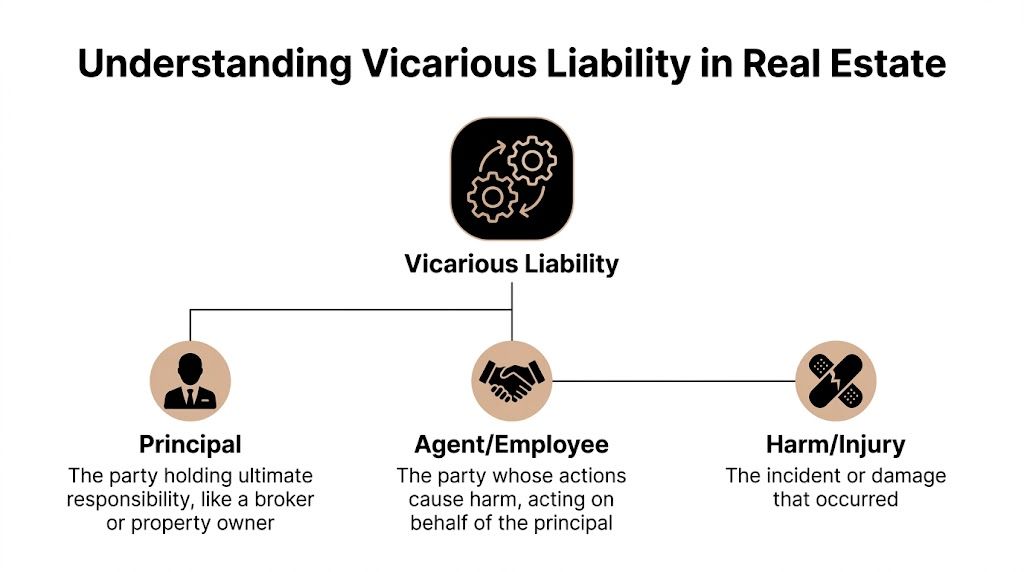
In plain English, vicarious liability means one party can be held legally responsible for the negligence of another because of their relationship. In real estate cases, that often means an injured person may have a claim not only against the person who directly caused the danger, but also against the broker, property owner, management company, or employer connected to that person.
Why this matters after an injury
For injury victims, this doctrine matters because the person who made the mistake may not have enough insurance or assets to fully cover the damage. A larger entity often has better coverage and a clearer legal duty to supervise, train, or control the people acting on its behalf.
That’s why these cases often overlap with broader property injury rules.
Practical rule: If you were hurt at a showing, apartment complex, commercial property, or pickup area, don’t assume only the nearest employee or contractor matters.
Where people get confused
Many people think liability always follows the person who physically caused the injury. That’s not always how California law works. Sometimes the key legal question is who had the right to direct, supervise, or benefit from that person’s work.
That distinction matters in real estate because property transactions involve layers of people: brokers, sales agents, property managers, maintenance staff, vendors, staging companies, security contractors, and rideshare drivers entering private property. When those roles overlap, the path to compensation can become much wider than it first appears.
Defining Vicarious Liability in Real Estate
Think of a ship captain and crew. If a crew member makes a careless mistake while doing the ship’s work, the law may hold the captain’s operation responsible, even if the captain never touched the rope, wheel, or cargo. Real estate uses a similar logic.
Vicarious liability real estate cases usually involve one person acting on behalf of another. A broker may be responsible for an agent. A property owner may face exposure because of a manager’s conduct. A developer may be drawn into a claim because others performed work for the project.
Vicarious liability versus direct liability
These two ideas sound similar, but they aren’t the same.
Direct liability means a person or company did something wrong themselves. Maybe an owner ignored a known hazard. Maybe a broker failed to set up any supervision at all. In that situation, the claim focuses on the defendant’s own conduct.
Vicarious liability is different. The theory is that the defendant is responsible because of a legal relationship with the wrongdoer, even if the defendant didn’t personally commit the act that injured you.
A short comparison makes that easier to see:
| Type of liability | What it means | Real estate example |
|---|---|---|
| Direct liability | The defendant personally acted negligently | An owner knows a stair rail is broken and does nothing |
| Vicarious liability | The defendant is responsible for someone else’s negligence due to a legal relationship | A broker is held responsible for an agent’s conduct within the agent’s role |
Why the law allows this
The policy behind the rule is practical. If businesses and principals benefit from work done on their behalf, the law often requires them to carry the burden when that work harms someone.
Some turn on supervision, agency, and delegated duties.
Why real estate is different from ordinary business settings
Real estate involves a lot of trust. Buyers rely on agents. Sellers rely on brokers. Visitors rely on property managers and onsite staff to keep the premises reasonably safe. Because of that, California law imposes meaningful oversight expectations in some relationships.
If you want a California-focused discussion of how these doctrines appear in business and injury disputes, this overview of vicarious liability in California provides additional context.
A useful way to think about it is this: the law sometimes follows the chain of responsibility, not just the chain of events.
The practical takeaway
When someone says, “I didn’t do it myself,” that isn’t always the end of the conversation. In the right case, the better question is whether that person or company had a legal relationship with the actor whose negligence caused the injury.
That is the foundation of vicarious liability in real estate. Once you understand that, the next issue is how California courts decide whether the relationship is close enough to impose responsibility.
The Legal Tests for Vicarious Liability in California
A painful injury at a property can involve more than one careless person. A leasing agent may control access to the building. A property manager may direct maintenance. A broker may supervise the agent handling a showing. In a rideshare pickup or dropoff case, the driver may be one part of the story, while the property owner or manager may be another if unsafe traffic flow, poor lighting, or ignored hazards contributed to what happened.
California courts sort through that chain of responsibility with a few recurring legal tests. The core question is simple: was the person who caused the harm acting for someone else in a way the law recognizes?
The two doctrines that come up most often are respondeat superior and principal-agent liability. They sound technical, but the idea is familiar. If one person is carrying out another person’s business, the law may place responsibility on both.
Respondeat superior
“Respondeat superior” usually applies in an employer-employee relationship. If an employee creates a dangerous condition while doing assigned work, the employer can also be liable.
A common property example helps. If an apartment complex employee mops a lobby, leaves the floor dangerously slick without warnings, and a tenant or delivery driver falls, the claim may reach the management company, not just the worker. The legal fight usually centers on whether the employee was doing the job they were hired to do at the time of the incident.
That same reasoning can matter in newer property situations. If onsite staff direct rideshare vehicles into an unsafe loading area, or a valet or security employee creates a traffic hazard that injures a rideshare passenger stepping out at the curb, the employer relationship matters because the worker was performing property-related duties.
Principal-agent liability in real estate
Real estate often involves agency rather than a standard payroll structure. A broker and sales agent are the classic example.
Here, courts ask whether the agent was acting with actual authority or apparent authority. Actual authority means the principal gave the agent permission to act. Apparent authority means the situation reasonably led others to believe the agent had that authority. A client or visitor may not know the internal office rules. They respond to who appears to be in charge.
Broker supervision matters in California. State law places real supervisory duties on brokers over sales agents. If an agent mishandles a showing, gives unsafe access instructions, or acts carelessly during a client interaction that is part of the agency role, an injured person may have a claim that reaches beyond the individual agent. The broker does not need to be standing in the room for that issue to arise.
Employee versus independent contractor
This issue changes many cases.
Property owners and brokers often hire outside companies for landscaping, repairs, security, cleaning, staging, or inspections. Those workers may be called independent contractors, and that label often narrows vicarious liability. But labels are only the starting point. Courts examine the actual relationship, especially who controlled the work, who gave directions, and whether the duty involved is one the law keeps with the owner or principal.
A simple comparison helps:
| Relationship Type | Control Level | Vicarious Liability Application | Common Example |
|---|---|---|---|
| Employer and employee | High day-to-day control | Often applies if negligence occurred during work duties | Building employee leaves a hazard in a common area |
| Broker and sales agent | Supervision tied to agency duties | Often applies when the conduct falls within the agent’s authority | Agent mishandles disclosures during a transaction |
| Principal and independent contractor | Lower control | Usually more limited, unless a specific legal duty connects the principal to the harm | Owner hires outside vendor for a property task |
| Property owner and manager | Depends on agreement and authority | Can apply when the manager acts on the owner’s behalf in operating the property | Manager neglects safety issues in common areas |
Scope of authority matters
Scope of authority is the boundary line. It asks whether the wrongful act grew out of the job the person was supposed to perform.
If an agent is handling a showing, controlling entry to the property, communicating with visitors, or managing conditions tied to that showing, those acts are more likely to fall within the scope of the agency role. If the same person steps far outside assigned duties for a purely personal reason, liability becomes less direct.
That distinction matters in injury cases because real estate work blends people, property, and access. A careless disclosure can cause financial harm. A careless instruction about where to enter, park, wait, or exit can cause physical injury. The legal test is not limited to paperwork mistakes. It can apply to actual conduct that put someone in harm’s way.
Courts often focus on who created the role, who controlled the work, and who owed the duty tied to the injury.
Non-delegable duties
Some duties stay with the owner, broker, or principal even after the task is handed to someone else. Lawyers call these non-delegable duties.
A useful comparison is hiring a moving company to carry a heavy piano down your stairs. You may hire help for the labor, but certain legal responsibilities connected to property safety can still remain with the party who owns, controls, or operates the premises. In a real estate context, that can matter where common-area safety, controlled access, traffic flow, or basic premises maintenance are involved.
This is one reason modern cases can involve overlapping theories. A rideshare passenger hurt at an apartment entrance, hotel driveway, office tower pickup zone, or open-house event may have a claim against the direct actor and also a separate claim against the party whose legal relationship or property duty made the risk possible. For injured people, that can be the difference between blaming one person and identifying the full set of parties who may owe compensation.
Real-World Examples of Vicarious Liability Claims
A buyer arrives for a weekend open house. A tenant walks down a poorly lit stairwell. A rideshare passenger steps out at a gated apartment entrance and gets hurt before reaching the lobby. Those facts may sound unrelated, but they raise the same legal question: who was acting for whom, and who still had a duty to keep the property reasonably safe?

Real cases help because vicarious liability can feel abstract until you see it in motion. In real estate, the doctrine often works like a chain of responsibility. The person who directly caused the harm matters. The company, owner, broker, or manager behind that person may matter too.
A broker and an agent at a home showing
Start with a simple showing. A prospective buyer enters a listed home. The agent is controlling access, directing visitors, and handling the flow of people through the property. During the showing, the agent leaves a side gate open, and the seller’s dog escapes and bites a visitor.
An injured person in that situation may have a claim against the agent. The analysis does not always stop there. If the agent was performing assigned showing duties under the broker’s supervision, the broker may also be drawn into the case. California real estate law places real supervisory obligations on brokers, especially where the agent’s conduct grew out of the work the broker authorized.
The practical point is easy to miss when you are focused on the injury itself. The visitor did not choose the showing procedure, the path through the property, or who was responsible for securing the premises. Those details were controlled by estate professionals.
A condo project and unsafe work by contractors
Now shift from a showing to construction. A resident or guest is injured because stairs were built incorrectly, a balcony railing gives way, or water intrusion created a slippery walkway that was never properly repaired.
These cases often involve more than the subcontractor who performed the work. Developers, general contractors, property operators, and in some situations associations may each have a role, depending on who controlled the work and who carried duties that could not be handed off. If you want a plain-English explanation of how those obligations can stay with the party in charge, this overview of non-delegable duties in property-related cases is a useful starting point.
A good comparison is a restaurant hiring a company to clean its floors. If the floor is left dangerously slick and a customer falls, the cleaning contractor matters. The restaurant’s own duty to keep the premises reasonably safe may matter too. Condo and apartment cases can work the same way.
A short visual explanation can help if you’re thinking about how these cases develop in litigation.
An owner and a property manager
Consider an apartment complex where the owner is rarely onsite. Day-to-day operations are left to a property manager. Tenants have reported loose lighting in a common stairwell for weeks. Nothing gets fixed. A visitor falls at night and suffers a serious injury.
The manager may be the first obvious defendant because the manager received the complaints and handled maintenance requests. The owner may still face liability if the manager was acting as the owner’s representative in operating the property. The law looks at control, authority, and duty, not just who happened to be standing nearest the hazard on the day of the fall.
That distinction matters for injured people. A property can be run through layers of management, but legal responsibility does not always disappear inside the org chart.
A rideshare pickup on private property
This example connects older agency rules to a modern accident pattern that many people do not expect.
A passenger orders an Uber or Lyft to a mixed-use building, hotel driveway, office complex, or gated apartment property. The pickup area is dark, traffic is poorly directed, and a security contractor or onsite worker ignores a known hazard or creates one. The passenger is injured while walking to the vehicle or getting in or out.
These facts can produce overlapping claims. The driver may bear some responsibility. The property owner or management company may also have exposure if the unsafe condition existed on the premises they controlled. A contractor working security, valet, or traffic control may bring vicarious liability into the picture if that worker was performing assigned duties for the property operator.
That is why rideshare injury cases at properties deserve a wider lens than broker-agent disputes alone. The same legal doctrine that can tie a broker to an agent’s conduct can also matter when a property uses managers, vendors, or contractors to handle access, lighting, security, curbside traffic, or guest movement. The Bellhaven discussion of vicarious liability references over 10 billion annual rideshare trips globally, which helps explain why these pickup and drop-off injuries are no longer unusual edge cases.
If you were hurt during a rideshare pickup at an apartment or commercial property, your claim may involve more than the driver’s insurance.
In a strong case review, a lawyer would examine several layers at once: the driver’s conduct, the condition of the property, the role of management, and whether an onsite worker or vendor was acting within assigned duties. That broader view often makes the difference between a claim aimed at one actor and a claim that identifies every party who may owe compensation.
When is a Property Owner or Broker Not Liable?
A lot of people hear about vicarious liability and assume it’s automatic. It isn’t. California law places real limits on when one party must answer for another’s conduct.

Outside the scope of authority
One of the most important questions is whether the person who caused the harm was acting within the role they were authorized to perform. If not, the principal may argue there is no vicarious liability.
A simple way to think about it is this:
- Authorized work conduct: An agent mishandles a showing, disclosure, or property access task assigned through a property-related engagement.
- Purely personal conduct: An agent acts for personal reasons unrelated to the principal’s business.
- Intentional wrongdoing: Liability may become much harder to prove unless the facts connect the conduct back to the principal’s approval, authority, or separate negligence.
The independent contractor issue
Another major limit involves independent contractors. People often assume that if an owner hires someone to do a job, the owner always answers for the contractor’s mistakes. That’s not the rule.
California law does not automatically impose vicarious liability for an independent contractor’s negligence. There must be a causal link between the principal’s breach of a specific non-delegable duty and the contractor’s negligence, as the same California vicarious liability discussion helps illustrate in broader terms.
That means a claim may fail if the injured person can’t tie the harm to a duty the law kept with the owner, broker, or principal.
A weak defense says, “That wasn’t my employee.” A stronger legal defense says, “That person acted outside my authority, and no non-delegable duty ties me to the harm.”
Personal frolic versus business purpose
Courts also look for what lawyers often call a personal detour or frolic. If the wrongdoer stepped away from work and acted entirely for personal reasons, vicarious liability may not follow.
This comes up in real estate more often than people think. An agent may be on the property, but not every act they take while present is part of the broker’s business. A maintenance worker may be employed onsite, but not every reckless act may be tied to assigned duties.
Why these defenses matter to injured people
These defenses don’t mean an injured person has no claim. They mean the case must be investigated carefully. The legal answer often depends on contracts, supervision records, job duties, communication logs, and who controlled the work.
For that reason, a serious case usually turns on facts gathered early. The sooner those facts are preserved, the easier it is to evaluate whether the property owner, broker, management company, or some other principal can be held accountable.
Your Path to Compensation After an Injury
A rideshare passenger steps out at an apartment complex. The walkway is poorly lit. A loose tile gives way, and the fall breaks a wrist. At first, it may look like a simple slip-and-fall. Then the questions start. Who controlled that walkway? Was the property owner responsible, or the management company, or a broker who directed showings there, or a contractor hired to maintain the entrance?
That is why the first days after an injury matter so much. In property cases involving vicarious liability, you are not only proving that a dangerous condition existed. You are also tracing who stood behind the people and companies connected to that condition.
Start with medical care. Some injuries seem minor until the swelling, pain, or dizziness shows up hours later. Prompt treatment also creates a record that ties the injury to the incident.
Then protect the facts while they are still fresh. A property scene changes quickly. Lights get repaired, spills get cleaned, gates get locked, and camera footage may be recorded over.
Useful steps include:
- Photograph the area: Capture the hazard, lighting, stairs, pavement, gates, railings, warning signs, and the surrounding layout.
- Report the incident in writing if possible: Tell the owner, manager, leasing office, security desk, broker’s office, or other person in control of the property.
- Collect witness information: Names and phone numbers matter. A short note about what each person saw helps later.
- Save every related record: Medical bills, discharge papers, receipts, emails, text messages, rideshare trip details, and incident reports can all help connect the dots.
In a straightforward premises claim, the main question is often whether the property was unsafe. In a vicarious liability case, there is a second layer. You may need to show how the negligent actor fit into a larger chain of responsibility, much like tracing a leak back through the pipes until you find the shutoff valve.
That extra layer often turns on documents people do not think to request early. Employment files may show who hired and supervised the worker. Agency agreements may show whether an agent was acting for a broker or principal. Maintenance logs, tenant complaints, vendor contracts, and insurance documents may reveal who had the right to control the area where the injury happened.
This broader view matters in modern property cases. A visitor, tenant, delivery driver, or rideshare passenger can be hurt in the same place, but the legal relationships behind the scene may differ. A rideshare drop-off injury at a hotel entrance, for example, may involve ordinary premises liability and questions about whether another party’s employee or agent created the danger. If you are trying to sort out those issues, a Los Angeles premises liability lawyer can help identify which theory applies and whether more than one party may owe compensation.
Compensation may include medical expenses, lost income, pain and suffering, and other losses recognized under California law. The exact categories depend on the injury and how it affects your daily life, your work, and your future treatment needs.
Time matters here. Filing deadlines can be short, and they can change if a public entity is involved. Evidence also gets weaker with delay. Witness memories fade. Video disappears. Repair records become harder to find.
Early action gives a claim its best chance. It helps preserve the scene, identify the right defendants, and show how a single unsafe act on a property may connect to a larger business relationship that the law treats as shared responsibility.
How a Personal Injury Attorney Can Strengthen Your Case
A person slips in a poorly lit apartment pickup zone while getting into a rideshare, breaks a wrist, and suddenly hears three different stories. The driver blames the property. The property manager blames a maintenance vendor. An insurer says the case is only about a simple fall. A personal injury attorney’s job is to sort that out and prove who the law can hold responsible.
Vicarious liability claims often rise or fall on relationships that are not visible from the scene itself. In a real estate case, that may mean examining whether a broker had authority over an agent, whether a management company acted for the owner, or whether a contractor functioned under another party’s control. In a modern premises case, the same event can also involve a guest, tenant, delivery worker, or rideshare passenger injured at the property.
A good lawyer builds the case the way a contractor reads a blueprint. The injury is the starting point, not the whole structure. Counsel traces who gave directions, who benefited from the work, who had the right to correct a dangerous condition, and whose insurance may apply.
What an attorney actually does in these cases
An attorney strengthens the claim by turning a confusing incident into a clear legal theory.
That often means:
- Identifying every responsible party: The careless actor on the ground may be only one part of the case if an employer, broker, property owner, or management company also bears legal responsibility.
- Matching facts to the right legal theory: Some injuries involve direct premises liability. Others also involve vicarious liability based on agency, employment, or delegated property operations.
- Preserving evidence before it disappears: Surveillance footage, incident reports, lease provisions, service contracts, and internal emails can make the difference between a weak claim and a persuasive one.
- Calculating the full value of the harm: A serious injury affects more than the first medical bill. It can change work, mobility, treatment needs, and daily life for months or years.
These cases confuse injured people for a simple reason. More than one party may owe a duty, but each one tries to point at someone else.
That problem shows up often in rideshare pickup and drop-off incidents on private property. If a passenger is hurt because of broken pavement, poor lighting, negligent security, or a traffic design that creates an unsafe loading area, the claim may involve both property-based duties and business relationships behind the property. A Los Angeles premises liability lawyer can examine whether the facts support a claim against the owner, manager, contractor, broker, or another party tied to the hazard.
Rideshare activity is massive worldwide, with Uber reporting over 10 billion trips annually. That scale helps explain why property injuries involving passengers now appear in situations that used to be discussed only as ordinary slip-and-fall cases. The legal question is no longer just “Who left the area unsafe?” It may also be “Who is legally responsible for the person or company that created or ignored the danger?”
A lawyer helps answer those questions early, while records are still available and before insurers narrow the case to the defendant that is easiest for them to defend.
This article is for informational purposes only. It is not legal advice, and reading it does not create an attorney-client relationship.
If you were injured at a home showing, apartment complex, condo development, commercial property, or during a rideshare pickup or drop-off, LA Law Group, APLC offers free initial consultations to help you understand your options. The firm handles California personal injury and premises liability matters with a hands-on approach, direct attorney access, and focused case evaluation aimed at identifying every potentially responsible party.
Attorney Advertising. This article is general information, not legal advice, and does not create an attorney-client relationship. Prior results do not guarantee a similar outcome.