
What Does a Civil Litigation Attorney Do and When Do You Need One

When you’re staring down a serious problem, like a major car wreck or a business deal gone sour, a civil litigation attorney is the professional you want in your corner. They are the legal experts who represent people and businesses in disputes that aren’t criminal, helping them navigate the court system to find a resolution.
Please note: This article is for informational purposes only and is not to be construed as legal advice. No attorney-client relationship exists based on the review of this article, and none of the information provided constitutes legal advice.
Your Guide to Understanding Civil Litigation Attorneys
Ever felt lost in a maze? The legal system can feel just like that—confusing, intimidating, and full of dead ends if you don’t know the way. A civil litigation attorney is your guide, the expert with the map and compass who knows how to get you through it.
Their job is to be your advocate in a civil dispute. These are simply disagreements between people or companies that don’t involve criminal charges. And they happen all the time, in almost every part of life.
What Kinds of Disputes Do They Handle?
A civil litigator’s work touches on a huge range of real-world problems. They get the call when talks break down and it’s time to take legal action. Think of them as specialists for many types of conflict, including:
- Personal Injury Claims: If you’ve been hurt in a car crash, a slip and fall, or even as a passenger in an Uber or Lyft, an attorney is the one who helps you fight for compensation for your injuries.
- Business and Contract Disputes: When a business partner walks away from a deal, a vendor doesn’t deliver, or your eCommerce business gets hit with an unfair Amazon account suspension, a litigator steps in to protect your bottom line.
- Property Disagreements: This covers everything from fighting with a landlord over your security deposit to a tense argument with a neighbor about where your property line really is.
In short, what a civil litigation attorney does is take your side of the story, back it up with hard evidence, and fight for your interests—whether that’s in a conference room or a courtroom.
Their only objective is to get the best possible outcome for you. That could mean winning a big financial settlement, forcing someone to honor a contract, or defending you from a lawsuit. They are your champion in the legal arena.
When you’re facing a legal dispute, the process can feel like a tangled mess. A civil lawsuit might seem like a chaotic, unpredictable journey, but there’s a structured path that every case follows. Think of it as a roadmap your attorney uses to lead your case from the initial conflict all the way to a final resolution.
Understanding this process pulls back the curtain on what a civil litigation attorney really does at each stage. The timeline below breaks down how an experienced lawyer takes a complex legal problem, digs into the details, and methodically works toward a successful outcome for you.
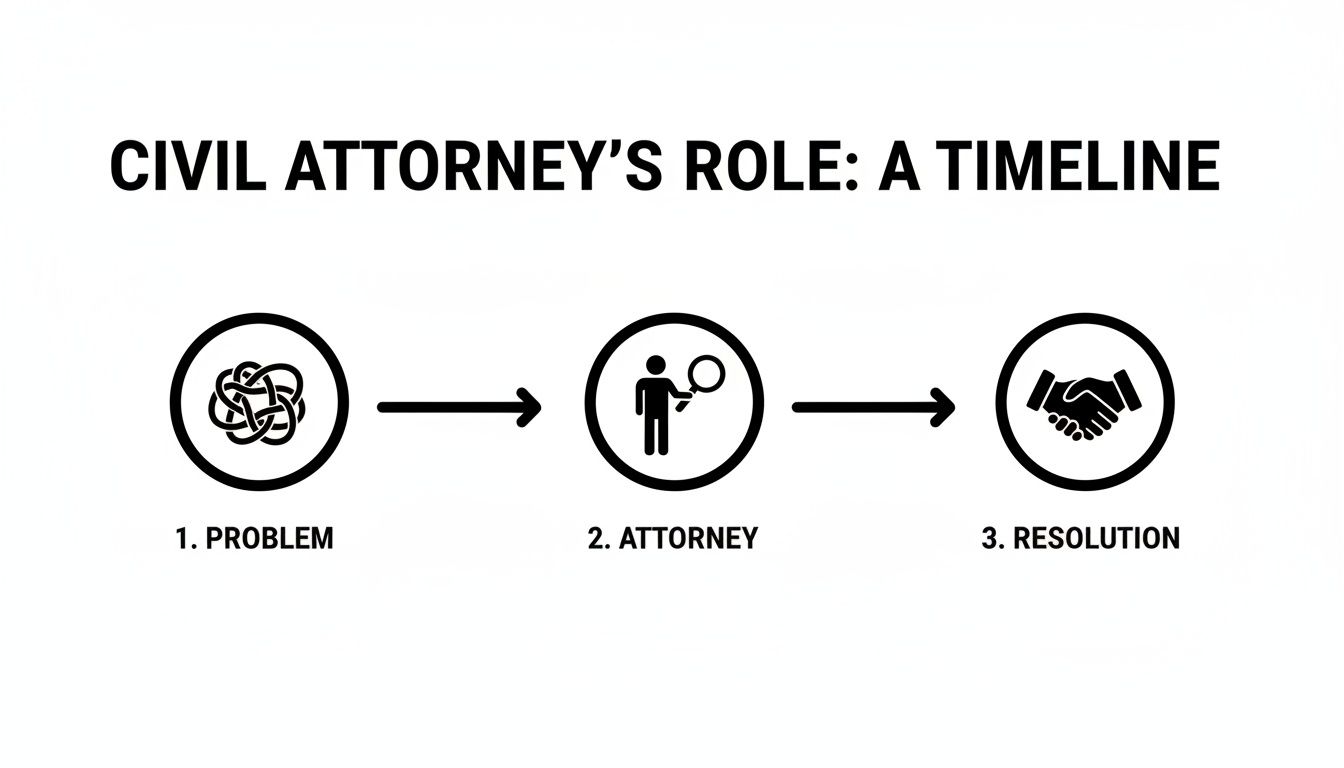
At its heart, a litigator’s job is to bring order and strategy to a messy situation. The end goal is almost always a handshake agreement through a settlement or, if necessary, a favorable decision from a judge or jury.
A civil lawsuit isn’t a single event but a series of distinct stages. To give you a clearer picture, this table outlines each phase and what your attorney is doing behind the scenes to protect your interests.
The Stages of a Civil Lawsuit and Your Attorney’s Role
| Stage of Lawsuit | Attorney’s Core Responsibilities |
|---|---|
| Initial Investigation | Assessing the facts, gathering early evidence, and determining the legal strength of your claim. |
| Pleadings | Drafting and filing the initial court documents (Complaint, Summons) that formally start the lawsuit. |
| Discovery | Exchanging information and evidence with the other side through written questions, document requests, and depositions. |
| Law and Motion | Filing motions to ask the court for specific rulings, such as dismissing parts of the case or compelling evidence. |
| Settlement/Mediation | Negotiating with the opposing party to reach a resolution without going to trial, often with a neutral third party. |
| Trial | Presenting your case in court before a judge or jury, including witness testimony and evidence. |
| Post-Trial/Appeal | Handling any post-trial motions or, if necessary, filing an appeal to challenge the court’s decision. |
Each step requires a specific set of skills and a deep understanding of legal procedure. It’s this expertise that transforms your story into a compelling legal case.
The Spark That Starts the Lawsuit
Every lawsuit begins long before anyone steps into a courtroom. It starts with an event, a dispute, and a crucial first meeting with your attorney.
This is the initial consultation and investigation stage. Your lawyer acts like a private investigator, listening carefully to your side of the story, digging into documents, and evaluating the strengths—and weaknesses—of your potential claim.
Once your attorney confirms that you have a solid legal foundation, the lawsuit officially kicks off with the Pleadings. These are the first formal documents filed with the court that get the ball rolling.
- The Complaint: This is the document your attorney drafts to start the case. It tells your story, explains the legal reasons you are suing, and specifies what you’re asking for, such as financial compensation.
- The Summons: This official court notice informs the person or business you are suing (the defendant) that a lawsuit has been filed against them.
- Service of Process: The Complaint and Summons must be formally delivered to the defendant. This is often done by a professional process server to ensure it’s handled correctly according to legal rules.
- The Answer: The defendant then has a specific amount of time to have their attorney file a response, called an Answer, where they admit to or deny the claims made in your complaint.
The Critical Fact-Finding Mission
After the initial paperwork is filed, the case moves into a phase called Discovery. This is often the longest and most labor-intensive part of any lawsuit. It’s where both sides are legally required to trade evidence and information.
Discovery is a fact-finding mission. It’s designed to prevent surprises at trial by making sure both sides have access to all the relevant information before stepping into a courtroom.
This is where your attorney’s work builds the real foundation of your case. Discovery involves a few key tools:
- Interrogatories: These are written questions sent to the other party, which they must answer in writing and under oath.
- Requests for Production: These are formal demands for documents, emails, contracts, photos, or any other physical evidence related to the case.
- Depositions: This is an in-person meeting where your attorney gets to question the other party or key witnesses under oath. Everything said is recorded word-for-word by a court reporter.
The discovery phase is where a skilled attorney truly proves their worth. In a hyper-competitive legal market like California, home to 181,048 lawyers, the ability to conduct sharp, effective discovery can make or break a case. A litigator’s expertise here is what uncovers the “smoking gun” email or the crucial piece of data that forces the other side to the negotiating table.
In fact, the evidence gathered during discovery is so powerful that it leads to 90-95% of civil cases being settled before they ever reach a trial.
For a more in-depth look at this entire process, you can explore our complete guide on the 7 steps in a civil case in California.
A Day in the Life of Your Litigation Attorney

While the big-picture timeline of a lawsuit is helpful, the real work—the stuff that builds momentum and wins cases—happens every single day. A litigator’s job is so much more than just showing up in court; most of the heavy lifting happens behind the scenes through sharp strategy, clear communication, and painstaking preparation.
Think of your lawyer as both a storyteller and an architect. They take all the pieces of your situation—your side of the story, your emails, your contracts, and what you hope to achieve—and build a powerful legal narrative. The goal is to create a case so solid that it persuades everyone from the opposing lawyer to the judge and jury.
This is the core of what a civil litigation attorney does. They are constantly managing multiple tasks, each a vital piece of the puzzle, all designed to push your case forward and fiercely protect your interests.
Counseling and Constant Communication
One of the most important things a litigator does is act as your personal guide and translator through the legal maze. The system is filled with complex rules and confusing jargon, but a good attorney makes sure you’re never left wondering what’s going on.
Your lawyer will give you regular updates, explain what new developments mean in plain English, and lay out your options clearly. This constant conversation is essential because it puts you in the driver’s seat, allowing you to make smart, informed decisions about your own case.
Effective client counseling is the bridge between legal strategy and client peace of mind. It transforms a stressful process into a collaborative partnership focused on a shared goal.
Drafting Documents and Conducting Research
In any legal fight, the pen can be far more powerful than the sword. A huge part of your lawyer’s day is spent buried in documents—drafting, reviewing, and perfecting them. These aren’t just forms; they are strategic weapons.
- Pleadings and Motions: Your lawyer will draft the initial complaint that kicks off the lawsuit or file strategic motions that ask the court to make specific rulings, which can change the direction of the entire case.
- Discovery Requests: They write detailed interrogatories (written questions) and requests for documents to systematically pull critical information out of the other side.
- Legal Memoranda: This is where the deep-dive research happens. Attorneys scour case law and statutes to build the legal foundation for your claims, then summarize it all in persuasive written arguments.
This intense research and writing is the bedrock of a strong case. Your attorney works to find favorable past cases and legal arguments that can be used to outflank the opposition. Often, it’s this diligent preparation that convinces the other side that settling is their only realistic choice.
Understanding Legal Fees and Lawsuit Timelines
If you’re thinking about filing a lawsuit, two questions are probably front and center in your mind: “How much will this cost me?” and “How long is this going to take?”
These are fair, critical questions. A good civil litigation attorney understands that a transparent discussion about fees and timelines isn’t just a formality—it’s the foundation of a strong, trust-based relationship with you.
Let’s walk through how attorneys are typically paid and what a realistic timeline for a civil case looks like.
How Attorneys Are Paid
Legal services aren’t one-size-fits-all, and neither are the fee structures. The right model depends entirely on the type of case you have.
- Hourly Rates: This is common for business disputes or when you’re defending against a lawsuit. The attorney tracks every minute they spend on your case—from drafting court documents to making phone calls—and bills you for that time.
- Flat Fees: For legal work with a clear beginning and end, a flat fee makes sense. Think of tasks like trademark registration, where the process is predictable and the cost can be determined upfront.
- Contingency Fees: This is the standard in personal injury law. With a contingency fee, your lawyer’s payment is a percentage of the final settlement or court award. It is worth asking how fees and case costs work and getting the terms in writing.
While legal fees can seem high, the value of a skilled litigator in a high-stakes case is undeniable. The U.S. Bureau of Labor Statistics projects steady growth in the legal field, with around 35,900 new job openings expected each year through 2036. This reflects a constant, ongoing need for these highly skilled professionals. You can read more on the outlook for the legal profession from the Bureau of Labor Statistics.
Setting Realistic Timelines
Just like costs, the timeline of a lawsuit can vary dramatically. There’s simply no magic number. Some disputes resolve in a matter of months, while more complex cases can stretch on for years.
Several factors will dictate how long your case takes:
- Case Complexity: A straightforward breach of contract case will almost always be quicker than a multi-defendant personal injury lawsuit that involves complicated medical evidence and expert witnesses.
- Court Availability: Our court system is often backlogged, which can lead to significant delays. It’s not uncommon to wait months just to get a hearing scheduled for a single motion.
- The Opposing Party: An uncooperative opponent can single-handedly extend the timeline. If they drag their feet during discovery or refuse to negotiate in good faith, the process will naturally take much longer.
Of course, beyond attorney fees, it’s natural to wonder about potential outcomes, such as the average settlement for car accident claims. It’s also vital to understand all potential court-related expenses, so we recommend checking out our guide on how a Memorandum of Costs works in California.
When Should You Hire a Civil Litigation Attorney

It can be tough to know when a personal frustration has crossed the line into a full-blown legal matter. How can you tell if your situation is something you need an expert for? Recognizing the clear signs that it’s time to call for help is the first step toward protecting your rights.
A lot of people hesitate. They think their problem is too small, or that hiring a lawyer seems too aggressive. But waiting is often a costly mistake. If you’re in a situation where your finances, your health, or your business is on the line, that’s a powerful signal to get professional legal advice.
Clear Signals It’s Time for a Consultation
Specific, real-world events are usually the red flags telling you that you need legal representation. It’s much easier to understand what a civil litigation attorney does when you connect their work to these concrete situations. You should absolutely consider hiring an attorney if you are:
- Injured in an Accident: If you were hurt in a car crash, as a passenger in an Uber or Lyft, or from a slip-and-fall on someone’s property because they were negligent, you may be entitled to compensation.
- Facing a Business or Contract Dispute: When a business partner walks away from a contract, a client refuses to pay what they owe, or your Amazon seller account gets unfairly suspended with your money frozen, a litigator can fight to enforce your rights and get back what you’ve lost.
- Served with Legal Papers: Getting a summons and complaint is an undeniable sign you need a lawyer, and you need one fast. If you’ve been served, it’s a good idea to read our guide on how to respond to a lawsuit summons to understand the immediate first steps.
- The Victim of Wrongful Actions: This covers things like defamation (libel or slander) that damages your reputation, or fraud where someone has deliberately tricked you for their own financial gain.
The Dangers of Waiting Too Long
In the legal world, time is never on your side. Every state has strict deadlines for filing lawsuits, which are known as the statute of limitations. If you miss that window, you could lose your right to sue forever, no matter how solid your case is.
Waiting to act is one of the biggest risks you can take in a legal dispute. A consultation with a civil litigation attorney is a low-risk, logical first step to understand your rights, your options, and the critical deadlines that apply to your case.
Acting quickly makes sure that crucial evidence is saved, witness memories are still fresh, and your attorney has the maximum time possible to build a strong, strategic case for you. Don’t let your rights expire—get advice as soon as you can.
Disclaimer: This article is for informational purposes and not to be construed as legal advice. No attorney client relationship exists based on the review of this this article and none of the information in this article is legal advice.
Why Choose LA Law Group for Your Legal Needs
Knowing what a civil litigation attorney does is one thing, but finding the right one for your specific situation is what truly matters. At LA Law Group, we’re not just service providers; we see ourselves as your dedicated partners, combining years of courtroom experience with a real, personal commitment to your case.
We built our firm around a simple idea: direct access. When you hire us, you speak directly with seasoned attorneys like Aryan Amid. This means your questions get answered clearly and your strategy is always straightforward. We cut out the middlemen to build a relationship based on trust and consistent communication from day one.
A Client-First Approach to Law
Our team focuses on the legal challenges that hit closest to home for our clients, from personal injury and business law to the specific problems faced by eCommerce sellers. This focus means we bring deep knowledge to the table, whether you were hurt in a rideshare crash or had your Amazon seller account shut down without warning. We take your story and turn it into a legal case that demands to be heard.
At LA Law Group, our mission is simple: secure the best possible outcome for you. We’re more than just your lawyers; we are your strategic allies, committed to protecting your finances and your peace of mind.
California-Wide Expertise, Local Service
Civil litigation is the backbone of resolving non-criminal legal fights, and the need for skilled lawyers is only growing. The legal services market is projected to keep expanding, which just shows how many people find themselves needing expert help for cases exactly like yours. You can learn more about this trend in the global legal services market.
With offices in Los Angeles, Santa Monica, Chatsworth, and Fremont, we provide expert legal help that’s accessible across California. We are also proud to serve our Spanish-speaking clients. Call us for a free consultation and put an expert legal team on your side—a team that always puts you first.
Disclaimer: This article is for informational purposes and not to be construed as legal advice. No attorney client relationship exists based on the review of this this article and none of the information in this article is legal advice.
Frequently Asked Questions About Civil Litigation
Even with a clearer picture of what a civil litigation attorney does, you probably still have some real-world questions buzzing around. Let’s tackle some of the most common concerns people have when they’re staring down a potential legal battle.
Can My Case Be Settled Out of Court?
Yes, absolutely. In fact, most civil lawsuits never make it to a trial. The reality is that somewhere between 90% to 95% of cases are resolved through a settlement agreement.
A huge part of an attorney’s job is mastering the art of negotiation. We spend much of our time strategically building your case to make a favorable settlement the most logical option for the other side. The goal is to make your position so strong during the investigation and discovery phases that the opposing party sees that settling is a smarter financial move than risking a total loss in court.
How Long Does a Civil Lawsuit Typically Take?
This is the million-dollar question, and unfortunately, there’s no single answer. The timeline for any lawsuit depends on a lot of moving parts—how complex the legal issues are, how much evidence we need to sift through, and frankly, how cooperative the other side decides to be.
A more straightforward dispute might wrap up in a few months. On the other hand, a highly complex case with multiple parties, expert witnesses, and mountains of documents could easily take several years to resolve. Once we review the specifics of your situation, we can give you a much better estimate.
The legal process is a marathon, not a sprint. Patience and a solid long-term strategy are often the keys to achieving a successful outcome.
What Should I Bring to My First Meeting with an Attorney?
Coming prepared makes a world of difference. To get the most out of your initial consultation, try to gather every relevant document you can find. Think about anything that helps tell the story of your dispute.
This usually includes things like:
- Any contracts, leases, or written agreements.
- Emails, letters, or even text messages related to the problem.
- Photos or videos, especially if they show property damage or injuries.
- Official documents like police reports or accident reports.
- A simple timeline of events that you’ve written down from memory.
Having these materials ready from the start helps an attorney grasp the facts quickly and give you a more accurate and helpful assessment of your case right away.
At LA Law Group, APLC, we believe in empowering our clients with clear information and expert guidance. If you’re facing a legal challenge and need an advocate on your side, schedule a free consultation with us today at https://www.bizlawpro.com.
Attorney Advertising. This article is general information, not legal advice, and does not create an attorney-client relationship. Prior results do not guarantee a similar outcome.