
Business Law Attorney Free Consultation: Your 2026 Guide

This article is for informational purposes only. It is not legal advice, and reading it does not create an attorney-client relationship.
You’re probably here because something in your business suddenly feels less routine than it did yesterday. A landlord sent over a lease addendum. A customer dispute is drifting toward legal threats. A partner wants to form an LLC, but another advisor mentioned an S corporation. Or you’ve built a brand name you like and now you’re worried someone else may start using it first.
At that moment, most business owners don’t need a full legal project yet. They need clarity. They need to know whether the issue is urgent, what documents matter, what the actual risk is, and whether paying for deeper legal work makes business sense. That’s where a business law attorney free consultation can be useful.
A lot of people still think of the free consultation as a sales tactic. Sometimes it is used that way. But that view is incomplete. In practice, the first consultation has become a normal access point into legal help. New York City’s Department of Small Business Services connects entrepreneurs to free legal clinics and consultations on issues such as business structure, leases, intellectual property, employment questions, and tax matters through its NYC business legal assistance program. That matters because it shows the first meeting is widely recognized as a practical entry point for business decision-making, not just a promotional giveaway.
Your First Step in Solving a Business Legal Puzzle
A founder signs a storefront lease because the location looks right. Two weeks later, the owner realizes the repair obligations, personal guaranty language, and default terms were broader than expected. Another owner launches an online store, then gets a cease-and-desist letter over a product name. A third starts making money with a friend and only then asks who ultimately owns the customer list, the logo, and the operating rules.
Those are different problems. But the first smart move is often the same. Get an initial legal read before the problem gets more expensive.
A good consultation helps you answer a few immediate business questions:
- What kind of problem is this really
- How urgent is it
- What could happen if I wait
- Can this be handled narrowly, or does it require larger representation
- What information does a lawyer need before giving firmer advice
Practical rule: Don’t wait until a business issue becomes a court issue before speaking with counsel.
For a new entrepreneur, that first meeting should feel less like a pitch and more like a triage session. You’re not expected to know legal vocabulary. You’re expected to explain what happened, what documents exist, and what outcome you want.
That’s also why the consultation can be reassuring. Many business problems look bigger than they are when you’re trying to decode them alone. Others look small until a lawyer spots the clause, deadline, or compliance issue that changes the picture. Early legal review helps separate noise from actual risk.
If you approach the meeting correctly, you’ll leave with something more valuable than a vague impression. You should leave with a clearer map of the issue, the likely path forward, and a better sense of whether formal legal work is necessary now, later, or not at all.
What a Free Business Law Consultation Actually Covers
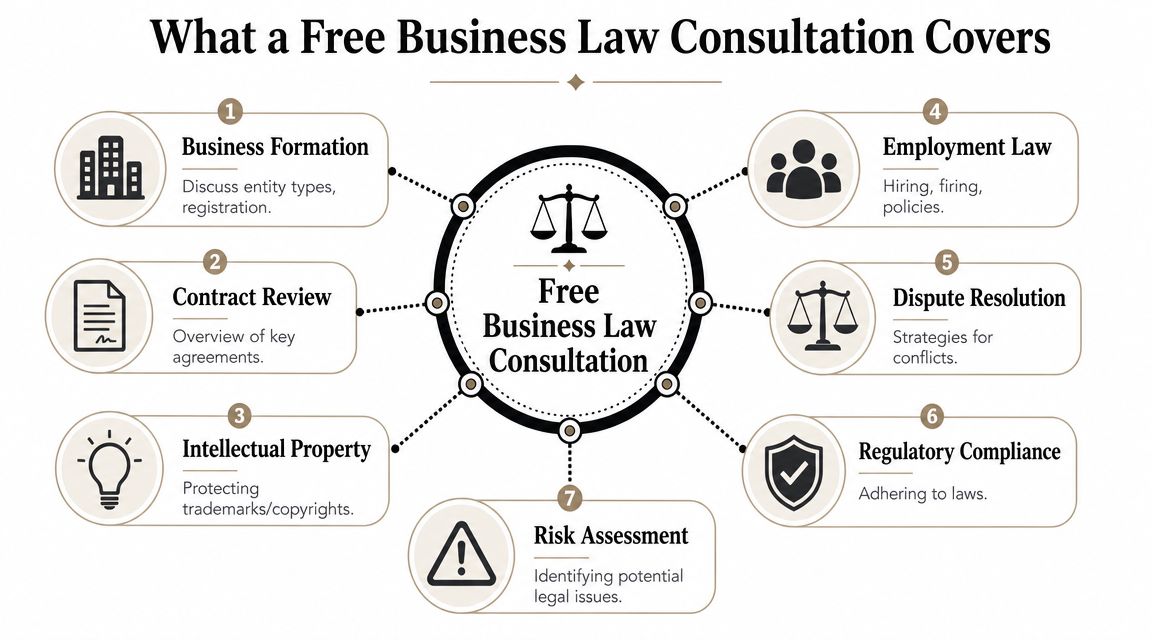
The first meeting is usually a diagnostic session. It’s meant to identify the issue, frame the risk, and decide what kind of legal work, if any, makes sense next.
What you can usually expect
A free consultation often covers topics like these:
- Business formation questions such as whether an LLC or corporation fits your ownership, tax, and management goals.
- Contract review at a high level so the attorney can spot the clauses that deserve immediate attention.
- Dispute framing to determine whether a conflict is still negotiable or already moving toward litigation.
- Intellectual property issues involving names, logos, content, ownership, or unauthorized use.
- Employment-related concerns such as contractor classification, policies, hiring questions, or separation issues.
- Compliance concerns where the business owner knows something may be off but isn’t sure what law applies.
- Risk assessment so you can understand what matters now and what can wait.
In contract-heavy businesses, owners often benefit from learning the difference between a document that needs full legal revision and one that needs targeted issue spotting. If you want a practical non-legal operations resource on process discipline, the FedEx ISP contract management guide is a useful companion to legal review because it highlights how contract handling breaks down when version control and obligations tracking are weak.
If your question centers on forming or negotiating an agreement, it also helps to understand the legal side of contract formation and business law services.
What it usually does not include
A free consultation usually does not include the full legal work itself.
- It isn’t full document drafting. The lawyer typically won’t write your operating agreement, demand letter, or custom contract during the meeting.
- It isn’t deep legal research. If your issue turns on unusual facts or multiple jurisdictions, that work usually comes after engagement.
- It isn’t a final legal opinion. Early impressions depend on the facts and documents you provide.
- It isn’t unlimited strategy time. The point is to define the problem well enough to decide on next steps.
The most productive consultations are specific. “I have a business issue” is hard to analyze. “My vendor agreement auto-renewed and I want out” is workable.
That distinction matters. Business owners often leave disappointed only when they expected the consultation to solve the entire matter on the spot. A better expectation is this: the meeting should tell you what the problem is, what the likely path looks like, and whether hiring counsel is worth it.
Why a Free Consultation Is Your First Smart Business Move
The strongest reason to schedule a consultation isn’t that it’s free. It’s that it helps you make a better business decision under uncertainty.

A business owner usually knows the commercial side of the problem first. Sales are stalled. A partner relationship is tense. A platform account is restricted. A contract term feels off. What the owner often doesn’t know yet is the legal category of the issue, and that category affects both cost and strategy.
In plain English, the first conversation can help determine whether a matter is transactional, regulatory, or litigation-bound, which then lets the client compare expected legal spend against the value at risk before retaining counsel.
Why that matters in the real world
If a problem can be solved by a focused contract review, a revised clause, or a demand letter, you may not need broad representation. If the issue is already headed toward court, you need to know that early so you can preserve documents, control communications, and budget realistically.
That difference is the heart of the consultation’s value.
- It reduces guesswork. You stop making decisions based on internet snippets and half-matching anecdotes.
- It helps scope the work. Narrow scope often means better control over timing and fees.
- It improves timing. Some business mistakes become expensive because the owner waited too long, not because the law was especially complicated.
- It creates comparison points. You can evaluate options instead of reacting emotionally to the first legal risk you hear.
For business owners who want a plain-language overview before they call counsel, this short video is a helpful primer:
What works and what usually fails
What works is treating the consultation like an executive review meeting. Bring the issue, the timeline, and the relevant papers. Ask what the lawyer thinks the actual risk is, not just whether you’re “right.”
What fails is using the meeting to chase reassurance. Business owners sometimes focus on proving the other side behaved badly. That may be true, but the more useful questions are whether the facts are documented, whether the contract supports your position, and whether enforcing the point is commercially sensible.
A legal win that costs more than the problem is worth may still be a bad business decision.
How to Prepare for Your Consultation
Preparation changes the quality of the meeting. When a client shows up with a clean timeline and the right documents, the conversation gets sharper fast. When the facts arrive in fragments, the attorney spends most of the time reconstructing the story.
Gather the right materials
Bring what exists. Don’t panic if you don’t have every document.
Start with the core file:
- Formation records such as articles, bylaws, prior agreements, or ownership documents.
- The contract at issue plus attachments, amendments, order forms, and related emails.
- A short timeline listing the key events in date order.
- Important communications including texts, emails, notices, or platform messages.
- Evidence of harm such as withheld payments, chargebacks, lost inventory access, or threatened termination.
- Your goal written in one sentence. For example: end the lease, enforce payment, protect the brand, remove a bad clause, or avoid a lawsuit.
If ownership rules are part of the problem, it helps to understand how internal company documents work. This explanation of what a business operating agreement is gives a useful starting point for owners who aren’t sure what that document controls.
Write your issue summary before the call
A one-page summary is enough. Keep it factual.
Include:
- Who is involved
- What happened
- What document governs the issue
- What deadline or pressure point exists
- What outcome you want
That summary does two things. It helps the lawyer identify the legal issue quickly, and it helps you hear your own problem more clearly. Business owners often realize while drafting the summary that the actual issue isn’t the one they planned to lead with.
Bring facts first. Conclusions can come later.
Key questions to ask during the meeting
| Category | Sample Question |
|---|---|
| Experience | Have you handled matters involving businesses like mine, including eCommerce or service-based operations if relevant? |
| Scope | What can you evaluate today, and what would require a formal engagement? |
| Risk | What do you see as the biggest legal or business risk in this situation? |
| Strategy | If this were your own business, what would you do first? |
| Timing | Are there deadlines, notice requirements, or document-preservation steps I should handle immediately? |
| Documents | What additional records would help you assess the matter more accurately? |
| Fees | Do you handle this type of work hourly, on a flat fee, with a retainer, or through phased billing? |
| Communication | Who would be my point of contact, and how do updates usually happen? |
| Alternatives | Is there a narrower option than full representation, such as limited review or a single demand letter? |
| Fit | Based on what you know so far, are you the right attorney for this issue? |
The last question matters more than people think. A good consultation is not just about whether the lawyer will take the matter. It’s about whether the lawyer is a sensible fit for the problem.
Evaluating the Attorney During the Meeting
The consultation is also your chance to evaluate the lawyer. In a market with many options, that first conversation is your best filter. The New York City Bar notes that LawHelpNY lists more than 600 free legal service projects and organizations, and the same page explains that free consultations remain an important entry point for people comparing counsel and triaging legal issues.
Green flags
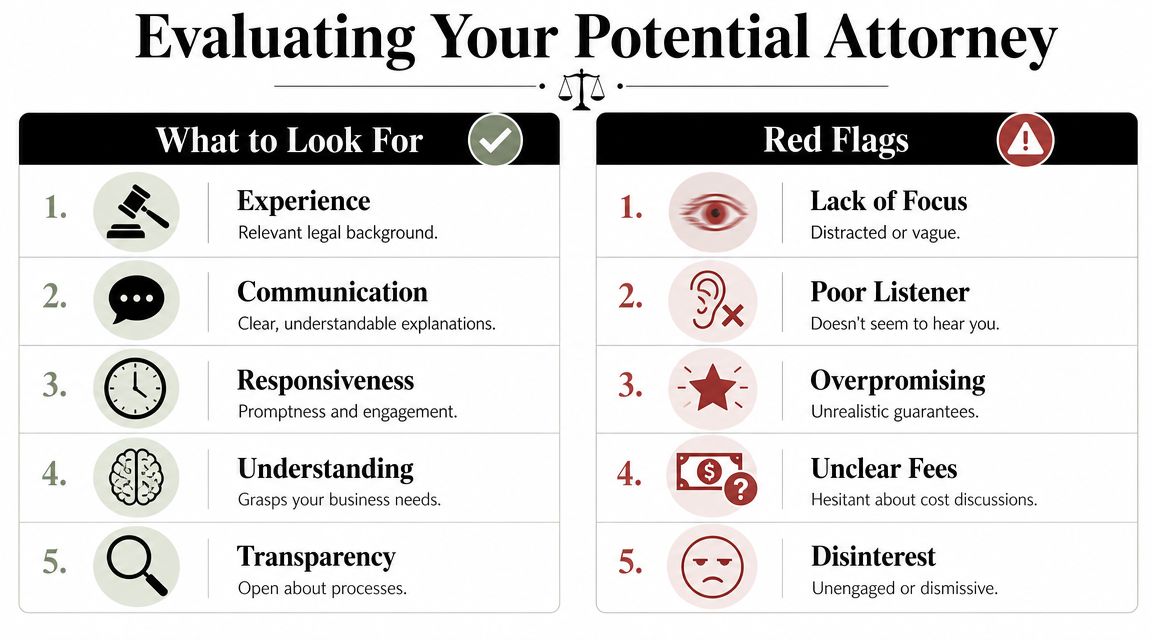
A strong business attorney usually does a few things consistently.
- Listens before advising. The lawyer asks questions that narrow the issue instead of jumping to a canned answer.
- Uses plain English. Complex legal ideas can be explained clearly without sounding simplistic.
- Understands business realities. The discussion includes cost, advantage, timing, and practical outcomes, not just legal theory.
- Defines next steps. You should hear what needs to happen now, what can wait, and what documents matter most.
- Discusses access clearly. Direct attorney communication is often a good sign, especially when the matter may evolve quickly.
One practical model is a direct-attorney approach, where the client speaks with the lawyer handling the issue instead of being routed through multiple layers. LA Law Group, APLC uses that kind of structure for initial consultations and business-law matters, which can be helpful for owners who want a more hands-on conversation at the outset.
Red flags
Some warning signs are easy to miss when you’re stressed.
- The lawyer talks more than listens
- The answer is full of jargon but short on analysis
- Fee questions are brushed aside
- You get certainty where caution would be more credible
- The attorney seems distracted by the story and not the documents
If the lawyer doesn’t seem interested in how your business actually operates, the advice may miss the commercial reality of the problem.
Good fit matters. You are not only hiring legal knowledge. You are choosing judgment, communication style, and problem-solving habits under pressure.
Next Steps and Understanding Legal Fees After the Consultation
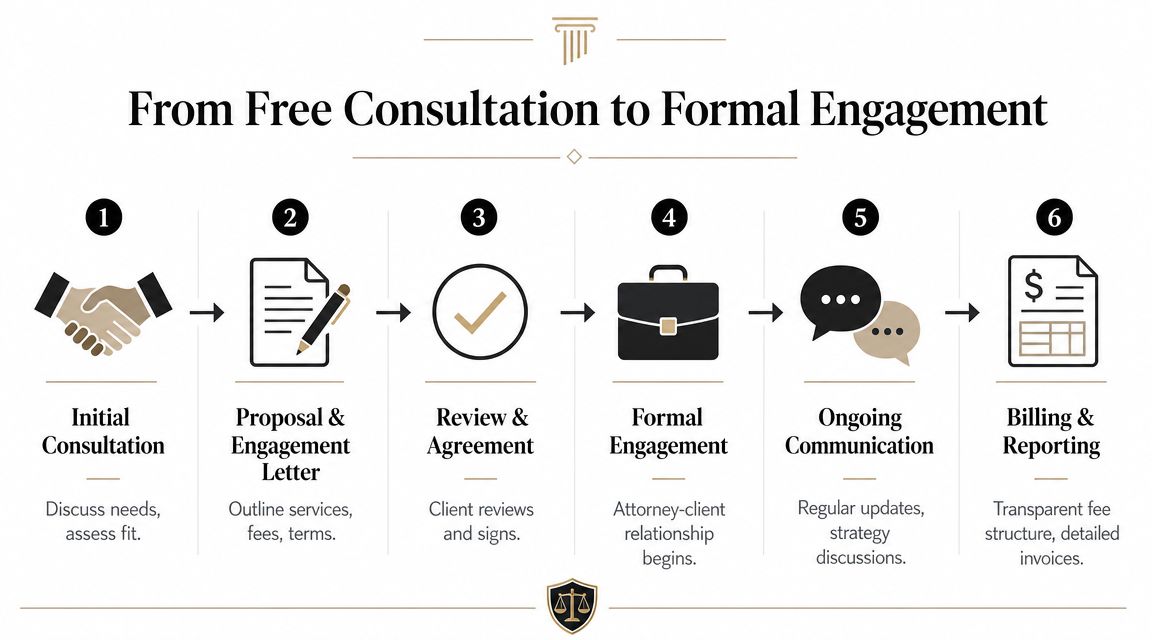
If the consultation goes well, the next step is usually a proposed scope of work. That might be narrow, such as reviewing a contract or sending a letter. It might be broader, such as ongoing counsel for a dispute, formation project, or compliance problem.
Common fee structures
Most business owners will see some version of these arrangements:
- Hourly billing works when the scope is uncertain or likely to change. The downside is predictability.
- Flat fees work well for defined tasks, such as certain filings, registrations, or specific contract projects.
- Retainers are common when ongoing availability or active dispute work is expected.
Each model has trade-offs. Hourly work can be appropriate for moving targets. Flat fees are easier to budget when the task is clearly defined. Retainers can make sense when the business expects continuing legal needs and wants quicker access to counsel.
If your issue could expand into a courtroom matter, it helps to understand the difference between preventive business advice and active dispute representation. This overview of what a civil litigation attorney does can help you identify when the matter has crossed that line.
Think beyond legal fees alone
A sound decision after the consultation isn’t always “hire the lawyer immediately.” Sometimes it’s “fix internal process first,” “collect missing records,” or “buy time while preserving rights.”
Risk management can also include non-legal protection. For example, if your business operations expose you to third-party claims, reviewing insurance options matters too. Industry-specific examples like general liability coverage from ISU Insurance can be useful reminders that legal strategy and risk transfer often work together.
The best post-consultation decision is the one that matches the issue’s size, urgency, and business value. That may mean limited-scope legal help. It may mean a formal engagement. It may mean waiting, but waiting on purpose instead of by default.
If you want to discuss a business contract, formation issue, intellectual property concern, eCommerce problem, or dispute with direct attorney access, LA Law Group, APLC offers free initial consultations, and serves clients across California. The firm also offers Spanish-language support and handles certain matters, including trademark and copyright registration, on a flat-fee basis.
Attorney Advertising. This article is general information, not legal advice, and does not create an attorney-client relationship. Prior results do not guarantee a similar outcome.